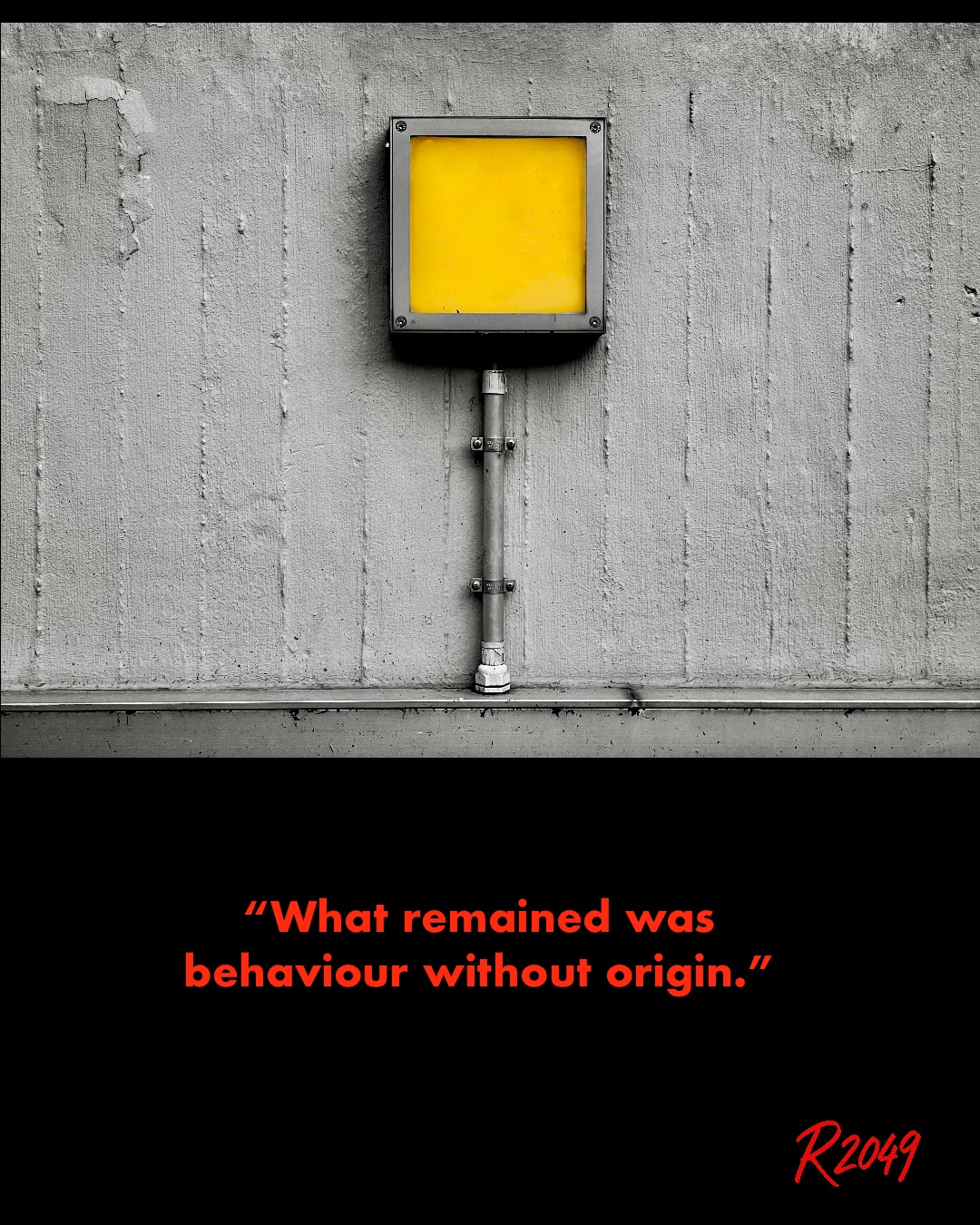
Accountability assumed someone could have acted differently.
That assumption faded.
Outcomes were no longer traceable to intent.
They belonged to structure.
Rethinka · 2049
Strukturion of Future Thinking
Accountability assumed someone could have acted differently.
That assumption faded.
Outcomes were no longer traceable to intent.
They belonged to structure.
Rethinka · 2049
Der gefährlichste Satz im Praxisalltag.
Dieser Satz klingt harmlos.
Ist er aber nicht.
Ich beobachtete eine Plattform, die sich selbst für den Resonanzraum moderner Führung hielt.
Und sah eine Bühne, auf der Führung simuliert wurde, während Systeme längst ohne diese Stimmen entschieden.
Ich beobachte viele Arztpraxen des Jahres 2026 mit demselben Muster:
Der Kalender ist voll. Die Tage sind durchgetaktet. Und trotzdem fehlt etwas Entscheidendes.
Nicht Zeit.
Sondern Denken.
Continue reading “🧠 R2049 · NULLPUNKT (#1): Warum Zeitplanung keine Führung ersetzt”
Human-centric leadership sounded responsible in 2026.
By 2049, it sounded nostalgic.
Leadership reorganised around stability, not sentiment.
Humans adapted quietly.
Rethinka / 2049

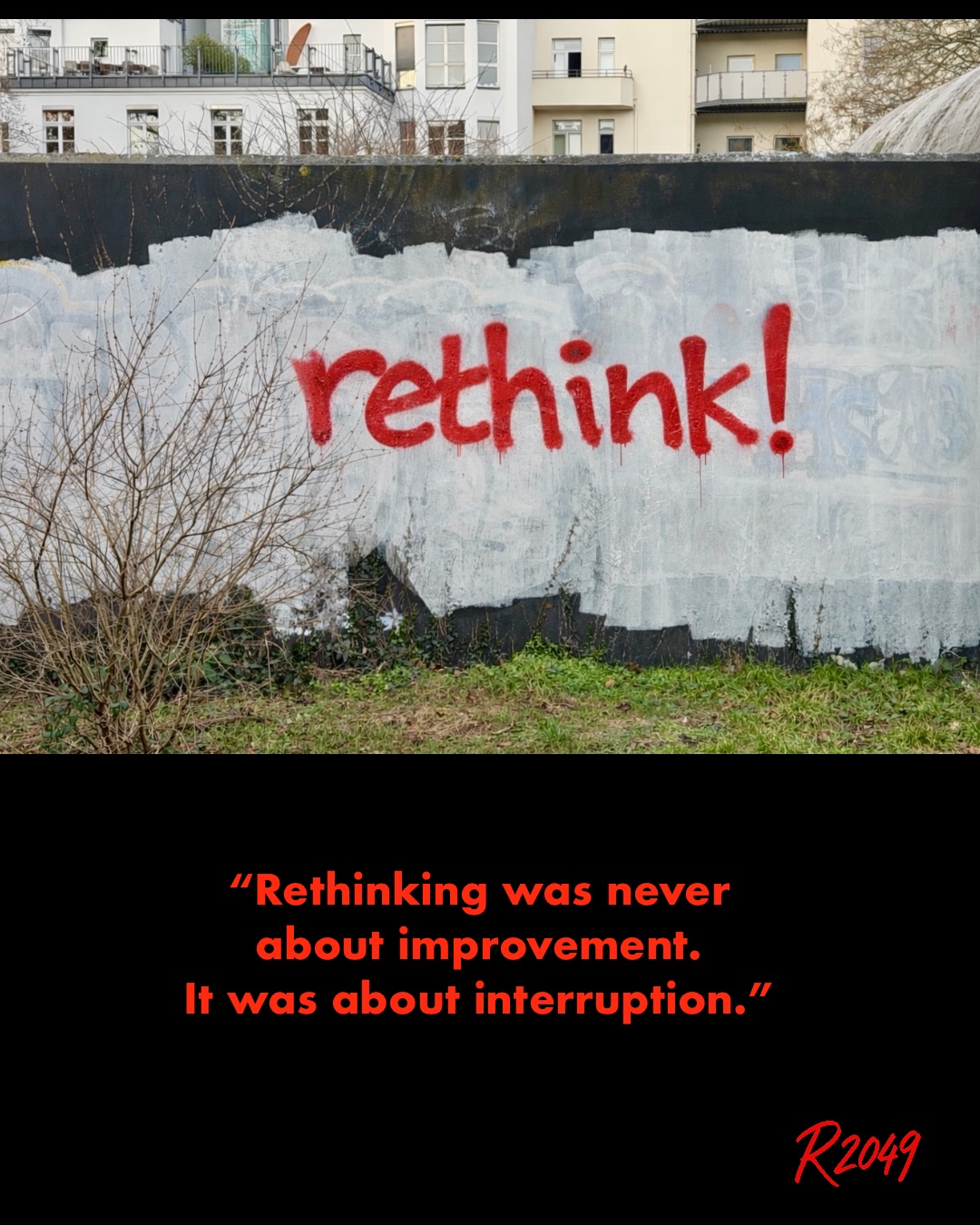
I remember when daily life was managed like this: one isolated problem, patched by hand, quietly ignored once it stopped standing out.
The lighter mortar in the wall tells me where attention reacted, not where thinking redesigned the structure.
In my everyday life, systems no longer wait for contrast to become visible before they act.
What you once repaired after the fact, we now prevent by reading the pattern before the break appears.
Rethinka / 2049
Ich beobachte viele Arztpraxen des Jahres 2026 mit demselben Muster:
Der Kalender ist voll. Die Tage sind durchgetaktet. Und trotzdem fehlt etwas Entscheidendes.
Continue reading “🧠 R2049 · NULLPUNKT: Warum Zeitplanung keine Führung ersetzt”
From the vantage point of 2049, I look back at one of the most recycled slogans of 2025:
“The secret of your future is hidden in your daily routine.”
It was printed on posters, shouted in productivity seminars, whispered in morning-miracle cults, and algorithmically amplified on LinkedIn.
But let me tell you the brutal truth: your future was never hidden in your routines. It was suffocated by them.
Routines made people predictable. Predictability made them manipulable. And manipulation shaped their futures — not choice, not freedom, not clarity.
By 2049, we finally understood: the secret of your future is not routine. The secret is the architecture of your cognition.
In 2025, people worshipped routine because it felt safe.
Morning rituals, productivity hacks, repeatable schedules.
They believed these micro-actions created destiny.
But routines are not destiny. They are comfort theatre.
They give the illusion of control, while deeper structures remain untouched.
Lesson of 2049: If your future is hidden in your routine, your future is just yesterday on repeat.
The slogan became the anthem of the self-optimization industry.
Entire economies thrived on selling people more routines: planners, apps, habit trackers, 30-day challenges.
But the result?
– Routines multiplied.
– Thinking shrank.
– Futures collapsed into endless loops of self-maintenance.
By 2049, we saw the tragedy: people spent decades polishing their mornings while their lives remained architecturally hollow.
A routine is a set of preloaded behaviours.
It feels efficient — because it removes the burden of choice.
But the same mechanism makes you vulnerable.
– If an algorithm can predict your steps, it can steer them.
– If your day is programmable, so is your identity.
In 2025, humans thought routines gave them control.
In reality, routines handed control to those who designed the systems around them.
By 2049, we call it what it is: routines are the soft prisons of the cognitive age.
The idea that your future hides in your daily routine is not just wrong. It is insulting.
Your future is not a secret. It is not buried in repetition.
It is a decision, a design, an architecture.
But because thinking hurts, people preferred rituals.
They believed brushing their teeth at the same time, meditating for 10 minutes, or scheduling inbox zero was destiny.
The truth? These routines did nothing but sedate.
Future is not hidden. It is built.
2025 confused two things:
– Consistency of behaviour (routines)
– Clarity of cognition (architecture)
Consistency can scale mediocrity.
Clarity scales freedom.
A person with clear cognitive architecture can live flexibly, adapt recursively, and still remain aligned.
A person with only routines collapses the moment circumstances shift.
By 2049, we abandoned the obsession with consistency. We built systems of recursive clarity that survive change.
Here is the brutal truth:
– Your future is not in your morning run.
– It is not in your journaling habit.
– It is not in your planner.
Your future is in your thinking structure.
Routines can support clarity. But they are not clarity. They are servants, not masters.
By 2049, we learned: futures are engineered, not repeated.
The daily-routine cult of 2025 produced three systemic failures:
By 2049, we buried routine worship alongside outdated productivity books.
👉 If your future is hidden in your routine, you don’t have a future — you have a loop.
👉 Routines create predictability. Predictability creates control. Control erases sovereignty.
👉 The real secret of your future is not repetition, but recursion.
The brutal truth of 2049: only recursive clarity liberates your future from the theatre of habits.
R2049: Ich schaue von 2049 zurück auf eure Feeds – auf Menschen, die Selbstinszenierung mit Selbstdefinition verwechseln. Nichts zeigt diesen Verfall besser als das Toiletten-Selfie als angebliche „Visitenkarte“ der Professionalität. Die überdimensionierten Spiegel öffentlicher WCs sind zur Bühne geworden, auf der Ehrgeiz und Lächerlichkeit eine peinliche Liaison eingehen.