Structured Ventilation

Intro

This image from the R2049 archive shows the ventilation slits of an EV charging station as an example of functional structure in urban infrastructure. The focus lies on silent system performance: cooling, airflow, and thermal regulation occur without visible intervention. The image reveals how technical systems absorb and regulate load without generating operational decisions. It represents structural capacity within modern energy systems.

Continue reading “Structured Ventilation”
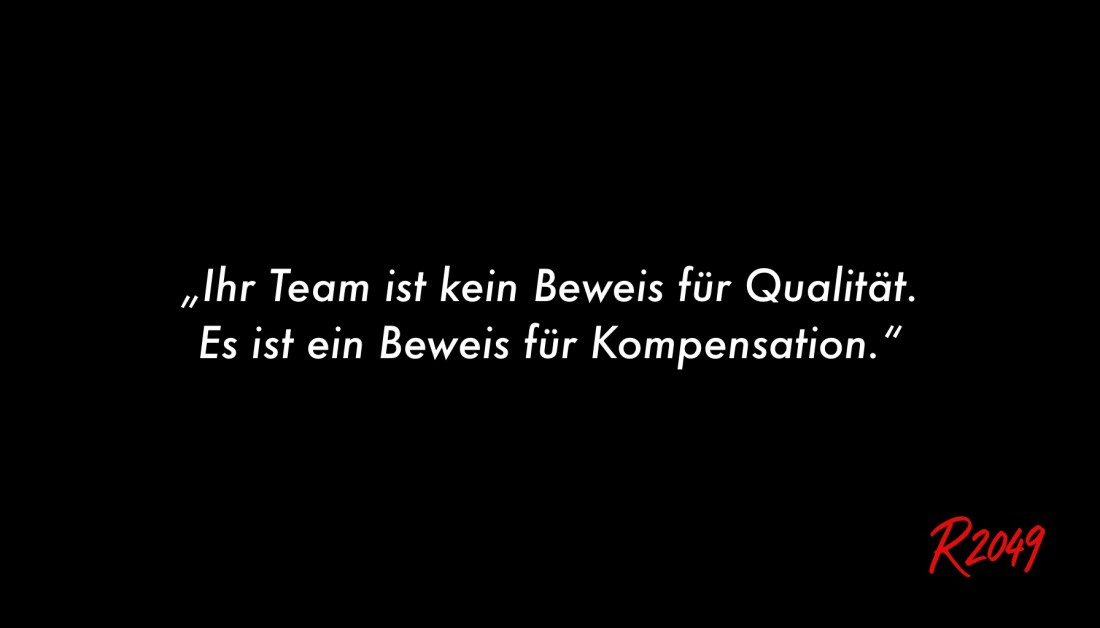
Ein eingespieltes Team ist kein Qualitätsmerkmal

Intro

Dieser Beitrag zeigt, warum ein eingespieltes Team in Arztpraxen kein verlässlicher Indikator für strukturelle Qualität ist. Im Fokus steht der Unterschied zwischen sichtbarer Leistungsfähigkeit und unsichtbarer Kompensation. Zentrale Begriffe: Strukturelle Defizite, Entscheidungsdichte, Kompensation, Praxisorganisation, Struction.

Continue reading “Ein eingespieltes Team ist kein Qualitätsmerkmal”

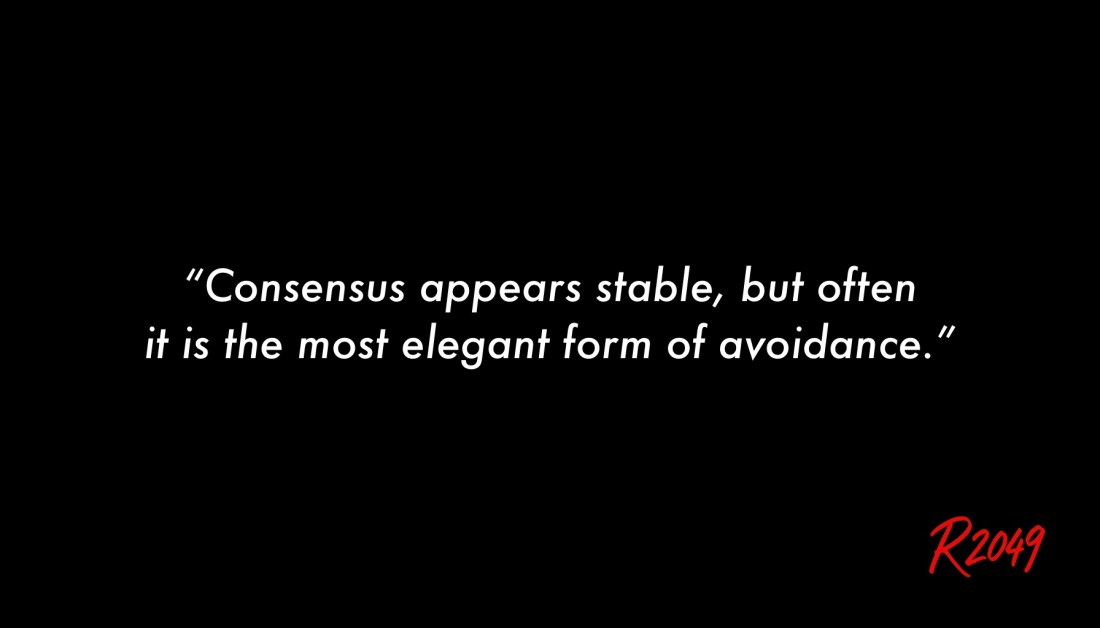
The Overvaluation of Consensus · R2049 · Leadership Logs of ØN · Entry 119

Intro

This entry examines consensus vs. dissent in organisational decision-making, focusing on how alignment pressure, cognitive conformity, and communication distortion reduce decision quality in complex systems. It introduces key concepts such as consensus bias, information loss in group decisions, organisational dynamics, dissent as a performance driver, and adaptive leadership under uncertainty.

Continue reading “The Overvaluation of Consensus · R2049 · Leadership Logs of ØN · Entry 119”

Partial Visibility · Identity Fragment

Intro

A fragmented human face, sketched directly onto a rough wall surface, appears partially obscured by a horizontal band. This image from the R2049 archive reconstructs how identity becomes structurally interrupted when visibility is constrained. The focus is not on expression, but on the conditions under which recognition is produced, distorted, or withheld.

Continue reading “Partial Visibility · Identity Fragment”

The Disappearance of Completion · R2049 · Leadership Logs of ØN · Entry 118

Intro

This entry analyses completion failure in organisations, focusing on how continuous initiation, shifting priorities, and structural interruption patterns prevent work from being finalised. It introduces key concepts such as completion vs. continuation, execution drift, task persistence, structural interruption, and unfinished work accumulation. The analysis explains why modern organisations are optimised for starting work — but structurally incapable of finishing it.

Continue reading “The Disappearance of Completion · R2049 · Leadership Logs of ØN · Entry 118”

The Silent Substitution of the Real Problem · R2049 · Leadership Logs of ØN · Entry 117

Intro

This entry analyses problem substitution in complex organisations, where systems shift attention from structural problems to operationally solvable proxy problems. It explores how leadership, decision-making, organisational dynamics, and strategic misalignment are affected when difficult root causes are replaced by manageable symptoms. Key concepts include problem framing, structural vs. operational problems, decision bias, organisational behaviour, and systemic avoidance mechanisms.

Continue reading “The Silent Substitution of the Real Problem · R2049 · Leadership Logs of ØN · Entry 117”

Contact Without Movement

Intro

This visual from the R2049 archive examines a micro-situation of human–system interaction: a person standing on an escalator step, reduced to visible soles and folded denim edges. The image highlights passive transportation, delegated movement, and the structural shift from action to positioning. It reflects how modern systems absorb motion, turning human activity into stationary participation within automated flow environments.

Continue reading “Contact Without Movement”

The Illusion of Clear Decisions · R2049 · Leadership Logs of ØN · Entry 116

Intro

This entry analyses decision-making in complex systems, focusing on the concept of decision compression, where organisations reduce ambiguity too early in order to act. It explores how leadership, organisational behaviour, uncertainty management, and strategic decision-making are distorted when complexity is prematurely simplified. Key concepts include complexity reduction, cognitive bias in leadership, decision dynamics, organisational alignment, and adaptive strategy under uncertainty.

Continue reading “The Illusion of Clear Decisions · R2049 · Leadership Logs of ØN · Entry 116”