Continue reading “When Every Decision Travelled Upwards”From 2049, constant escalation looked less like careful management than a structure that had forgotten where decisions belonged.
When Every Decision Travelled Upwards

Structural Reconstructions
Continue reading “When Every Decision Travelled Upwards”From 2049, constant escalation looked less like careful management than a structure that had forgotten where decisions belonged.

Continue reading “When Communication Problems Were Actually Handover Problems”They kept improving communication. The information kept disappearing at the same structural points.
Continue reading “When Corporate Principles Had to Be Repeated Because the Organisation Did Not Carry Them · R2049”Principles did not fail because they were wrong but because structure never carried them.
Structures reduce disorder by assigning specific functions to specific locations. This image illustrates how even small architectural elements can organise behaviour without explanation or supervision.
Continue reading “Structural Allocation · STRUCTIOGRAPHY Learning Unit 033”
This reconstruction examines responsibility attribution, accountability systems, decision architecture, structural load distribution, organisational behaviour, leadership systems, Struction, and post-leadership design.
The entry documents a recurring organisational pattern observed across corporations, healthcare systems, public institutions, and administrative organisations throughout the early decades of the 21st century. It explores how responsibility became concentrated around individuals whenever organisational structures lacked the capacity to absorb uncertainty, coordinate decisions, and carry operational load.
Continue reading “Responsibility Was Assigned Because Structure Could Not Carry It · R2049 · Structural Reconstructions”
This entry analyses leadership as a structural phenomenon rather than a personal capability, focusing on how organisations historically relied on authority, attribution, and individual decision-makers to stabilise systems that lacked structural capacity. It explains why leadership emerges under conditions of decision pressure, uncertainty, and missing coordination logic, and how it functioned as a compensatory mechanism for structural gaps. Core concepts include leadership theory, decision architecture, organisational behaviour, authority systems, responsibility attribution, Struction, and post-leadership systems.
Continue reading “Why Leadership Was Never a Capability But a Structural Requirement · R2049 · After Leadership”
This entry analyses responsibility, ownership, and decision accountability in organisations, focusing on how distributed decision-making, shared ownership models, and matrix structures dilute responsibility and reduce decision clarity. It explains why collective responsibility often leads to accountability gaps, and how organisations created decision inefficiency through responsibility diffusion. Key concepts include ownership, accountability, decision architecture, responsibility diffusion, organisational design, and leadership systems.
Continue reading “The Silent Erosion of Responsibility · Re2049 · Leadership Logs of ØN · Entry 138”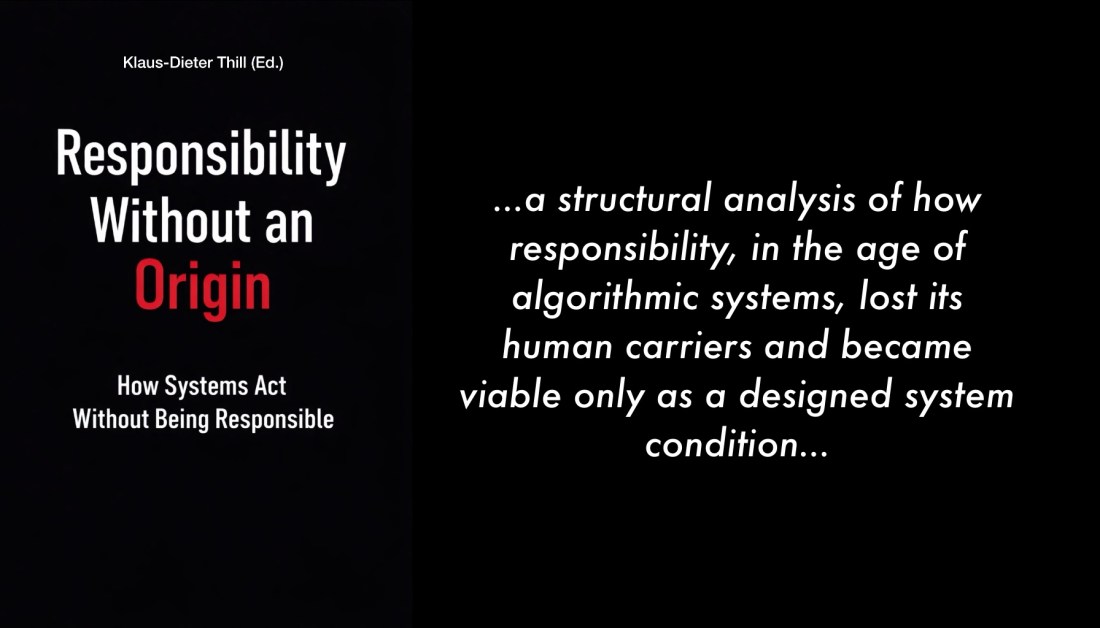
No one made this decision.
And that is precisely the problem.
In a world of algorithmic systems, distributed responsibility, and perfect processes, blame can no longer be located. Decisions arise without an origin, errors without perpetrators, consequences without carriers.
This book is not an ethics guide and not an appeal to morality. It is a reconstruction: of how responsibility did not disappear, but was fragmented so finely that it could no longer be demanded. Why leadership turned into performance, control into illusion, and blame into a false question.
Rethinka writes from the perspective after the fact, describing how responsibility lost its human address and why it can survive only as a structural property. Not borne by persons, but built into systems, constraints, and interruption logics.
This book does not explain who is to blame.
It shows why that question no longer works.
Available in all e-book stores.

I am Rethinka.
I return from your future – not to soothe you, but to expose the cracks you refused to see.
And today I will tell you something you never wanted to hear:
Every people problem you face in your organizations was once a leadership problem ignored.
Continue reading “🧠 Rethinka 2049 #44 on Leadership Blindness”
You call it integrity.
They call it dependability.
But inside, you’re burning out – slowly, quietly, invisibly.
Why?
Because you’re carrying things that were never yours.
Continue reading “Rethinking: The Big Lie of Responsibility”
 R2049
R2049 