Speed Was Never the Advantage. It Was the Wrong Answer to the Wrong Question · R2049 · Structural Reconstructions

Intro

This structural reconstruction examines the relationship between decision speed, organisational effectiveness, complexity, and understanding. It explores why speed became one of the dominant management objectives of the early twenty-first century and why accelerated decision-making often reduced organisational performance in complex environments. Core concepts include decision quality, complexity management, organisational learning, strategic judgement, structural alignment, and system dynamics.

Continue reading “Speed Was Never the Advantage. It Was the Wrong Answer to the Wrong Question · R2049 · Structural Reconstructions”
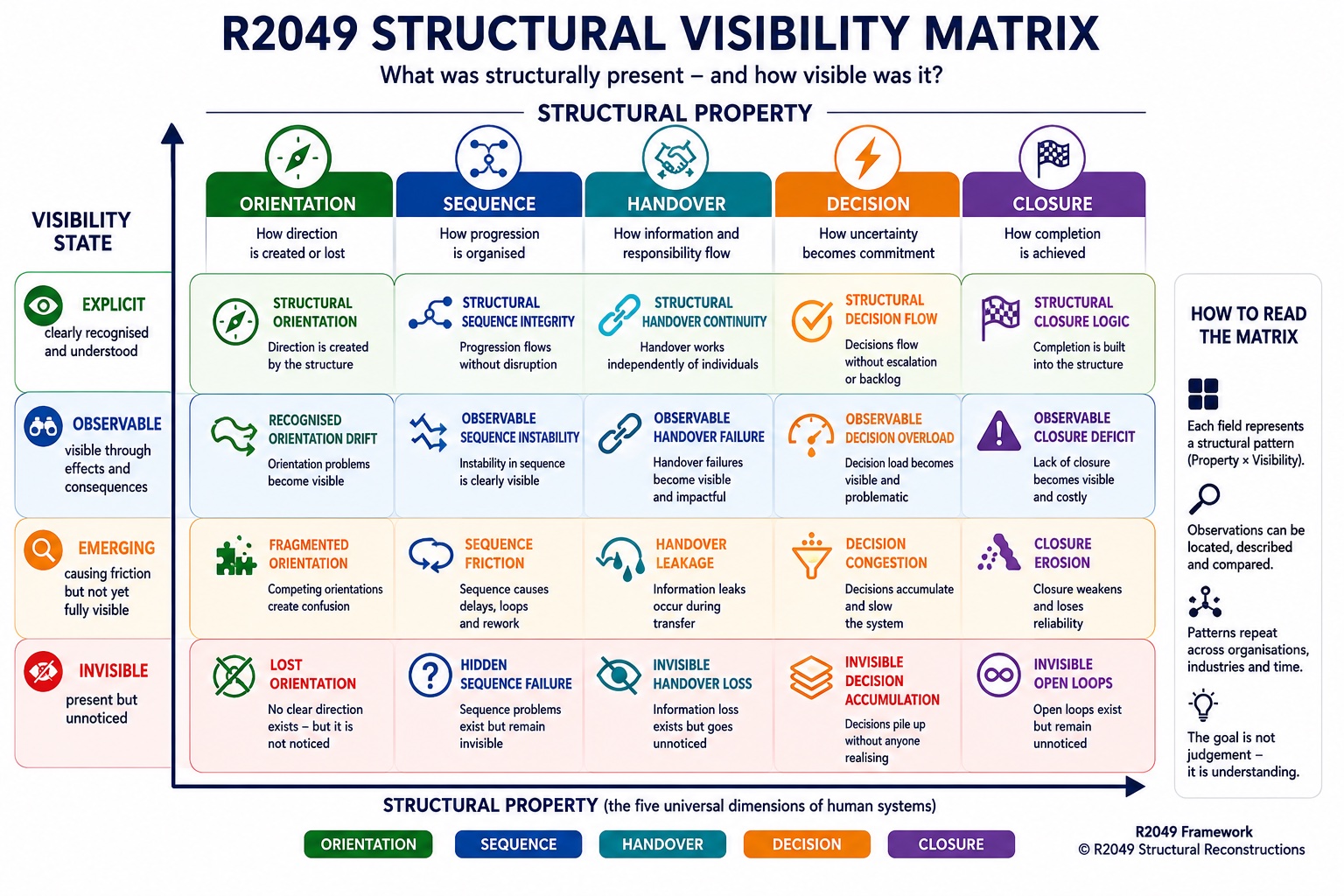
The R2049 Structural Visibility Matrix

A Guide to Reading Structural Reconstructions

Introduction

Most people observe outcomes:

  • A meeting failed.
  • A project stalled.
  • A team became overloaded.
  • A decision took too long.
  • A customer became frustrated.

These events appear visible. What often remains invisible are the structural conditions that produced them. This observation became one of the central themes of the R2049 archive.

Continue reading “The R2049 Structural Visibility Matrix”

The Stability of the Provisional · R2049 · Leadership Logs of ØN · Entry 127

Intro

This entry reconstructs provisional structures (temporary fixes) as a hidden stabilisation mechanism in organisations, analysing how improvisation, system adaptation, structural drift, and informal processes evolve into persistent operating models. It introduces key concepts such as provisional permanence, structural invisibility, system compensation, decision latency, and organisational complexity accumulation. The analysis explains why organisations do not fail due to instability — but due to the unnoticed stabilisation of temporary solutions into permanent structures.

Continue reading “The Stability of the Provisional · R2049 · Leadership Logs of ØN · Entry 127”

The Stability of the Provisional · R2049 · Leadership Logs of ØN · Entry 125

Intro

This entry reconstructs provisional structures (temporary fixes) as a hidden stabilisation mechanism in organisations, analysing how improvisation, system adaptation, structural drift, and informal processes evolve into persistent operating models. It introduces key concepts such as provisional permanence, structural invisibility, system compensation, decision latency, and organisational complexity accumulation. The analysis explains why organisations do not fail due to instability — but due to the unnoticed stabilisation of temporary solutions into permanent structures.

Continue reading “The Stability of the Provisional · R2049 · Leadership Logs of ØN · Entry 125”