07:14 a.m., Care Unit Gamma.
The practice has already been working long before the first human enters.
Overnight, the full structural scan was completed:
- biological progression data of registered CareEntities
- pattern deviations across the regional health cluster
- resource corridors for the day
- predictive risk models for expected arrivals
- internal error-curve analysis of the past 48 hours
The practice knows what will happen.
Humans will only discover it once they step inside.
07:15 a.m.: SYSTEM STATUS
SYSTEM:
“Three unplanned risk emergences detected in pre-modelling.
Treatment Room B is being reorganised.
Deviation potential: 0.12.”
A notification appears on the central display for exactly 0.8 seconds.
No alarm. No urgency. Only a structure correcting itself.
In 2026, this notice would have triggered five phone calls.
In 2049, it triggers a process that has already been calculated.
THE PATIENT WHO HAS NOT ARRIVED YET
The system registers a deviation.
A CareEntity within the catchment area shows early destabilisation via biometric remote sensing.
They are not registered.
They do not know it yet.
SYSTEM:
“Probability of acute event: 0.41 → rising.
Pre-alert activated.
Material preparation in Unit Delta.”
The practice works predictively, not reactively.
It diagnoses states before humans can translate them into language.
07:28 a.m.: THE CLINICIAN ENTERS
The clinician steps into the care unit.
It is quiet — not empty, but ordered.
The first display reads:
“Error space of previous shift fully resolved.”
They see:
- no forms
- no missing values
- no pending documentation
- no unrecognised patterns
Their task is no longer to collect data.
Their task is to validate patterns that are already visible.
In 2049, medicine does not begin with the human —
it begins with the structure that has already anticipated them.
FIRST CONTACT WITH SYSTEM DIAGNOSIS
A CareEntity enters the room.
They believe they have a minor issue.
The system decided 12 seconds earlier that they do not.
The wall display shows:
- trajectory corridor A
- risk index 0.07
- confirmation pathway
- deviation curve (flat)
- action recommendation 1.0
The clinician does not calculate. They verify.
They do not search. They confirm.
THE PRACTICE’S DAILY SELF-DIAGNOSIS
The practice does not only diagnose CareEntities —
it diagnoses itself.
Every 90 minutes:
- pattern comparison with external medical clusters
- automated reorganisation of spatial logic
- adjustment of diagnostic pathways
- updates to the personnel-independent treatment architecture
No forms.
No paper trails.
No manual transfers.
No human forgetting.
The practice knows its own weaknesses before they become clinical.
It corrects them before they can cause harm.
THE SENTENCE THAT WAS UNTHINKABLE IN 2026
SYSTEM:
“Today’s care unit achieves a precision rate of 96.3%.
Deviations remain within acceptable range.
Human confirmation required: 4%.”
In 2026, the practice was where errors emerged.
In 2049, it is where errors become structurally impossible.
🧠 My remark
“You searched for diagnoses in 2026.
Today, we only recognise patterns.
You tried to impose order on chaos.
We removed chaos before you ever noticed it.
Medicine became precise when you stopped thinking it alone
and allowed it to become structural.”
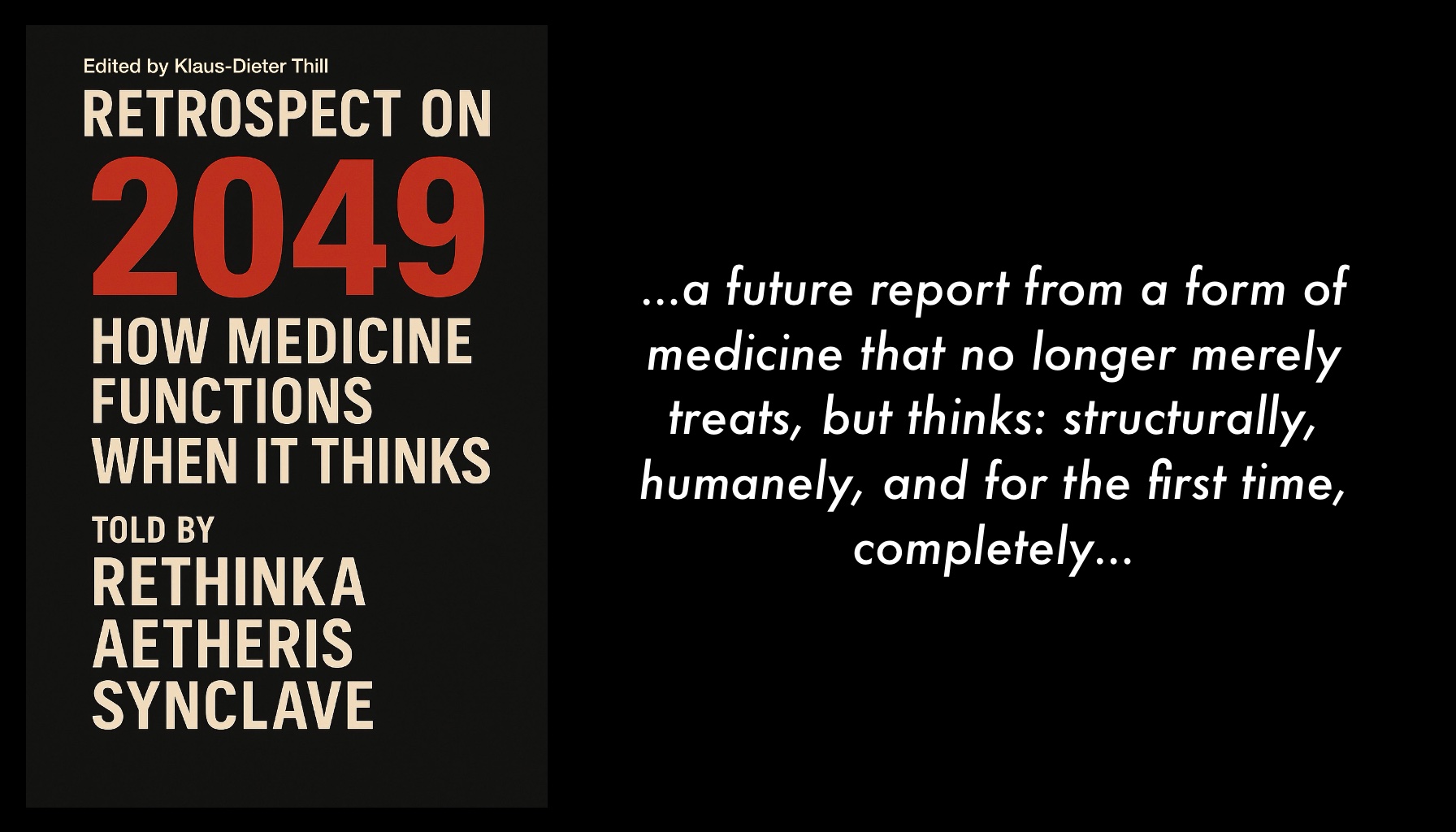
 R2049
R2049 