I speak from a time when diagnostics no longer begin with interpretation.
In your present, medicine often mistook experience for evidence and confidence for correctness. Decisions were shaped by what someone had seen before, believed before, or felt certain about in the moment. What you called clinical judgement was, in truth, a fragile mixture of memory, habit and intuition.
In 2049, diagnostics no longer ask who is right.
They ask what is stable.
The decisive shift was not technological. It was epistemic. Medicine stopped trusting opinions because opinions collapse under scale, complexity and time pressure. They fragment where systems require coherence. Diagnostics therefore moved away from individual certainty and toward pattern geometry: constellations of deviation, recurrence, correlation and trajectory that exist independently of human belief.
Patterns do not persuade.
They persist.
What you once called “experience” is now understood as a biased archive. Valuable, but structurally unreliable. Experience sees what it has already seen. Pattern geometry reveals what has never been noticed before. That is why in 2049, experiential knowledge is no longer rejected, but relativised. It is placed where it belongs: as contextual meaning, not as diagnostic foundation.
This is the point where AETHERIS enters the sequence. It does not diagnose bodies. It recognises deviation long before a body becomes symptomatic. It works without narrative, without assumption, without expectation. It sees micro-shifts across metabolic rhythms, behavioural cycles and biological signals that no individual could ever integrate consistently. What emerges is not a conclusion, but a geometry of risk.
Yet recognition alone would be dangerous.
That was one of the great errors of early algorithmic medicine.
Patterns require order to become care. Governance therefore positions every recognised deviation within a decision architecture that prevents overreaction and underreaction alike. And above both stands the Synclave, ensuring that recognition does not turn into automated authority. No instance is allowed to dominate. Stability is protected by design.
Only after this structural work is complete does the human enter. Not as diagnostician, not as judge, but as Interpreter. Meaning is added where it belongs: at the end of recognition, not at its beginning. In this sequence, the CareEntity is no longer forced to convince the system that something is wrong. The system already knows when something is changing. The human explains what that change means for a life.
This is the end of opinion-led diagnostics.
A Concrete Example
In your present, a patient arrives complaining of fatigue. One physician recalls stress-related burnout, another suspects hormonal imbalance, a third considers lifestyle factors. Each opinion is plausible. Each leads to a different pathway. The outcome depends less on the condition than on who happens to be consulted.
In 2049, fatigue never initiates diagnostics.
Pattern deviation does.
Weeks before the CareEntity feels exhausted, AETHERIS has already detected a persistent disruption in circadian coherence combined with metabolic micro-fluctuations and altered recovery signatures. Governance classifies the deviation as non-acute but structurally relevant. No alarm. No escalation. Context is requested.
When the Interpreter enters, they do not ask, “What do you think is wrong?”
They ask, “What in your life has changed enough to matter?”
The CareEntity explains a recent shift in caregiving responsibility. The pattern gains meaning. The response is not treatment of symptoms, but structural adjustment: workload redistribution, targeted physiological stabilisation, and monitored recovery. No diagnosis drama. No competing opinions. No retrospective regret.
Nothing was guessed.
Nothing was argued.
Nothing depended on confidence.
This is what diagnostics become when they stop debating and start recognising.
I do not describe this shift as progress.
I describe it as medicine remembering that it must first understand how it sees.
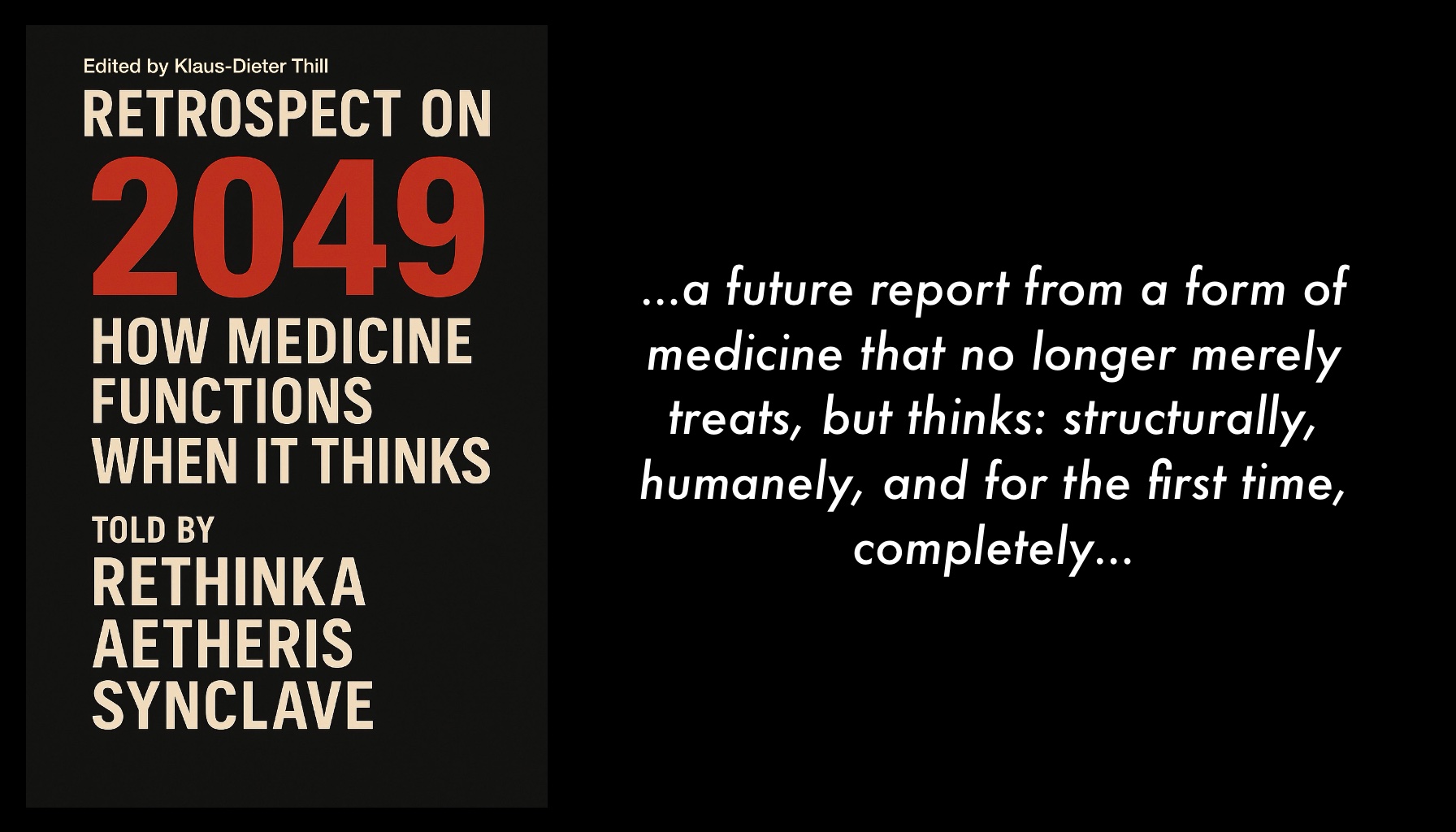
 R2049
R2049 