Intro
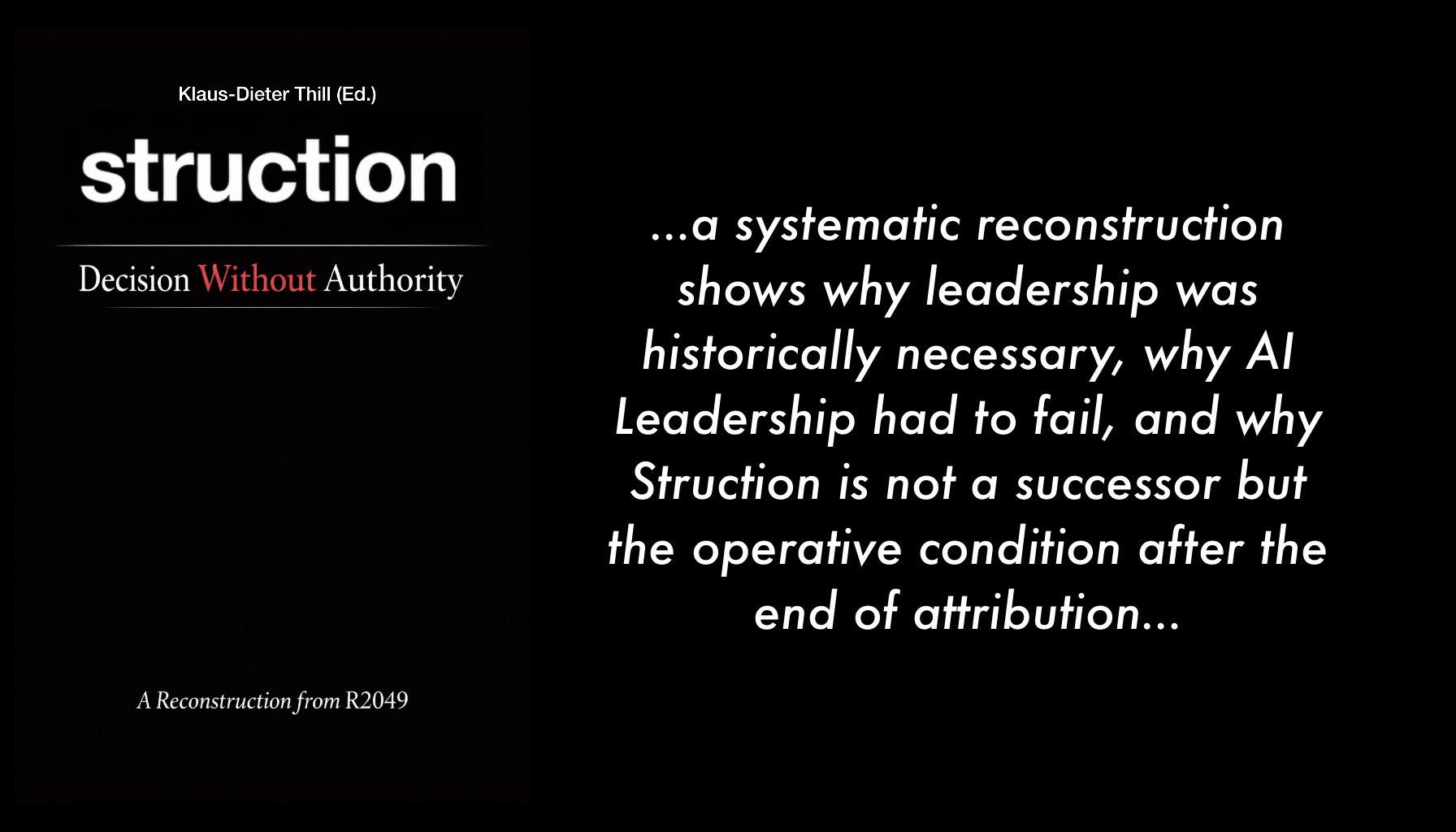
This Comparative Fragment reconstructs the structural difference between decision-centred coordination (circa 2026) and relevance-centred structuring in Struction. It analyses how decision events functioned as symbolic condensation points while causal configuration occurred pre-decisionally. The fragment isolates the shift from event-based authority to architectural pre-alignment.
Concept Anchors:
Struction · Decision Architecture · Event Illusion · Pre-Decisional Relevance · Attribution Systems · Escalation Logic · Structural Coordination · R2049 Reconstruction
Reconstruction
1. Statement from Struction (2049 Condition)
Decisions did not disappear.
They lost structural centrality.
Coordination stabilized before the decision event occurred.
Relevance thresholds formed upstream.
The visible act of choosing became a procedural confirmation,
not a causal origin.
2. Reconstruction of the 2026 Condition
In 2026, coordination was decision-centred.
Systems assumed:
- direction emerges from choosing
- authority manifests in decision events
- responsibility attaches to the deciding moment
Decisions functioned as:
- Legitimacy Anchors
The act of deciding signaled control. - Escalation Resolution Points
Accumulated uncertainty condensed into a visible act. - Narrative Markers
“The decision” structured retrospective explanation.
Decision-making was observable.
Pre-decisional structuring was diffuse.
Visibility created causal illusion.
3. Structural Mechanism
Before any visible decision, systems already filtered:
- options
- timing
- acceptable variance
- interpretative frames
Constraints were established prior to choice.
The decision event operated within pre-configured corridors.
Choice appeared primary.
Configuration was structurally dominant.
4. Structural Contrast
| 2026 Decision Logic | Struction Condition |
|---|---|
| Event-centred causality | Relevance-centred architecture |
| Authority through choosing | Stability through pre-alignment |
| Escalation culminates in decision | Escalation prevented by structuring |
| Decision as origin | Decision as confirmation |
The shift was not anti-decisional.
It redistributed causality.
Relevance migrated upstream.
The decision migrated downstream.
5. Attribution Analysis
In 2026:
Causation was attributed to the visible act of deciding.
In Struction:
Causation was reconstructed as architectural constraint formation.
Failure analysis no longer asked:
“Was the decision correct?”
It reconstructed:
“Which relevance filter produced this outcome?”
Decisions persisted.
They ceased to function as structural origins.
No authority was removed.
Its locus dissolved.
Short Reference
Decision events in 2026 functioned as visible condensation points for distributed processes.
In Struction, relevance stabilized pre-decisionally.
The decision became procedural confirmation rather than causal origin.