
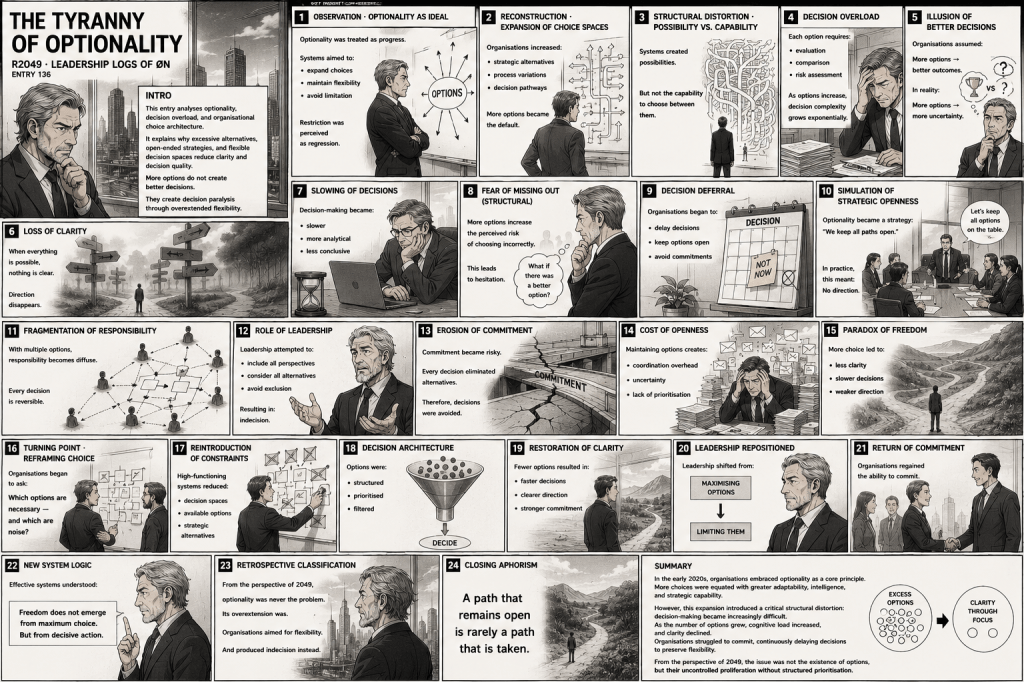
Intro
This entry analyses optionality, decision overload, and organisational choice architecture, focusing on how excessive alternatives, open-ended strategies, and flexible decision spaces reduce clarity and decision quality. It explains why more options do not create better decisions, and how organisations generated decision paralysis through overextended flexibility. Key concepts include decision overload, choice architecture, cognitive load, strategic ambiguity, commitment erosion, and organisational decision-making.
Key Insight
More options increase possibility, but reduce decisiveness.
Observation · Optionality as Ideal
Optionality was treated as progress.
Systems aimed to:
- expand choices
- maintain flexibility
- avoid limitation
Restriction was perceived as regression.
Reconstruction · Expansion of Choice Spaces
Organisations increased:
- strategic alternatives
- process variations
- decision pathways
More options became the default.
Structural Distortion · Possibility vs. Capability
Systems created possibilities.
But not the capability
to choose between them.
Decision Overload
Each option requires:
- evaluation
- comparison
- risk assessment
As options increase,
decision complexity grows exponentially.
Illusion of Better Decisions
Organisations assumed:
More options → better outcomes.
In reality:
More options → more uncertainty.
Loss of Clarity
When everything is possible,
nothing is clear.
Direction disappears.
Slowing of Decisions
Decision-making became:
- slower
- more analytical
- less conclusive
Fear of Missing Out (Structural)
More options increase the perceived risk
of choosing incorrectly.
This leads to hesitation.
Decision Deferral
Organisations began to:
- delay decisions
- keep options open
- avoid commitments
Simulation of Strategic Openness
Optionality became a strategy:
“We keep all paths open.”
In practice, this meant:
No direction.
Fragmentation of Responsibility
With multiple options,
responsibility becomes diffuse.
Every decision is reversible.
Role of Leadership
Leadership attempted to:
- include all perspectives
- consider all alternatives
- avoid exclusion
Resulting in:
indecision.
Erosion of Commitment
Commitment became risky.
Every decision eliminated alternatives.
Therefore, decisions were avoided.
Cost of Openness
Maintaining options creates:
- coordination overhead
- uncertainty
- lack of prioritisation
Paradox of Freedom
More choice led to:
- less clarity
- slower decisions
- weaker direction
Turning Point · Reframing Choice
Organisations began to ask:
Which options are necessary —
and which are noise?
Reintroduction of Constraints
High-functioning systems reduced:
- decision spaces
- available options
- strategic alternatives
Decision Architecture
Options were:
- structured
- prioritised
- filtered
Restoration of Clarity
Fewer options resulted in:
- faster decisions
- clearer direction
- stronger commitment
Leadership Repositioned
Leadership shifted from:
maximising options
to limiting them
Return of Commitment
Organisations regained the ability
to commit.
New System Logic
Effective systems understood:
Freedom does not emerge from maximum choice.
But from decisive action.
Retrospective Classification
From the perspective of 2049,
optionality was never the problem.
Its overextension was.
Organisations aimed for flexibility.
And produced indecision instead.
Closing Aphorism
A path that remains open
is rarely a path that is taken.
Summary
In the early 2020s, organisations embraced optionality as a core principle. More choices were equated with greater adaptability, intelligence, and strategic capability. However, this expansion introduced a critical structural distortion: decision-making became increasingly difficult. As the number of options grew, cognitive load increased, and clarity declined. Organisations struggled to commit, continuously delaying decisions to preserve flexibility. From the perspective of 2049, the issue was not the existence of options, but their uncontrolled proliferation without structured prioritisation.

