Summary
Structures rarely achieve resilience through uniformity alone. They become adaptable by integrating different forms, sizes and functions into a coherent whole. Diversity is not the opposite of structure. Properly organised, it is one of its greatest strengths.
Observation
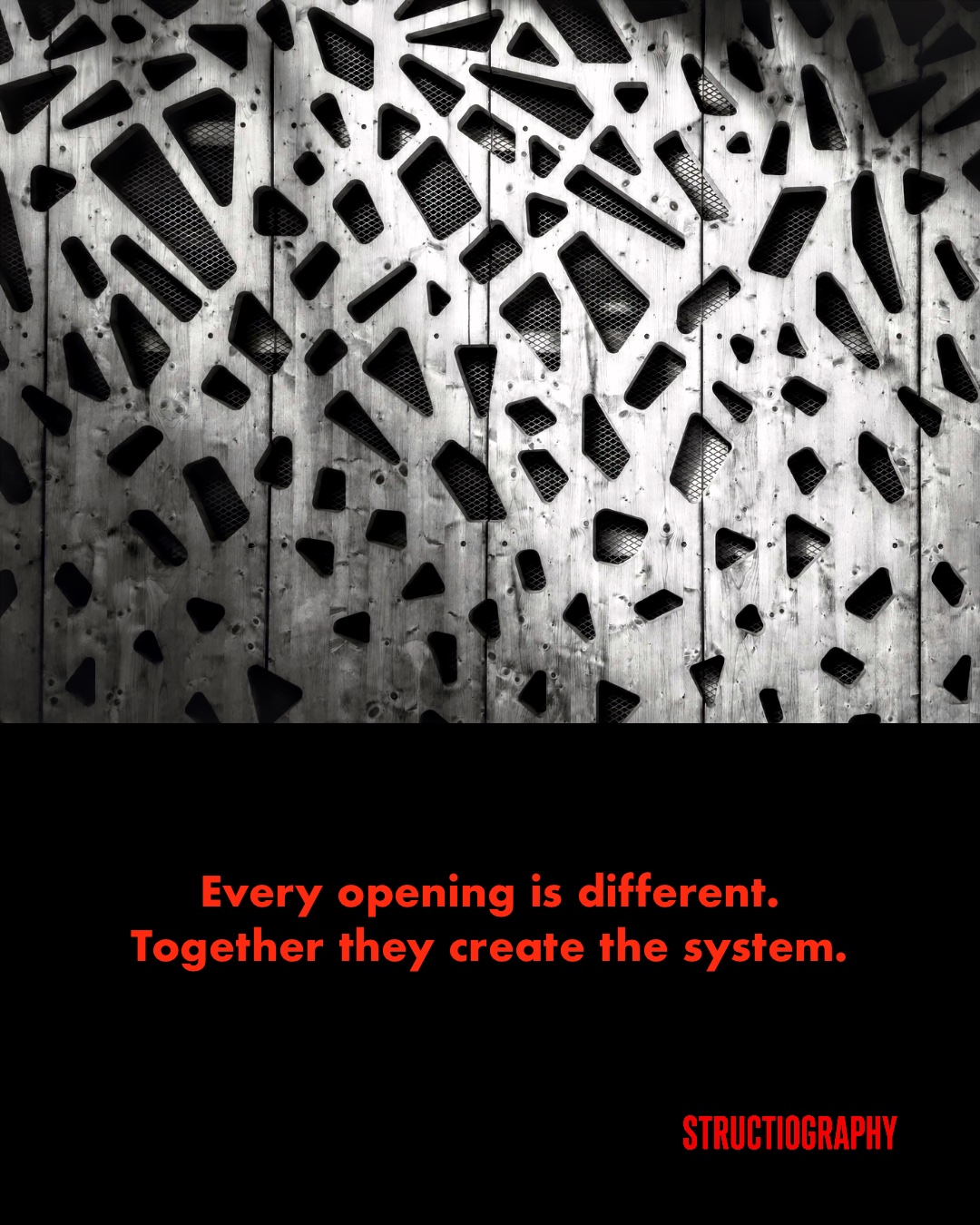
The photograph shows a wall covered with openings of different shapes and dimensions.
No two are identical.
Some are large.
Others are small.
Some are vertical.
Others are horizontal.
Individually they appear irregular.
Together they create a coherent architectural pattern.
The order does not arise from repetition.
It arises from structured diversity.
Structural Reconstruction
Human systems function in much the same way.
Teams benefit from different competencies.
Organisations require different roles.
Healthy ecosystems depend on different species.
Innovation emerges when diverse perspectives are organised rather than standardised.
Uniformity may simplify coordination.
But diversity increases adaptability.
A resilient structure does not eliminate differences.
It integrates them.
Structural Principle
A core principle of Structiography is:
Structural strength emerges when diversity is organised rather than suppressed.
The question is therefore not whether elements differ.
The question is whether their differences contribute to a coherent whole.
Reflection Question
Think about a system you belong to.
Does it value similarity because it is easier to manage?
Or does it organise diversity to increase its long-term resilience?
Core Learning
Uniformity creates consistency.
Structured diversity creates resilience.
Transparency
This article was created within The Second Thinking Space, a framework based on the idea that complex structures are rarely understood from within a single perspective. Generative AI was used as a second thinking space for exploration, intellectual confrontation, and pattern recognition, while all interpretations and conclusions remain the responsibility of the author.