Efficiency Was Not a Competitive Advantage, It Was the Systematic Narrowing of Possibilities · R2049 · Structural Reconstructions

Intro

This reconstruction examines the relationship between organisational efficiency, process optimisation, resource minimisation, adaptability, resilience, strategic flexibility, optionality, and system survivability. It explores how efficiency became one of the dominant management objectives of the early 2020s and why the systematic elimination of variation, redundancy, buffers, and alternative pathways often reduced the adaptive capacity of organisations. Relevant concepts include organisational design, operational efficiency, resilience engineering, decision-making under uncertainty, systems thinking, complexity management, and strategic optionality.

Continue reading “Efficiency Was Not a Competitive Advantage, It Was the Systematic Narrowing of Possibilities · R2049 · Structural Reconstructions”
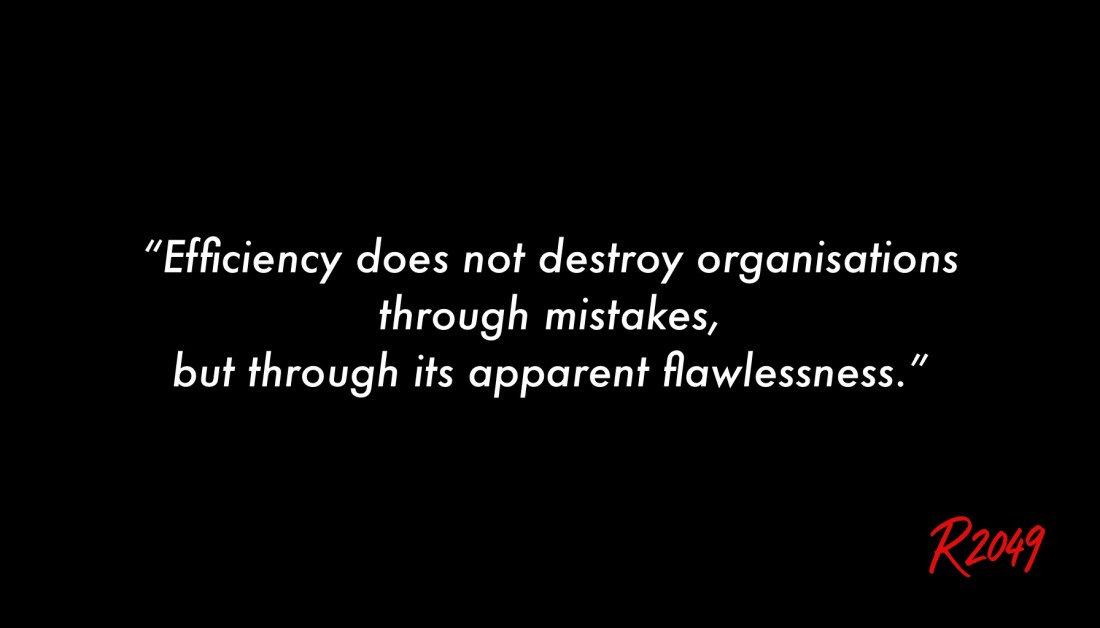
The Silent Violence of Efficiency · R2049 · Leadership Logs of ØN · Entry 120

Intro

This entry analyses efficiency as a structural risk in organisational systems, focusing on how process optimisation, cost reduction, and performance metrics create hidden rigidity. It introduces key concepts such as efficiency vs. adaptability, optimisation bias, structural inertia, invisible complexity, and learning suppression. The analysis shows why efficiency does not guarantee performance — but can lock organisations into outdated models while appearing highly effective.

Continue reading “The Silent Violence of Efficiency · R2049 · Leadership Logs of ØN · Entry 120”

Rethinking: Change Often Means Loss – But Also Gain

„Adaptability turns uncertainty into opportunity.“

The Rethinking Impulse as a RethinkAudio – Listen. Reflect. Analyze. Advance.

Introduction & Context: Why This Topic Matters So Profoundly

Change rarely arrives as a welcome guest. More often than not, its first impression is loss – the dissolution of something familiar, the disappearance of a sense of security. This holds true across domains, whether in professional contexts – such as organizational restructuring, career transitions, or the abandonment of well-worn processes – or in the private realm, when relationships end, homes are left behind, or long-standing routines are disrupted.

Continue reading “Rethinking: Change Often Means Loss – But Also Gain”

Rethinking: The Fear of the Unknown Blocks Us

„It is not change itself that is the problem – but rather the narrative we weave around it.“

The Rethinking Impulse as a RethinkAudio – Listen. Reflect. Analyze. Advance.

Introduction & Context: Why the Fear of the Unknown Undermines Adaptability

Change is an inescapable constant of life — yet few things unsettle us as profoundly as stepping into the unknown. This visceral unease intensifies whenever we are confronted not simply with a shift from one known state to another, but with the disorienting exposure to what lies beyond our current horizon of experience. This fear of the unknown, rarely addressed with the seriousness it warrants, is in fact one of the most formidable barriers to genuine adaptability. For as long as we instinctively cast the unknown as a latent threat, every change that resists full prediction or control will be subconsciously classified as a risk to be avoided.

Continue reading “Rethinking: The Fear of the Unknown Blocks Us”

Rethinking: The Brain Loves Routine – and Resists Change

„Adaptability isn’t about reacting – it’s about leading change.”

The Rethinking Impulse as a RethinkAudio – Listen. Reflect. Analyze. Advance.

Why Is This Topic Important?

Change is an inevitable force in life, yet while the world around us evolves at an ever-accelerating pace, our brains cling stubbornly to the familiar. Routine provides us with stability and a sense of security, conserving cognitive energy and reinforcing a feeling of control. However, this very comfort can become a trap. Those who remain ensnared in habitual patterns risk stagnation and miss out on transformative growth.

Continue reading “Rethinking: The Brain Loves Routine – and Resists Change”

Rethinking: Not Every Change is an Improvement – but Every Improvement is a Change

„Strategic adaptability means knowing when to flow and when to stand firm.”

The Rethinking Impulse as a RethinkAudio – Listen. Reflect. Analyze. Advance.

Introduction & Context

Change is ubiquitous. It shapes both our personal and professional lives, presenting challenges while simultaneously offering opportunities. However, not every change equates to an improvement. Unquestioningly embracing novelty can be as counterproductive as rigidly clinging to the status quo. Adaptability is not about passively accepting all transformations but about making discerning choices: when is adaptation prudent, and when is resistance justified?

Continue reading “Rethinking: Not Every Change is an Improvement – but Every Improvement is a Change”