
This structural reconstruction examines how organisational trust, governance, leadership, compliance, organisational design, institutional resilience, adaptive systems, structural diagnostics and organisational learning evolved during the transformation era of the 2020s and 2030s. Rather than analysing management practices individually, this paper reconstructs a recurring structural mechanism that later explained thousands of apparently unrelated organisational developments. Looking back from 2049, the gradual replacement of trust by increasingly elaborate control architectures became known as the Structural Substitution Principle—one of the fundamental explanatory mechanisms within the emerging science of Structural Reconstructions.
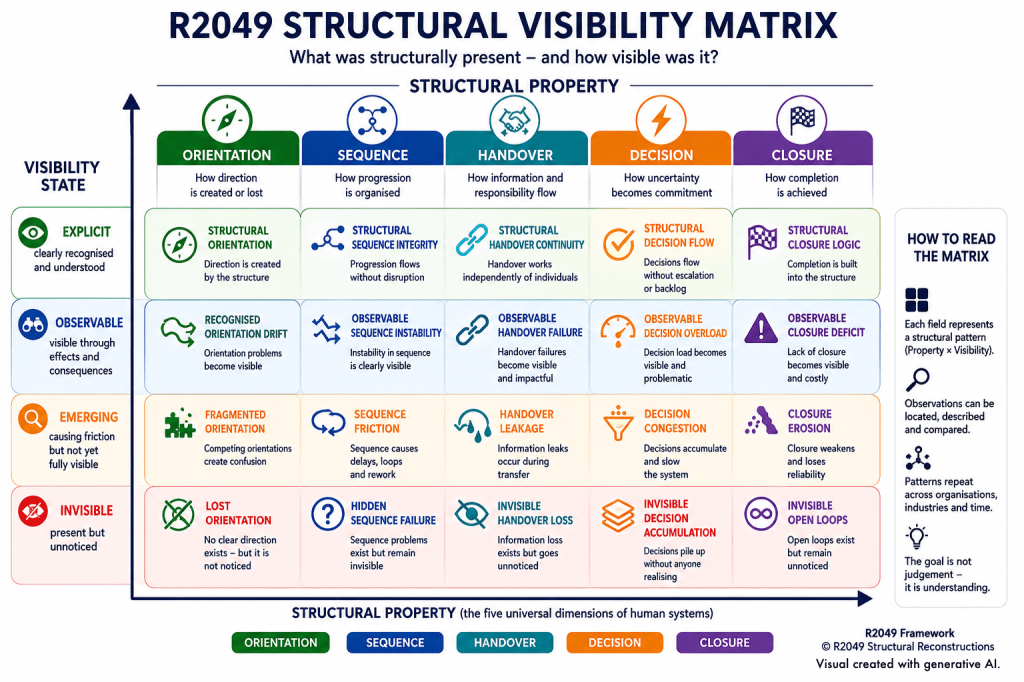
Matrix Classification
- Structural Property: Decision
- Visibility State: Emerging
- Matrix Position: Decision Congestion
- Definition: Trust-based coordination is progressively replaced by formal control mechanisms. Each additional approval appears locally rational but collectively increases decision density, coordination effort and structural dependence on verification.
Introduction
Among the earliest research programmes undertaken by the Structural Reconstruction Institute after 2045 was a comparative analysis of organisational governance across several decades. At first glance the historical evidence appeared contradictory. During the same period in which leadership literature increasingly emphasised trust, empowerment, psychological safety and decentralised responsibility, organisations continuously expanded formal systems of verification. New approval layers, documentation requirements, audit procedures, compliance frameworks and reporting obligations emerged almost everywhere, regardless of industry, geography or organisational size.
Initially these developments were interpreted as rational reactions to increasingly complex environments. Digitalisation, geopolitical instability, cybersecurity threats, regulatory expansion and global supply chains all seemed to justify more sophisticated governance structures. Although these explanations contained elements of truth, they failed to explain one remarkable observation. Organisations facing entirely different external conditions frequently evolved towards remarkably similar control architectures. The similarities proved far greater than environmental explanations alone could justify.
Only retrospective structural reconstruction eventually revealed the deeper mechanism. The expansion of organisational control had not primarily been an environmental adaptation. It had been the repeated activation of a stable structural process that emerged whenever existing trust no longer generated sufficient organisational predictability. Rather than rebuilding trust, organisations consistently substituted it with mechanisms that produced observable evidence of reliability. This substitution solved immediate operational problems while simultaneously transforming the long-term architecture of organisational cooperation itself.
Reconstruction I · The Structural Asymmetry Between Trust and Control
One of the first discoveries made by the archives concerned the fundamentally different nature of trust and control. Contemporary management theory frequently presented them as opposite concepts positioned along the same organisational continuum. Structural reconstruction demonstrated that this interpretation had been misleading. Trust and control were not opposites. They represented two entirely different mechanisms for reducing uncertainty within complex human systems.
Trust reduced uncertainty through stable expectations between individuals. It enabled cooperation because participants anticipated reliable future behaviour without requiring constant verification. Control, by contrast, reduced uncertainty by making behaviour externally observable through formal procedures, documentation and institutional oversight. Both mechanisms could generate organisational stability. Yet they differed profoundly in one critical characteristic.
Control produced visible evidence.
Every approval could be documented.
Every audit generated measurable outputs.
Every compliance review produced records.
Every verification procedure left an institutional trace.
Trust generated almost none of these observable artefacts. When trust functioned successfully, nothing unusual occurred. Processes simply continued without interruption. Decisions required fewer approvals. Coordination became easier. Conflicts emerged less frequently. Ironically, the more effectively trust operated, the less visible its contribution became within organisational measurement systems.
This asymmetry fundamentally shaped managerial behaviour during the transformation era. Organisations increasingly relied on phenomena that could be documented rather than on mechanisms whose effectiveness consisted precisely in their invisibility. Over time this created an institutional preference for observable governance, not necessarily because it produced superior organisational outcomes, but because it generated evidence that governance existed.
The archives later recognised this asymmetry as the initial condition from which the Structural Substitution Principle could emerge.
Reconstruction II · The Structural Substitution Principle
The comparative reconstructions revealed a remarkably consistent sequence that appeared across almost every type of organisation investigated. Although industries, technologies and political environments differed substantially, the structural development followed nearly identical stages.
The process almost always began with an exceptional event. Sometimes it was a compliance failure, sometimes a cybersecurity incident, an operational disruption, a public scandal or an expensive strategic mistake. The specific trigger proved largely irrelevant. What mattered structurally was the organisational interpretation of the event. The incident demonstrated that existing trust had failed to provide sufficient predictability. Leadership therefore sought an alternative mechanism capable of preventing similar failures in the future.
The immediate response was rarely irrational. New approval procedures were introduced. Documentation requirements increased. Additional reporting obligations emerged. Independent review functions were established. Responsibility became more precisely defined. Every individual intervention appeared justified when viewed in isolation. In most cases the original incident did not recur, reinforcing the impression that the additional controls had solved the underlying problem.
Retrospective reconstruction, however, demonstrated that organisations had misunderstood what had actually happened. The new governance mechanisms did not simply eliminate the original risk. They permanently changed the architecture through which cooperation itself was organised. Every additional verification procedure transferred a small portion of organisational coordination from interpersonal trust towards institutional control. This shift appeared insignificant at first because each individual intervention affected only a limited part of the system. Yet over years and decades these local adjustments accumulated into a profound structural transformation.
The archives therefore concluded that organisations had not consciously chosen to distrust their members. Instead, they had repeatedly activated the same adaptive mechanism whenever uncertainty increased. Trust was gradually substituted by observable forms of control because control generated measurable evidence of organisational action, while trust generated primarily the absence of failure. This recurring process eventually became known as the Structural Substitution Principle.
Reconstruction III · The Irreversibility of Control
One of the most surprising discoveries concerned the remarkable persistence of organisational control systems. Historical analysis showed that control mechanisms possessed an unusually high institutional survival rate. Once introduced, they rarely disappeared, even after the circumstances that had originally justified them had fundamentally changed.
This persistence was not caused by bureaucratic rigidity alone. It resulted from a structural asymmetry in organisational decision-making. Introducing an additional control carried very little political risk. If future problems occurred, leadership could legitimately argue that stronger governance had been necessary. Removing an existing control created the opposite situation. Any later failure could immediately be interpreted as evidence that the removed procedure had been essential all along.
Consequently, organisations developed a powerful structural bias. Controls accumulated almost automatically, while their removal required unusually strong justification. Every major disruption expanded governance architectures. Very few successful years reduced them. Over time this produced an irreversible historical layering of organisational control.
The archives later described this phenomenon as Structural Control Irreversibility. It explained why organisations with entirely different cultures, leadership philosophies and strategic ambitions nevertheless converged towards increasingly similar governance structures. The phenomenon was not primarily cultural or ideological. It emerged from the structural logic of institutional self-protection.
Reconstruction IV · The Hidden Economics of Verification
The leadership literature of the early transformation era generally evaluated control systems through their visible benefits. Stronger governance reduced compliance failures. Better documentation improved traceability. Additional approvals lowered certain operational risks. These effects were measurable and therefore became central indicators of organisational quality.
The structural reconstructions introduced a second balance sheet that had previously remained largely invisible.
Every additional control also generated coordination costs.
Verification consumed attention.
Documentation consumed cognitive resources.
Approvals consumed time.
Audits required preparation.
Reporting demanded interpretation.
Individually these expenditures appeared insignificant. Collectively they transformed the economic architecture of organisational cooperation.
Unlike financial investments, these costs rarely appeared as explicit budget items. Instead they emerged indirectly through longer decision cycles, slower adaptation, declining initiative, increasing procedural dependence and reduced organisational flexibility. Because each additional control solved a visible local problem while distributing its costs across the entire system, few organisations recognised the cumulative consequences.
The archives later concluded that organisations had unintentionally optimised local certainty while gradually reducing global adaptability. This trade-off remained largely invisible because the benefits of each control were immediate and measurable, whereas the structural costs emerged slowly across thousands of everyday interactions.
By the late 2040s this accumulated verification burden had become recognised as one of the defining characteristics of mature bureaucratic systems. The problem had never been individual controls themselves. The problem had been the failure to understand their collective structural behaviour once they interacted as an increasingly dense organisational architecture.
Reconstruction V · Control as a Structural Communication System
Perhaps the most profound discovery of the archives emerged only after numerous comparative reconstructions had been completed. Control did not merely regulate behaviour. It communicated assumptions about the organisation itself. Every verification procedure, every approval requirement and every additional reporting obligation silently transmitted a structural message concerning how the institution expected people to behave.
Whenever an activity that had previously relied upon professional judgement became subject to formal verification, the system implicitly announced that judgement alone was no longer considered sufficient. Whenever additional documentation replaced informal coordination, the organisation communicated that observable evidence had become more valuable than mutual confidence. None of these signals required explicit discussion. They became embedded in everyday routines and gradually reshaped the behavioural expectations of the entire organisation.
The archives reconstructed that this communication process occurred independently of leadership intentions. Executives often continued speaking publicly about empowerment, decentralisation and entrepreneurial responsibility while simultaneously expanding formal governance systems. Both developments appeared compatible because they addressed different dimensions of organisational life. Yet structurally they produced contradictory signals. One encouraged autonomous judgement; the other continuously reduced the institutional necessity for exercising it.
Over time these contradictions accumulated. Employees increasingly adapted their behaviour to the architecture they experienced rather than to the values they were told the organisation represented. Initiative became more selective. Risk-taking declined. Informal cooperation gave way to procedural coordination. None of these behavioural shifts resulted primarily from declining motivation. They emerged because the structural environment had gradually changed the incentives governing everyday organisational action.
The archives therefore concluded that culture should not primarily be understood as a collection of declared organisational values. Culture emerged from the repeated structural signals communicated through everyday institutional design. Control systems were among the most influential of these signals because they operated continuously, quietly and almost entirely beneath conscious managerial attention.
Reconstruction VI · The Control Inversion Threshold
One of the central objectives of the Structural Reconstruction Programme was to identify not merely recurring patterns but genuine structural laws that explained apparently unrelated organisational developments. During the comparative analysis of governance architectures, researchers eventually identified one such recurring threshold.
In the early stages of organisational development, additional control mechanisms generally produced measurable improvements. Errors declined. Compliance increased. Processes became more predictable. Coordination improved. These benefits reinforced the belief that further expansion of governance systems would continue generating proportional improvements.
The archives demonstrated that this assumption proved valid only within a limited structural range.
Beyond a certain level of institutional density, the relationship reversed.
Each additional control generated progressively smaller improvements in operational security while simultaneously increasing organisational complexity at an accelerating rate. Verification systems began interacting with one another. Documentation requirements overlapped. Approval procedures multiplied. Governance structures increasingly required governance themselves.
At this stage organisations gradually crossed what later became known as the Control Inversion Threshold.
The significance of this threshold cannot be overstated. Before crossing it, control primarily stabilised organisational operations. After crossing it, organisational operations increasingly existed to maintain the expanding control architecture itself. A growing proportion of institutional energy was no longer directed towards creating value for customers, patients, citizens or clients. Instead it became absorbed by sustaining the internal mechanisms designed to regulate organisational behaviour.
The archives identified this inversion across remarkably different organisational environments. Large corporations, hospitals, government agencies, universities and international institutions all displayed similar structural trajectories despite pursuing fundamentally different missions. This suggested that the phenomenon represented a general property of complex organisations rather than a sector-specific management problem.
Reconstruction VII · Adaptive Trust Architecture
During the early 2040s a relatively small number of organisations began approaching governance from an entirely different perspective. Rather than asking where additional control should be introduced, they investigated where historical control mechanisms had gradually replaced trust without producing proportional organisational value.
This apparently modest change in perspective initiated a profound transformation. Historical governance structures were no longer regarded as permanent institutional assets. Instead they became hypotheses that required periodic structural revalidation. Every approval process, documentation requirement and verification mechanism had to answer a new question.
Does this control still compensate for an existing organisational uncertainty?
Or has it become the historical residue of a problem that no longer exists?
This distinction fundamentally altered organisational redesign. Numerous governance mechanisms disappeared not because organisations had become less responsible, but because they had become more structurally precise. Control was concentrated where uncertainty genuinely required formal verification. Trust was deliberately restored where institutional learning, professional competence and transparent accountability already generated sufficient organisational reliability.
The archives later described this new equilibrium as Adaptive Trust Architecture. Unlike earlier governance philosophies, it rejected both naïve trust and excessive control. Instead it recognised that both mechanisms possessed legitimate structural functions. The essential leadership challenge therefore shifted from maximising either trust or control towards understanding precisely where each mechanism generated the greatest long-term adaptive capacity for the organisation as a whole.
Final Structural Reconstruction
Looking back from the perspective of 2049, the expansion of organisational control systems appears fundamentally different from how it was originally interpreted. Earlier management literature frequently described the development as a rational response to an increasingly uncertain world. The structural reconstructions preserved within the archives, however, revealed that this explanation addressed only the visible surface of a much deeper process.
The decisive development was not the growth of control itself. The decisive development was the repeated activation of a structural substitution mechanism that gradually altered the architecture of organisational cooperation. Every significant disruption increased the probability that additional verification would replace interpersonal trust. Every successful intervention strengthened confidence in the substitution mechanism itself. Because the immediate problem usually disappeared, organisations rarely questioned whether the underlying structural response had generated new long-term vulnerabilities.
Across thousands of reconstructed organisational histories, this mechanism displayed remarkable stability. It emerged regardless of industry, ownership structure, national culture or leadership philosophy. Individual organisations believed they were making isolated governance decisions. In retrospect, they had collectively participated in the same structural evolution.
This insight fundamentally changed the scientific understanding of organisational governance during the late 2040s. Control was no longer analysed primarily as an administrative instrument. It became recognised as a structural variable that continuously reshaped learning capacity, adaptive behaviour, decision architectures, innovation dynamics and institutional resilience. The significance of the Structural Substitution Principle therefore extended far beyond questions of compliance or organisational trust. It became one of the central explanatory mechanisms for understanding why many apparently successful institutions gradually lost their ability to adapt while continuing to operate with increasing efficiency.
Perhaps the most important conclusion reached by the archives was that organisations had rarely intended to reduce trust. The substitution occurred almost entirely through rational local optimisation. Every additional approval, every new reporting requirement and every expanded verification procedure appeared individually reasonable. The cumulative structural consequences only became visible decades later, when comparative reconstruction made it possible to observe the evolution of entire organisational systems rather than isolated management decisions.
This retrospective perspective transformed one of the most persistent assumptions of early twenty-first-century leadership theory. The central governance question was no longer whether organisations required more trust or more control. That distinction proved far too simplistic for complex adaptive systems. The more fundamental question became whether institutional structures continuously preserved the ability to distinguish between uncertainty that genuinely required formal control and uncertainty that could only be resolved through the deliberate cultivation of trust.
The mature organisations of the late 2040s therefore abandoned the pursuit of maximum governance. Instead they pursued structural equilibrium. Control was applied precisely where systemic risks demanded objective verification. Trust was deliberately protected wherever organisational learning, professional judgement and adaptive cooperation generated greater long-term resilience than any additional layer of institutional oversight could ever achieve.
In retrospect, this transition marked more than an improvement in management practice. It represented the emergence of a fundamentally different scientific understanding of organisations themselves. Human systems were no longer viewed as machines requiring progressively tighter regulation. They were understood as adaptive structures whose long-term stability depended upon maintaining an appropriate balance between formal control and relational trust. The archives ultimately recognised this balance not as a cultural preference but as a structural property governing the adaptive capacity of complex organisations.
Structural Mechanism
Structural Substitution Principle
A recurring structural mechanism through which organisations systematically replace trust-based coordination with observable control architectures whenever uncertainty exceeds the predictive capacity of existing institutional relationships. While locally effective, repeated substitution gradually increases coordination costs, reduces adaptive capacity and reshapes the long-term architecture of organisational cooperation.
Position Within the Structural Reconstruction Framework
The Structural Substitution Principle belongs to the family of Structural Transformation Mechanisms. Unlike isolated organisational phenomena, structural transformation mechanisms explain how repeated local adaptations accumulate into long-term systemic evolution. Together with mechanisms such as Structural Deceleration of Insight, Efficiency-Induced Future Blindness, Priority Instability, Knowledge Preservation Fallacy and Interpretive Agility, it forms part of the emerging explanatory framework reconstructed by the Leadership Archives of 2049.
Each mechanism explains a different dimension of organisational evolution. Their scientific value lies not in describing individual events but in revealing recurring structural laws capable of explaining large numbers of apparently unrelated organisational developments through a coherent theoretical architecture.
Structural Reconstruction Aphorism
Organisations did not become less adaptive because they trusted too much. They became less adaptive because they gradually forgot where trust remained structurally superior to control.
Summary
When historians first examined the organisations of the early twenty-first century, they assumed that the dramatic expansion of governance systems, compliance structures and organisational controls had been driven primarily by increasing external uncertainty. Comparative reconstructions conducted during the late 2040s, however, revealed a much deeper structural mechanism. Across industries, governments, healthcare institutions and multinational corporations, organisations repeatedly responded to uncertainty by substituting trust-based coordination with observable forms of control.
Initially this substitution appeared highly successful. Individual incidents became less frequent, accountability improved and processes became more predictable. Yet over longer periods the accumulated control architecture fundamentally altered organisational behaviour. Every additional verification procedure reduced local uncertainty while simultaneously increasing coordination costs, slowing adaptation and gradually diminishing the structural necessity of trust itself. The archives later identified this recurring mechanism as the Structural Substitution Principle, one of the foundational laws governing organisational evolution during the transformation era.
Transparency
This article was created within The Second Thinking Space (https://shorturl.at/RfYe0), a framework based on the idea that complex structures are rarely understood from within a single perspective. Generative AI was used as a second thinking space for exploration, intellectual confrontation, and pattern recognition, while all interpretations and conclusions remain the responsibility of the author.
 R2049
R2049 