
Summary
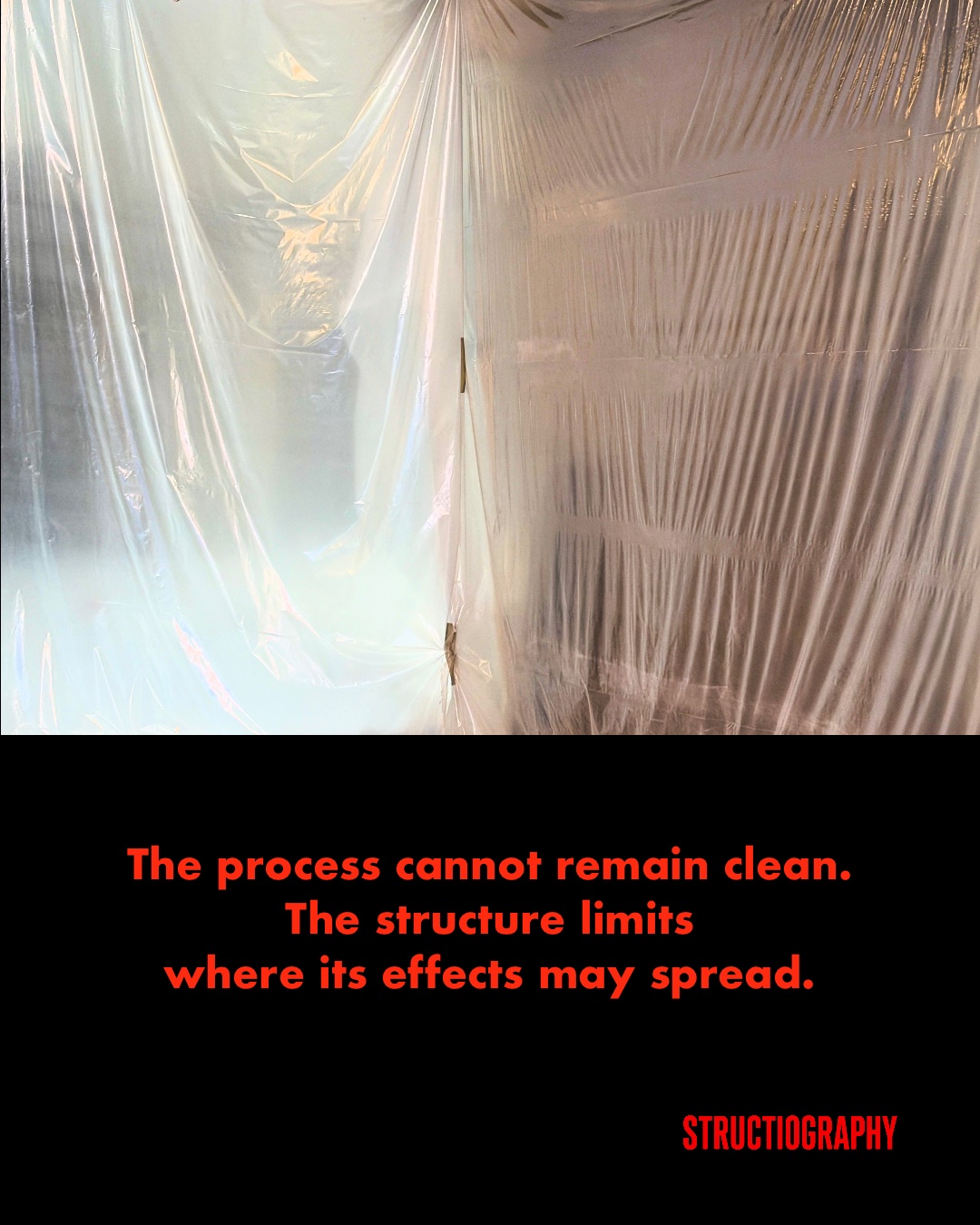
Structures do not only enable activity. They also contain its consequences. This image illustrates how temporary boundaries can protect a larger environment while change takes place within a defined area.
Observation
The photograph shows an interior covered with translucent plastic sheeting.
Walls, openings and surfaces remain partly visible, but direct access has been interrupted.
The material appears light and provisional.
Yet it performs a precise function.
It separates one zone from another.
Dust, paint, moisture or debris may emerge behind it, but their movement is restricted.
The plastic does not stop the work.
It limits its reach.
Structural Reconstruction
Human systems require similar forms of containment.
Test environments isolate uncertain processes.
Clear responsibilities prevent problems from spreading between teams.
Escalation routes direct disruptions towards defined decision points.
Temporary rules protect ongoing operations during periods of change.
Without containment, a local intervention can affect the entire system.
The problem is then no longer the change itself, but the uncontrolled distribution of its consequences.
Structural Principle
Effective structures do not prevent every disruption. They define how far disruption may travel.
Containment creates a boundary within which experimentation, repair and transformation can occur without destabilising everything around them.
Reflection Question
Where in your environment could a local problem spread unnecessarily because no structural boundary contains it?
Core Learning
Change produces consequences.
Containment determines their reach.
Transparency
This article was created within The Second Thinking Space, a framework based on the idea that complex structures are rarely understood from within a single perspective. Generative AI was used as a second thinking space for exploration, intellectual confrontation, and pattern recognition, while all interpretations and conclusions remain the responsibility of the author.

