
Summary
Structures often remain unnoticed while their elements conform to an expected pattern. A small deviation can suddenly reveal the relationships that were present all along.
Observation
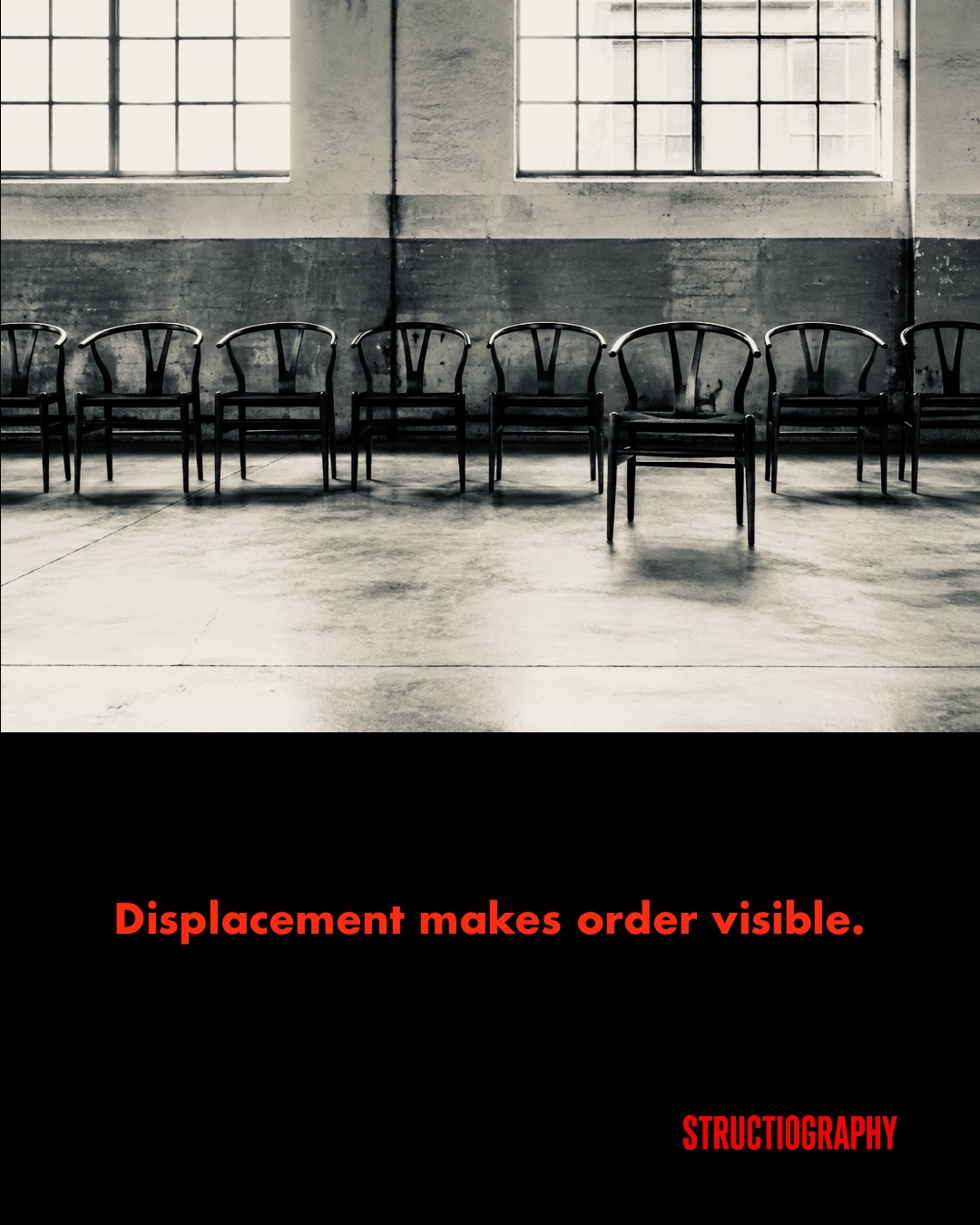
The photograph shows a row of chairs arranged in a shared direction.
One chair has been moved slightly out of alignment.
The difference is small, yet the eye notices it immediately.
What attracts attention is the displaced chair.
What becomes visible, however, is the order surrounding it.
Spacing, orientation and repetition suddenly matter.
Structural Reconstruction
This principle extends far beyond chairs.
A book shifted on a shelf, a bollard outside a line, a bicycle parked at a different angle or one window breaking a façade rhythm can expose an underlying structure that previously escaped attention.
Deviation therefore acts like a visual probe.
By disturbing one relationship, it reveals the others.
The important question is not simply:
What is different?
It is:vWhat structure had to exist for this difference to become noticeable?
Structural Principle
Deviation makes latent order perceptible.
Structure often exists less in individual objects than in the relationships between them.
Reflection Question
How little must one element move before an arrangement no longer feels structurally unchanged?
Core Learning
Deviation attracts attention. But the real discovery is the order it reveals.
Transparency
This article was developed within the framework of the concept The Second Thinking Space with the support of generative artificial intelligence. AI is used to explore questions, broaden perspectives, generate alternative formulations, identify patterns, and facilitate the critical examination of ideas and assumptions.
The article has been substantively reviewed, editorially revised, and approved by the author. All editorial decisions, evaluations, interpretations, and conclusions are the sole responsibility of the author.

