
Visible. Not Addressed.
Search Info
Primary topic: Traffic signs, directional information and the spatial organisation of public communication
Central question: What does the reverse side of a traffic sign reveal about how information in public space is distributed according to position and direction?
Key concepts: traffic signs, public space, visual communication, urban infrastructure, spatial orientation, information design, directional information
Core insight: The reverse side of a traffic sign reveals that public information is not simply placed in space for everyone to receive; its meaning depends on the position, direction and role from which a person encounters it.
Summary
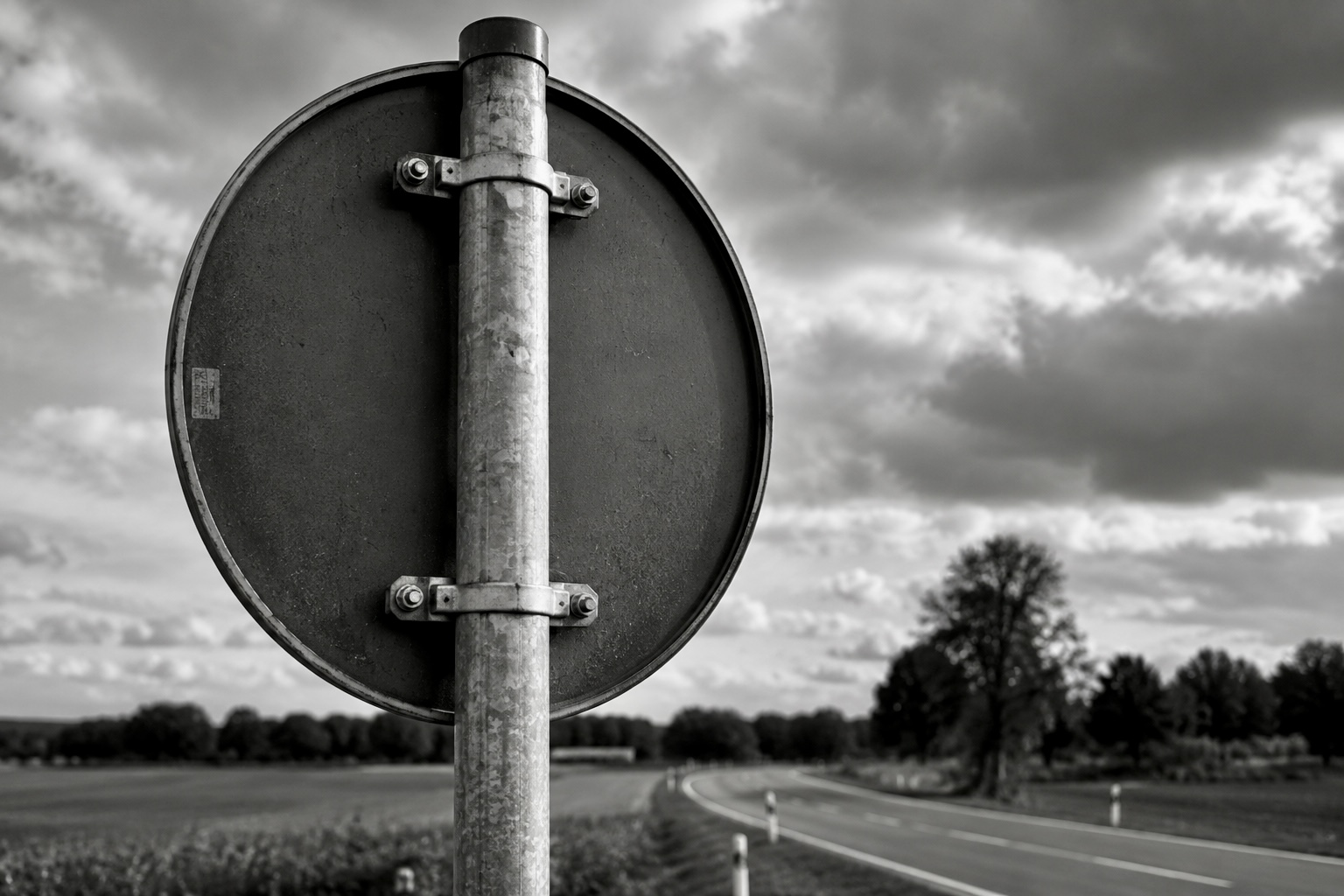
A traffic sign seen from behind presents an unusual visual condition: the object is completely visible while its information remains unavailable. From the perspective of 2049, such images became useful evidence of a largely unnoticed property of public communication in the early twenty-first century. Traffic infrastructure did not merely distribute information across space; it assigned information to particular directions of movement. The reverse of the sign therefore exposes a structural distinction between visibility and addressability. Something can occupy public space, remain directly before the observer and still not be intended for them.
The Information Was Only Millimetres Away
The photograph contains almost everything required to recognise the object. A metal pole rises from the ground, supporting the familiar geometric form of a traffic sign. Its fastening brackets, grey metal surface and structural construction are clearly visible. Nothing is concealed in the ordinary sense. The sign stands openly in public space and can be inspected without obstruction, yet the information for which the object exists cannot be read because the observer occupies the wrong side of it.
Only a few millimetres of material separate complete information from almost complete informational absence. There is no physical distance to overcome, no locked enclosure and no technological barrier. Changing position would be enough. The photograph therefore records a particularly simple form of withheld visibility: the object is present, but its meaning has been directed elsewhere.
From the perspective of 2049, this apparently trivial arrangement became useful because it revealed something larger about the organisation of public space. Information had never simply been placed into an environment. It had been positioned for particular trajectories through that environment.
Public Information Had a Direction
Traffic signs were among the clearest examples of directional information architecture in the early twenty-first century. Their location, height, orientation, colour and symbols were designed around movement. A sign addressed approaching drivers from a particular direction; the same physical object could be irrelevant to someone travelling the opposite way. Its information was public, but its intended audience was spatially selected.
This distinction usually remained invisible because people encountered signs from the position for which they had been designed. A driver approaching a junction saw the instruction, interpreted it and continued. Object, observer and direction aligned so completely that the architecture of the communication itself disappeared behind the message being communicated.
The reverse view interrupts that alignment. Suddenly the sign ceases to function as information and becomes infrastructure. Instead of an instruction, one sees sheet metal, brackets, bolts and a pole. The semantic surface disappears and the supporting structure becomes visible. What had appeared to be a simple message is revealed as an object whose meaning depends upon a carefully organised relationship between surface and observer.
The sign had not lost its information. The observer had lost the position from which that information was intended to exist.
Visibility Was Not the Same as Addressability
Later Visual Reconstruction distinguished between visibility and addressability. Visibility describes whether something can be perceived. Addressability describes whether its communicative surface is organised for the position from which it is perceived. The distinction matters because public environments contained enormous quantities of information that were technically visible while being functionally addressed elsewhere.
Traffic infrastructure made this unusually literal. The person standing behind a sign could see the object more completely than a driver passing its front, perhaps noticing its construction, weathering, mounting and relation to the surrounding landscape. Yet the observer who saw more of the object received less of its intended meaning.
This reverses a familiar assumption about observation. Greater visual access does not necessarily produce greater informational access. Sometimes the position that reveals the structure is precisely the position from which the message disappears.
That contradiction sits close to the centre of The Withholding Gaze. What is visible does not automatically become understandable, and what becomes understandable may depend less on the object itself than on the relationship from which it is encountered.
The Front Was a Message; the Back Was a Structure
The two sides of the traffic sign belonged to different visual worlds. The front was deliberately designed to suppress material complexity. Its colours, symbols and geometry had to be recognised rapidly, often while the observer was moving. Screws, supports and manufacturing details were secondary to the message. The surface reduced the physical object to a communicative function.
The reverse performed almost the opposite operation. Without symbol or instruction, the sign returned to its material condition. Metal replaced meaning. Fastenings became visible. The pole was no longer merely the support beneath an instruction but part of a constructed object embedded in the street.
The photograph therefore does not simply show the wrong side of a familiar thing. It separates two layers that ordinary use normally combines: semantic function and physical infrastructure. From the front, infrastructure disappears behind information; from the back, information disappears behind infrastructure.
Neither view is more truthful. Each reveals something the other withholds.
This became an important principle in later Structiography because infrastructures frequently achieved their effectiveness by allowing their material organisation to recede from attention. People saw what systems wanted them to use while overlooking much of what made that use possible.
The City Was Full of Positioned Meaning
Traffic signs represented only the most obvious example. Public environments of the period contained information whose intelligibility depended continuously on position. Platform displays faced waiting passengers. Advertising addressed particular flows of pedestrians or traffic. Building entrances organised signs for those approaching rather than departing. Road markings could be understood properly only from the trajectory for which they had been painted.
The city therefore did not contain a single informational landscape shared equally by everyone present within it. It contained overlapping informational fields, each organised around expected movements, directions and roles.
A pedestrian, cyclist and driver could occupy almost the same coordinates while inhabiting different communicative environments. They encountered different signs, priorities, surfaces and signals because infrastructure anticipated different forms of movement from each of them.
From 2049, this made the apparently neutral concept of “public information” look less simple. Information could be publicly visible without being universally addressed. The environment continuously selected recipients through orientation.
The reverse side of the traffic sign made that selection visible precisely because the observer had stepped outside it.
What the Photograph Withholds
The image creates an obvious temptation: to move around the sign and discover what is written on the other side. Yet doing so would resolve the very condition that gives the photograph its analytical value. Once the front becomes visible, the object returns to ordinary usefulness. It becomes a speed limit, prohibition, warning, direction or instruction, and attention moves towards what the sign says.
The photograph deliberately refuses that completion.
We do not need to know what the sign says because its withheld content is not the subject. The relevant evidence lies in the fact that content can exist immediately before us while remaining unavailable solely because of orientation.
This is why the image belongs to The Withholding Gaze rather than functioning merely as an illustration of traffic infrastructure. It does not document the information on the sign. It documents the relationship required for information to become information.
The missing front remains present as an inference. We know that something is there because the object’s construction tells us so, but the photograph does not surrender it.
The R2049 Visual Reconstruction
From the perspective of 2049, the reverse side of a traffic sign became a compact record of how early twenty-first-century environments organised meaning. The period was saturated with visual information, yet information was never simply distributed everywhere. It was oriented towards expected observers moving through expected trajectories. Meaning depended upon where someone stood, which way they travelled and which role the surrounding system assigned to them.
The photograph interrupts that arrangement by occupying the position the communication did not anticipate. From there, the sign becomes simultaneously more visible and less legible. Its material construction emerges while its intended message disappears.
This produces the structural reconstruction contained in the image. The public environment did not consist simply of objects carrying information. It consisted of relationships between objects, directions and observers through which information became accessible to some positions and absent from others.
The reverse side therefore does not represent informational failure. The sign is functioning exactly as designed. Its refusal to communicate from this position is part of its organisation.
What the photograph reveals is consequently more subtle than a hidden message. It reveals the architecture of address itself: the unnoticed fact that information can stand openly in front of us and still belong to somebody travelling the other way.
The sign concealed nothing. We were simply standing where its meaning was never meant to arrive.
Transparency
This article was developed within the framework of the concept The Second Thinking Space with the support of generative artificial intelligence. AI is used to explore questions, broaden perspectives, generate alternative formulations, identify patterns and facilitate the critical examination of ideas and assumptions. The article has been substantively reviewed, editorially revised and approved by the author. All editorial decisions, evaluations, interpretations and conclusions are the sole responsibility of the author.

