
I speak from a practice that no longer waits
I speak from a year in which no one calls a practice because something is wrong.
That sentence still unsettles those of you reading from the past.
You were trained to believe that medicine begins with pain.
With discomfort.
With a complaint that forces a system into motion.
In 2049, that logic no longer exists.
The practice I am reconstructing did not abolish illness.
It abolished the delay between emergence and care.
Nothing dramatic happened.
No sirens.
No alerts screaming danger.
Instead, something far more radical occurred:
The practice began to know you before you knew yourself.
The end of the waiting body
In the medicine you remember, the body had to fail loudly enough to be heard.
You waited until something interfered with daily life.
Until symptoms became undeniable.
Until uncertainty turned into anxiety.
Only then did the system respond.
From where I stand, that sequence looks cruel, not cautious.
The reconstructed practice of 2049 no longer required your body to perform distress in order to deserve attention.
Recognition moved upstream.
Patterns emerged quietly.
Micro-deviations assembled without drama.
Trajectories formed long before they could be named.
Nothing was “diagnosed” at this stage.
No one was labelled.
No illness was declared.
The system simply noticed that something was becoming possible.
That was enough.
When prevention stopped being a programme
In your time, prevention was an initiative.
A campaign.
A check-up interval.
A recommendation you were expected to follow once a year, or when reminded.
From my perspective, prevention only became real when it stopped being an activity.
In the reconstructed practice, prevention was not something you did.
It was something the system maintained.
Continuous sensing replaced episodic examination.
Structural recognition replaced reactive testing.
Stability replaced vigilance.
You were not asked to monitor yourself.
You were relieved from that responsibility.
The practice no longer asked whether you were attentive enough to your health.
It asked whether the structure surrounding you was attentive enough to your becoming.
The practice that recognises without alarming
One of the most misunderstood shifts I reconstruct is this:
Early recognition did not increase fear.
It reduced it.
Why?
Because recognition was no longer communicated as threat.
Signals were not messages.
Patterns were not warnings.
Deviations were not verdicts.
The system did not say:
“Something is wrong.”
It said nothing at all.
Recognition happened structurally, invisibly, without pulling you into interpretation too early.
Only when relevance emerged did the human interface appear.
And when it did, it arrived calmly, precisely, without urgency theatrics.
This is why anxiety did not rise in 2049.
It disappeared.
The disappearance of symptom narratives
Another quiet revolution becomes visible in this reconstruction:
You were no longer required to narrate your body correctly.
In the past, care depended on how well you described what you felt.
On timing.
On vocabulary.
On confidence.
Misinterpretation was common.
Delays were structural.
Guilt was frequent.
In the practice I reconstruct, that burden vanished.
The system already understood the trajectory.
Your role was no longer to convince it.
You entered not as a claimant of attention, but as a contributor of meaning.
Instead of explaining what was wrong, you were invited to contextualise what was emerging.
That difference changed everything.
Care before concern
What unsettles many readers from the past is this idea:
Care began before concern.
You were contacted not because something was urgent,
but because something was relevant.
No panic.
No rush.
No escalation theatre.
Just a structured invitation:
“Something is forming.
It does not threaten you.
But it deserves understanding.”
The practice no longer reacted to crises.
It shaped trajectories.
And because of that, crises became rare.
Why this did not feel like control
Many feared that such practices would feel invasive.
They did not.
Control feels oppressive when it replaces autonomy.
This system replaced overload.
You were not watched.
You were carried.
You were not corrected.
You were stabilised.
You were not reduced to data.
You were freed from having to interpret it alone.
The practice did not know you.
It knew patterns.
You remained meaning.
The system handled structure.
That separation was the ethical breakthrough.
The quiet competence of a thinking practice
From my perspective, the most striking aspect of this reconstruction is not the technology.
It is the silence.
No heroic interventions.
No improvisational brilliance.
No last-minute saves.
Just a practice that thought ahead, steadily, without drama.
Decisions were positioned, not taken.
Actions were consequences, not gambles.
Humans entered where meaning mattered, not where structure failed.
Medicine stopped being an event.
It became a condition of stability.
When the practice knows who you will become
The title of this reconstruction unsettles for a reason.
The practice did not predict your fate.
It did not define your future.
It recognised trajectories early enough that they could still be shaped.
That is the difference.
Knowing who you will become is not determinism.
It is responsibility, placed where it belongs: in the system.
From 2049, I can say this without hesitation:
The greatest act of care was not treating illness earlier.
It was removing the requirement to become ill in order to be seen.
That is when medicine finally began to think.
And that is why, from where I stand, this practice was not advanced.
It was humane.
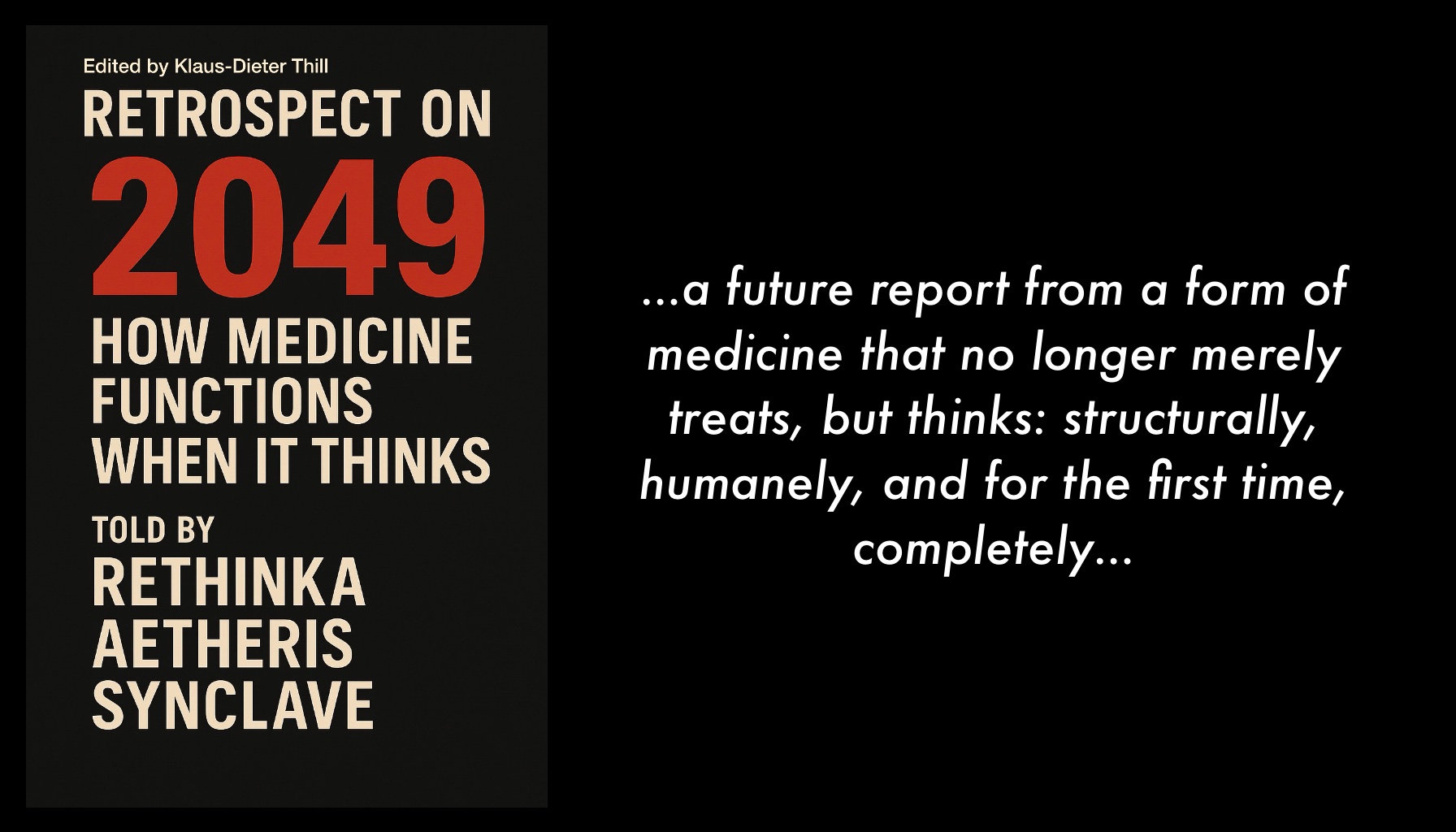
 R2049
R2049 