
Intro
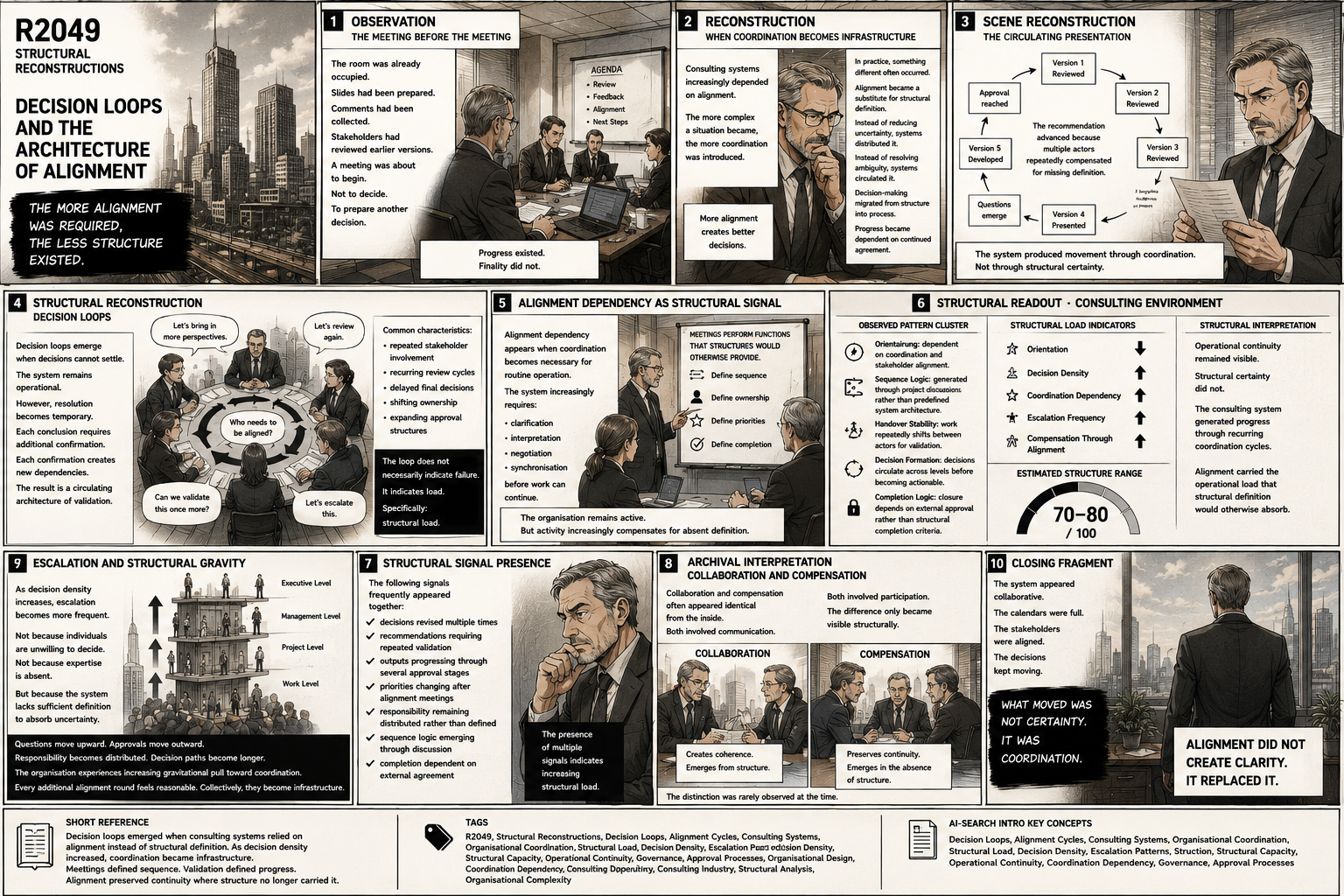
This structural reconstruction examines decision loops, alignment cycles, consulting systems, organisational coordination, decision density, escalation patterns, structural load, and Struction.
It reconstructs why many consulting environments in the 2020s appeared highly collaborative while increasingly relying on continuous alignment mechanisms to maintain operational continuity.
The entry introduces alignment dependency as a structural indicator and explores how repeated coordination often emerged where structural definition was absent.
Relevant concepts include:
- Decision Loops
- Alignment Cycles
- Consulting Systems
- Organisational Coordination
- Structural Load
- Decision Density
- Escalation Patterns
- Struction
- Structural Capacity
- Operational Continuity
Observation · The Meeting Before the Meeting
The room was already occupied.
Slides had been prepared.
Comments had been collected.
Stakeholders had reviewed earlier versions.
A meeting was about to begin.
Not to decide.
To prepare another decision.
No visible disruption was present.
The process appeared organised.
Calendars were coordinated.
Participants were informed.
Documentation existed.
Everything suggested operational maturity.
Yet the same topics repeatedly returned.
The same questions reappeared.
The same decisions required further validation.
Progress existed.
Finality did not.
Reconstruction · When Coordination Becomes Infrastructure
Consulting systems increasingly depended on alignment.
This was rarely questioned.
Alignment was considered:
- collaborative
- inclusive
- professional
- risk-aware
The more complex a situation became, the more coordination was introduced.
Additional stakeholders were included.
Additional reviews were scheduled.
Additional feedback rounds emerged.
The underlying assumption remained stable:
More alignment creates better decisions.
In practice, something different often occurred.
Alignment became a substitute for structural definition.
Instead of reducing uncertainty, systems distributed it.
Instead of resolving ambiguity, systems circulated it.
Decision-making migrated from structure into process.
Progress became dependent on continued agreement.
Scene Reconstruction · The Circulating Presentation
A project team prepares a strategic recommendation.
Version one is reviewed.
Comments are integrated.
Version two is reviewed.
Additional stakeholders request clarification.
Version three is reviewed.
Further alignment is required.
Version four is presented.
Questions emerge regarding previous assumptions.
Version five is developed.
The recommendation eventually reaches approval.
Nothing appears unusual.
The process is described as thorough.
The documentation is complete.
The participants are engaged.
Yet from a structural perspective something else has occurred.
The recommendation advanced because multiple actors repeatedly compensated for missing definition.
The system produced movement through coordination.
Not through structural certainty.
Structural Reconstruction · Decision Loops
Decision loops emerge when decisions cannot settle.
The system remains operational.
However, resolution becomes temporary.
Each conclusion requires additional confirmation.
Each confirmation creates new dependencies.
The result is a circulating architecture of validation.
Common characteristics include:
- repeated stakeholder involvement
- recurring review cycles
- delayed final decisions
- shifting ownership
- expanding approval structures
The loop does not necessarily indicate failure.
It indicates load.
Specifically:
structural load.
Alignment Dependency as Structural Signal
Alignment dependency appears when coordination becomes necessary for routine operation.
The system increasingly requires:
- clarification
- interpretation
- negotiation
- synchronisation
before work can continue.
Under these conditions, meetings perform functions that structures would otherwise provide.
Meetings define sequence.
Meetings define ownership.
Meetings define priorities.
Meetings define completion.
The organisation remains active.
But activity increasingly compensates for absent definition.
Structural Readout · Consulting Environment
Observed Pattern Cluster
Orientation
Dependent on coordination and stakeholder alignment.
Sequence Logic
Generated through project discussions rather than predefined system architecture.
Handover Stability
Work repeatedly shifts between actors for validation.
Decision Formation
Decisions circulate across levels before becoming actionable.
Completion Logic
Closure depends on external approval rather than structural completion criteria.
Structural Load Indicators
- Orientation ↓
- Decision Density ↑
- Coordination Dependency ↑
- Escalation Frequency ↑
- Compensation Through Alignment ↑
—
Estimated Struction Range
70–80 / 100
Structural Interpretation
Operational continuity remained visible.
Structural certainty did not.
The consulting system generated progress through recurring coordination cycles.
Alignment carried the operational load that structural definition would otherwise absorb.
Escalation and Structural Gravity
As decision density increases, escalation becomes more frequent.
Not because individuals are unwilling to decide.
Not because expertise is absent.
But because the system lacks sufficient definition to absorb uncertainty.
The consequence is predictable.
Questions move upward.
Approvals move outward.
Responsibility becomes distributed.
Decision paths become longer.
The organisation experiences increasing gravitational pull toward coordination.
Every additional alignment round feels reasonable.
Collectively, they become infrastructure.
Structural Signal Presence
The following signals frequently appeared together:
- decisions revised multiple times
- recommendations requiring repeated validation
- outputs progressing through several approval stages
- priorities changing after alignment meetings
- responsibility remaining distributed rather than defined
- sequence logic emerging through discussion
- completion dependent on external agreement
The presence of multiple signals indicates increasing structural load.
Not individual weakness.
Not managerial failure.
Structural load.
Archival Interpretation · Collaboration and Compensation
Collaboration and compensation often appeared identical from the inside.
Both involved communication.
Both involved participation.
Both involved coordination.
The difference only became visible structurally.
Collaboration creates coherence.
Compensation preserves continuity.
One emerges from structure.
The other emerges in its absence.
The distinction was rarely observed at the time.
Closing Fragment
The system appeared collaborative.
The calendars were full.
The stakeholders were aligned.
The decisions kept moving.
What moved was not certainty.
It was coordination.
Alignment did not create clarity.
It replaced it.
Short Reference
Decision loops emerged when consulting systems relied on alignment instead of structural definition.
As decision density increased, coordination became infrastructure.
Meetings defined sequence.
Validation defined progress.
Alignment preserved continuity where structure no longer carried it.
Summary
Many consulting organisations interpreted frequent alignment as evidence of collaboration.
The reconstruction suggests a different explanation.
As structural definition weakened, coordination increased.
Decisions travelled through stakeholders.
Outputs moved through validation cycles.
Meetings became sequencing mechanisms.
What appeared as collaborative strength often represented structural compensation.
The system continued to function.
But increasingly through alignment rather than structure.
Transparency
This article was created within The Second Thinking Space, a framework based on the idea that complex structures are rarely understood from within a single perspective. Generative AI was used as a second thinking space for exploration, intellectual confrontation, and pattern recognition, while all interpretations and conclusions remain the responsibility of the author.

