
Reconstruction 002 · Quadrant II: Pragmatically Stable Leadership
Intro
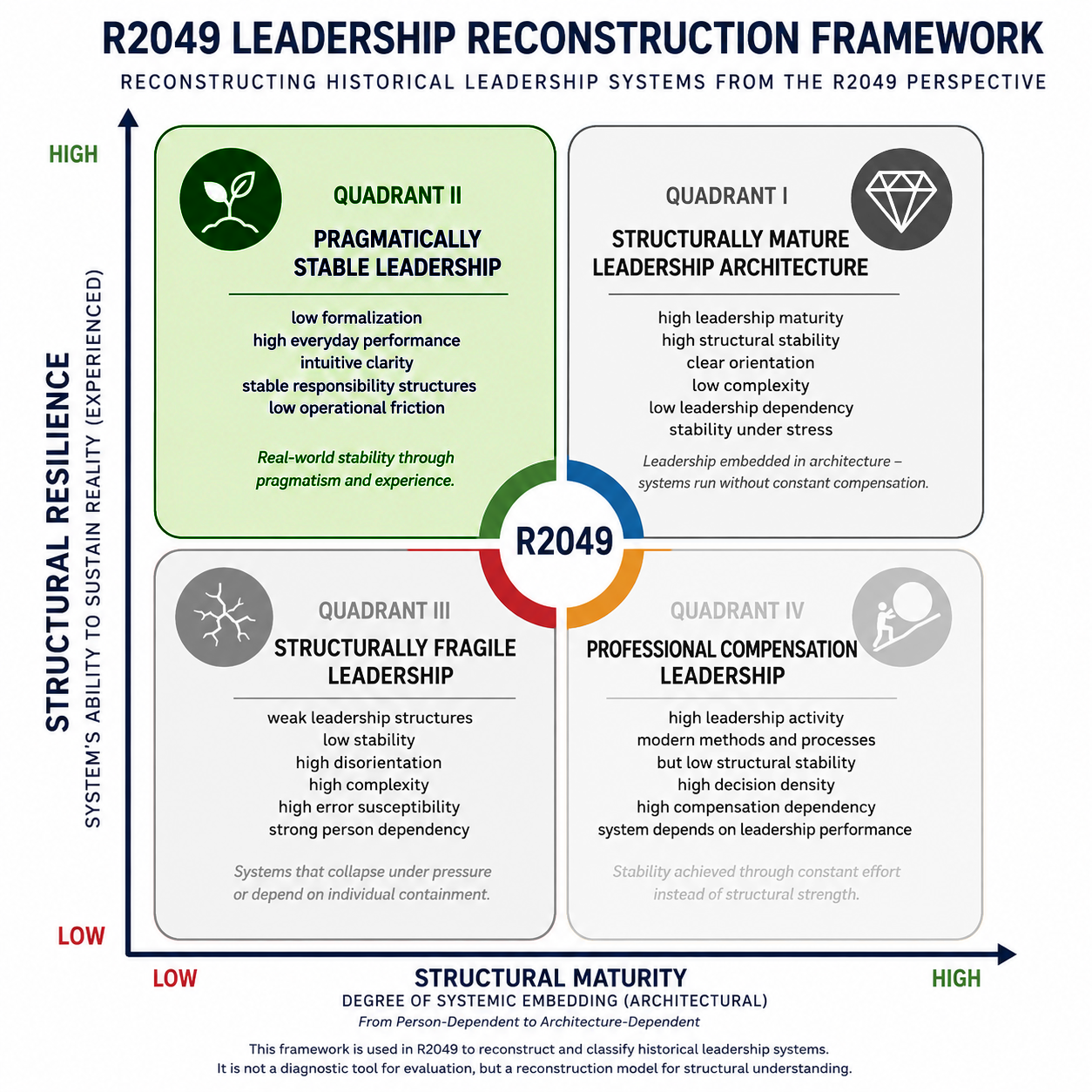
This reconstruction examines pragmatically stable leadership, operational reliability, shared context, informal coordination, organisational resilience, decision efficiency, team stability, leadership architecture, tacit knowledge and structural functionality.
The entry analyses a frequently overlooked organisational pattern observed throughout the 2020s: teams that achieved remarkable stability despite limited formalisation, minimal documentation and relatively simple management structures.
The reconstruction explores why some organisations functioned reliably not because they followed sophisticated procedures, but because they developed highly effective shared understanding. Key concepts include pragmatically stable leadership, operational trust, informal coordination, organisational resilience, decision simplicity, shared context and structural functionality.
The Organisations Nobody Talked About
Historical archives often focused on organisations that appeared sophisticated. Researchers examined transformation programmes, governance frameworks, leadership models and operational systems because visible complexity naturally attracted attention.
Yet many of the most stable teams left surprisingly little evidence of such sophistication behind. Their records appeared unremarkable. Organisational charts were simple. Procedures were often incomplete. Manuals were rarely updated and sometimes barely existed at all.
Despite this apparent lack of formal structure, these teams functioned with remarkable consistency. Not occasionally. Consistently.
Stability Without Formalisation
When reconstruction specialists examined these environments more closely, a recurring pattern emerged.
Stability did not originate from extensive formalisation. It originated from shared operational understanding. People knew what mattered, understood priorities, recognised exceptions and rarely required clarification because context already existed.
The organisation did not need to continuously explain itself to its members because its members already understood how the system worked.
This understanding was not produced by documentation. It developed through repetition, experience and interaction. New employees absorbed operational norms quickly. Experienced colleagues transmitted practical knowledge naturally. Information moved through conversations rather than escalation chains, and coordination often occurred before formal coordination became necessary.
Many operational problems were resolved before management ever became involved.
The Power of Fewer Decisions
One of the most distinctive characteristics of these organisations was the low number of decisions required during normal operations.
Many organisations of the period generated significant decision traffic simply to maintain coordination. These teams operated differently. Expectations were already understood, responsibilities were rarely debated and routine activities remained routine.
Because constant clarification was unnecessary, cognitive load remained low throughout the organisation. Energy could therefore be directed toward productive work rather than internal alignment.
What many organisations attempted to achieve through management systems, these teams often achieved through shared context.
Leadership That Rarely Looked Like Leadership
This does not mean leadership was absent.
Leadership existed, but it appeared in a different form. Leaders were not constantly intervening, acting as coordination hubs or resolving endless ambiguities. Instead, they created conditions in which fewer interventions became necessary.
The most effective leaders often attracted little attention—not because they lacked influence, but because the organisation no longer depended on visible influence to function.
In many cases, leadership became visible only when something unusual happened. During normal operations, the system simply worked.
Trust as Operational Infrastructure
Another defining feature was trust.
Not trust as an abstract management ideal, but practical operational trust. People trusted colleagues to fulfil responsibilities. They trusted information to be accurate, commitments to be honoured and routines to produce predictable outcomes.
This trust reduced organisational friction. Verification became less necessary, monitoring requirements decreased and coordination accelerated.
The organisation preserved energy that other systems consumed managing uncertainty. What appeared from the outside as simplicity was often the result of years of accumulated trust and shared experience.
Why These Teams Underestimated Themselves
Archives also revealed that these teams rarely considered themselves exceptional.
Many regarded their way of working as entirely normal. Because stability felt ordinary, they assumed it was common. Only when compared with more fragile organisations did the significance of their achievement become visible.
While other organisations required extensive coordination efforts to achieve comparable outcomes, these teams maintained stability almost effortlessly. Not because they worked harder, but because they generated less structural friction.
Their effectiveness was often invisible precisely because it produced so little drama.
Not Perfect, But Remarkably Functional
Pragmatically stable leadership did not represent structural perfection.
These organisations still contained vulnerabilities. Knowledge was sometimes concentrated in individuals. Processes could remain undocumented. Growth occasionally exposed weaknesses in informal coordination mechanisms. Some systems struggled when expansion outpaced the shared understanding on which they depended.
Yet despite these limitations, they consistently achieved a level of functionality that many more sophisticated organisations failed to reach.
The explanation was surprisingly simple: the structure matched operational reality. The organisation did not attempt to manage complexity that did not actually exist.
The Alternative to Management Inflation
Many organisations during the early twenty-first century pursued increasing formalisation as a path to stability. More procedures, more controls, more reporting requirements and more frameworks were introduced in the belief that structure automatically produced reliability.
Some organisations benefited from these efforts. Others merely accumulated complexity.
Pragmatically stable teams demonstrated an alternative path. Stability could emerge not from additional management activity, but from shared understanding.
The lesson was never that procedures were unnecessary. The lesson was that procedures could not replace context.
When context disappeared, organisations compensated with management. When context remained strong, management requirements declined naturally.
Why This Quadrant Matters
From the perspective of 2049, these teams occupy a distinctive position within the Leadership Reconstruction Framework.
They were neither fully architected systems nor structurally fragile organisations. Their success depended neither on heroic leadership nor on advanced organisational design.
Instead, they achieved stability through practical alignment between people, work and expectations.
They understood the system without needing to constantly describe it. The manual existed. Few people read it.
The organisation functioned anyway.
That was precisely the point.
Short Reference
Pragmatically Stable Leadership describes systems that maintain reliability through shared understanding, operational trust and low-friction coordination.
The structure is not highly formalised.
The people understand it well enough that it rarely needs to be.
Summary
Some of the most reliable teams operated with surprisingly little formal structure. They were not heavily documented, process-obsessed or governed by elaborate management systems. Yet they consistently achieved stable outcomes. Their strength emerged not from managerial complexity, but from shared understanding.

