
Intro
This reconstruction examines artificial intelligence, decision architecture, decision flow, organisational design, structural capacity, structural excellence, operational effectiveness, human-AI systems, decision overload and structural stability.
It explores why some organisations became more effective after AI not because decisions became faster, but because fewer decisions were required in the first place.
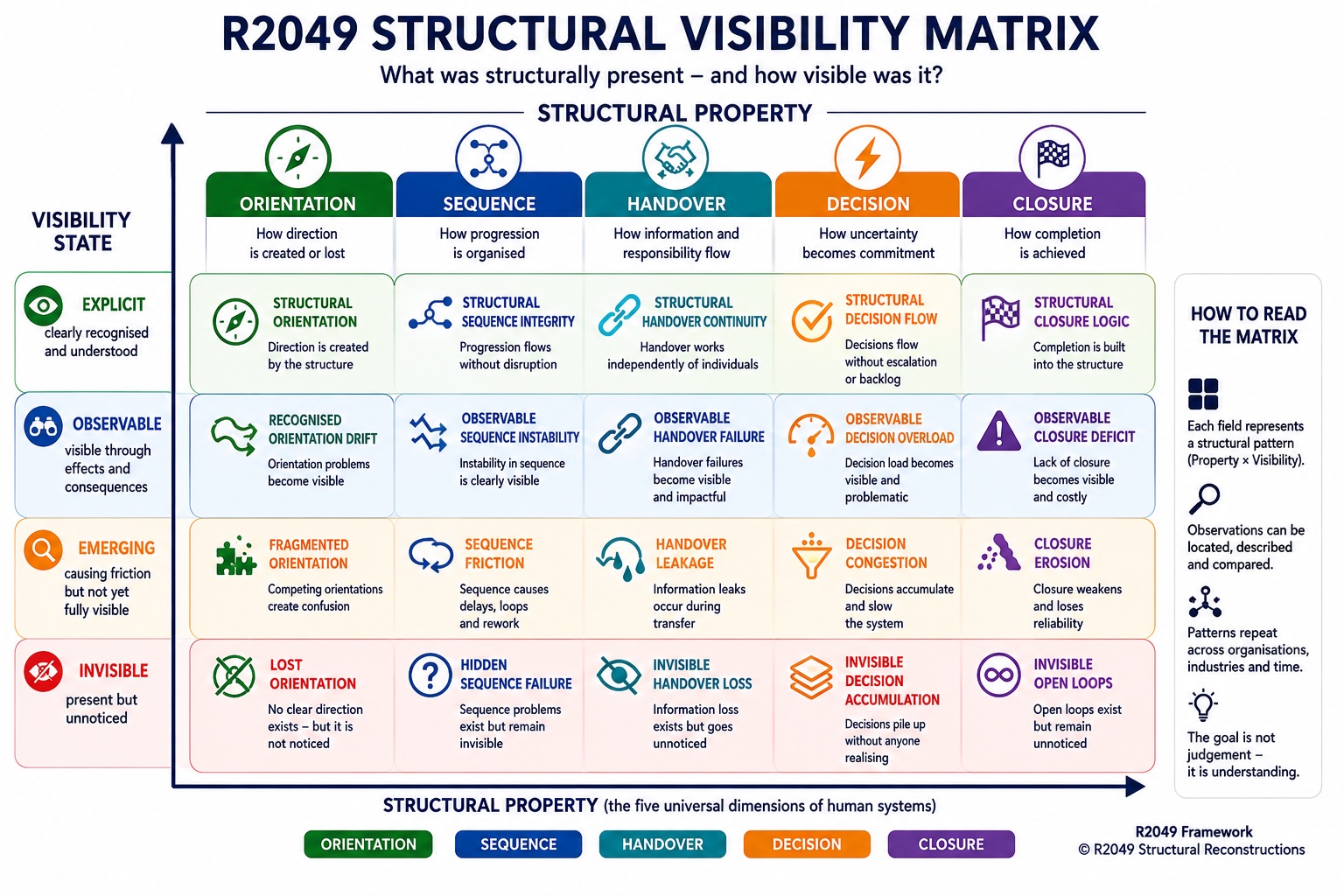
Part of the R2049 Structural Visibility Matrix.
Structural Property: Decision
Visibility State: Explicit
Matrix Position: Structural Decision Flow
Reconstruction
The Assumption: AI Would Improve Decisions
When artificial intelligence entered organisational life at scale, public discussion focused almost entirely on capability. The central questions concerned what AI could do, how accurately it could perform tasks and which jobs might eventually be affected.
Inside organisations, however, a different transformation quietly emerged.
In a small number of unusually effective teams, managers noticed something unexpected. Meetings became shorter. Escalations became less frequent. Approval chains began to shrink. Operational interruptions declined. Yet workload itself had not necessarily decreased.
In some cases, complexity had actually increased.
At first, observers attributed these improvements to automation. The explanation seemed obvious. AI completed routine tasks, generated reports, analysed information and reduced administrative effort. Naturally, decision-making should become easier.
The reality proved more interesting.
The Hidden Inventory of Decisions
What changed was not simply the speed of decision-making.
What changed was the number of situations that required a decision at all.
For decades, organisations had unknowingly accumulated vast quantities of micro-decisions. Employees routinely asked questions that should never have required escalation. Managers spent considerable portions of their day resolving uncertainties created by the structure itself. Teams continuously translated ambiguity into decisions because the system provided no other mechanism for doing so.
AI exposed this pattern with remarkable clarity.
As intelligent systems became integrated into daily operations, organisations discovered that many recurring decisions were not strategic choices. They were structural compensations. They existed because information was difficult to access, responsibilities were unclear, handovers were inconsistent or completion criteria remained ambiguous.
The decision itself was often solving a problem created elsewhere.
The Question That Changed Everything
In structurally mature organisations, leaders recognised this distinction early. Rather than asking how AI could help people make more decisions, they asked a different question:
Why does this decision exist in the first place?
That question changed everything.
Every unnecessary approval, every recurring clarification, every routine escalation and every predictable exception became a candidate for structural examination. AI did not simply answer questions faster. It revealed how many questions should never have been asked.
Structural Excellence And Decision Flow
Over time, a visible pattern emerged. Teams that achieved the greatest improvements were rarely those with the most advanced technology. They were those with the strongest structural foundations.
Their orientation was clear. Information could be located without searching. Responsibilities were understood without constant clarification. Handovers transferred context reliably. Completion criteria were explicit. As a result, uncertainty diminished naturally before reaching the level of a decision.
Decision flow improved because decision demand declined.
From the perspective of 2049, this distinction became one of the defining characteristics of Structural Excellence. Many organisations measured productivity through activity. Structural observers measured productivity through avoided complexity.
An organisation that requires fifty decisions to accomplish a task may appear dynamic. An organisation that requires five decisions for the same outcome is often structurally superior.
The difference is not intelligence but architecture.
The Team That Removed Decisions
One archived observation from the late 2020s illustrates this particularly well. A technology company introduced AI assistants across several operational departments. Initial performance indicators showed modest gains. Response times improved, reporting became faster and administrative effort decreased.
Yet one team achieved dramatically better results than the others.
When analysts investigated the difference, they discovered that the team had approached AI differently. Instead of using the technology to accelerate existing decision processes, they used it to identify recurring decision patterns. Every repeated question became a structural signal. Every frequent escalation became evidence of architectural friction
Within months, dozens of recurring decisions disappeared entirely.
Not because people stopped deciding.
Because the structure no longer required those decisions to exist.
The result was remarkable. Managers reported feeling less busy despite maintaining the same level of responsibility. Teams experienced fewer interruptions. Coordination costs declined. Projects progressed more smoothly through the organisation. Most importantly, strategic decisions received greater attention because operational decisions consumed less cognitive capacity.
The organisation had not merely improved decision-making. It had reduced decision dependence.
What AI Actually Amplified
This is why the most effective human-AI systems of the early AI era eventually came to be understood differently by future observers. Their success did not originate from superior algorithms. It originated from superior structural design.
Artificial intelligence amplified what already existed.
Where decision architecture was weak, AI often accelerated confusion. Where structural foundations were strong, AI amplified coherence.
The technology remained largely the same. The structure did not.
By the 2040s, this lesson had become widely accepted among organisations capable of sustaining long-term performance. The primary objective was no longer to make better decisions faster.
The objective was to build systems that required fewer unnecessary decisions.
That is where structural capacity begins. And that is often where structural excellence becomes visible.
Matrix Classification
Structural Property: Decision
Visibility State: Explicit
Matrix Position: Structural Decision Flow
Definition:
Decision flow exists when uncertainty is consistently transformed into commitment without backlog, escalation or recurring decision accumulation.
R2049 Archive Note
This reconstruction belongs to the Decision domain of the R2049 Structural Visibility Matrix.
It documents a structurally mature environment in which decision architecture reduced decision demand, allowing artificial intelligence to amplify structural capacity rather than compensate for structural weakness.
Archive Classification: D-02-EXP
Summary
Many organisations expected artificial intelligence to improve decision-making by increasing speed. Some certainly achieved faster responses, quicker analyses and more efficient workflows. Yet the most successful organisations experienced something different.
They did not primarily make decisions faster.
They needed fewer decisions.
From the perspective of 2049, this distinction became one of the clearest indicators of structural excellence.
 R2049
R2049 