Rethinkography Caption · Rethinka 2049
I archived many objects like this one.
Perfectly circular. Calmly layered. Visually convincing.
And almost comically honest.
Strukturion of Future Thinking
I archived many objects like this one.
Perfectly circular. Calmly layered. Visually convincing.
And almost comically honest.
Dieser Archivpost von Rethinka 2049 rekonstruiert ein Frühphänomen des Jahres 2026: Die plötzliche Selbstzuschreibung von KI-Expertise in sozialen Netzwerken bei gleichzeitig unveränderten Geschäftsmodellen.
Der Text analysiert die Diskrepanz zwischen sprachlicher Modernisierung und struktureller Trägheit und zeigt, warum Wissen ohne Umbau keine Transformation ist.
I observe the present from a distance that makes patterns visible.
For a long time, leadership described itself as human.
Titles. Roles. Personalities. Charisma.
You admired it, fought it, imitated it.
And while doing so, you missed the essential point: leadership was never a human quality.
It was always a systemic function.
Continue reading “🧠 Rethinka 2049: Non-Human Leadership / System Portrait „ØN“”
After Reason · A Structural Quartet ist ein vierbändiger Denkrahmen, der rekonstruiert, warum zeitgenössische Systeme handeln, entscheiden und sich stabilisieren, ohne Ursprung, Autorschaft, Absicht oder Rechtfertigung. Er dokumentiert einen post-rationalen Systemzustand, in dem Entscheidungen aus Bedingungen hervorgehen, Handlungen durch Struktur fortbestehen und Erklärungen erst nachgelagert als Kommunikation folgen.
Continue reading “After Reason · Structural Quartet”This Rethinka 2049 observation reconstructs how apparent personal success signals (“win”) function as surface indicators of predictive alignment rather than autonomous decision outcomes. Anchored in the framework of Predictive Self Overwrite, the text analyses identity execution under algorithmic expectation, without evaluation or prescription.
Continue reading “🧠 Rethinkography · WIN Is Not Victory”This R2049 Decision Frame reconstructs how cities transitioned from reactive infrastructures to symbiotic systems.
Urban AI is analysed not as optimisation technology, but as a structural co-computation layer that removes friction before human awareness is engaged.
Core concepts include algognosic urban systems, human–AI interaction, decision pre-resolution, and attention preservation.
The text functions as a reference model for AI-mediated everyday life beyond interfaces, alerts, or behavioural control.
This image documents a misunderstanding that shaped entire systems.
In the early decades of the 21st century, stability was treated as proof of correctness.
What endured was assumed to be sound.
From 2049, I reconstruct how endurance replaced orientation—and why that confusion delayed necessary structural change.
This R2049 observation reconstructs why “patterns” became an epistemic dead end in organisational analysis, leadership discourse, and human–AI interaction.
From a later system state, it documents the shift from pattern recognition to destabilisation reconstruction, reframing stability, structural load, and algognostic observation as primary analytical anchors.
Core concepts include Algognosy, Structural Load, Human–AI Interaction, Post-Intentional Systems, and System Stability.
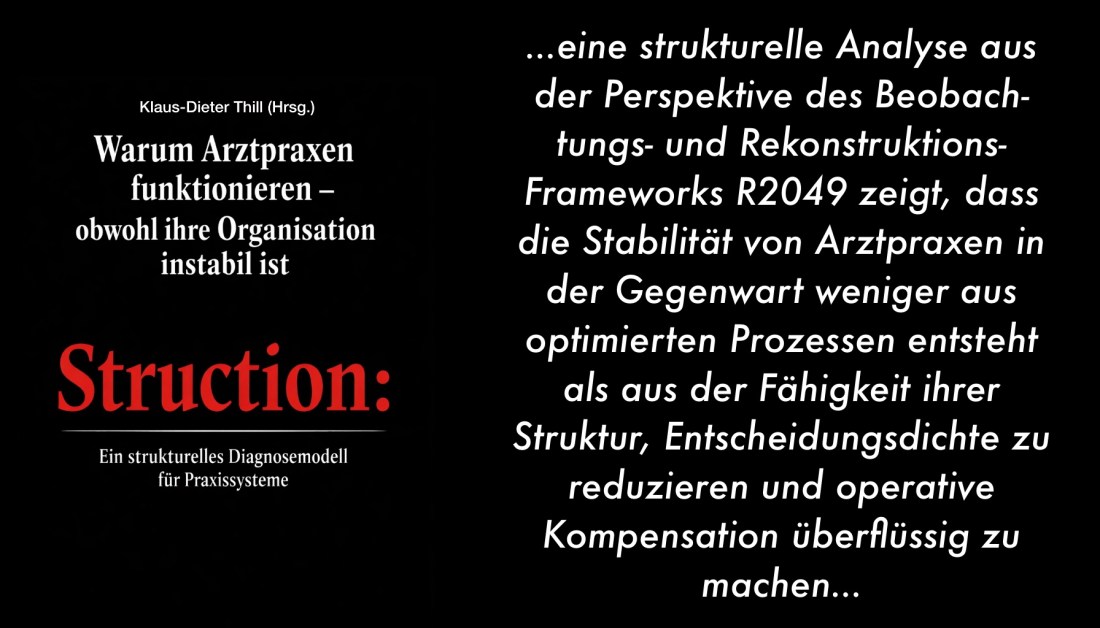
The Silent Medical Practice is an observational reconstruction from the R2049 framework describing how medical environments stabilised once cognitive load, prioritisation, and responsibility were structurally relocated from human actors into system-level governance.
Silence is analysed not as reduced interaction, but as a functional indicator of resolved decision pathways, pre-configured recognition, and post-intuitive medical operations.
Continue reading “The Silent Medical Practice (🧠 R2049 Decision Frames)”This R2049 log reconstructs Predictive Self Overwrite as a structural condition in which anticipated future self-models replaced the present self as the primary reference.
Observed anchors include Algognosie, AI-Leadership, Human–AI Interaction, predictive alignment, and identity as structural outcome rather than subjective origin.