This reconstruction examines the relationship between medical technology, healthcare efficiency, decision density, workflow architecture, structural stability, clinical operations, digital health systems, organisational design and cognitive workload in primary care and specialist settings.
The reconstruction analyses a recurring pattern observed throughout healthcare systems during the first decades of the twenty-first century: the widespread assumption that technological advancement would automatically improve efficiency. Later structural analysis revealed that many organisations became more capable through technology, yet not necessarily more efficient. The decisive factor proved to be neither the technology itself nor the amount of available information, but the underlying structure through which decisions were processed and coordinated.
This article reconstructs how decision density emerged as a structural condition within clinical systems of the 2020s. It explains why overload in practices and hospital units was frequently misinterpreted as a pure capacity problem, while the actual instability originated from missing structural definition. The analysis introduces the concept of Struction as a measure of structural carrying capacity under operational pressure and connects it to orientation clarity, patient sequencing, handover stability, completion logic, and compensatory workload. Key concepts include decision density, Struction Score, healthcare systems, operational compensation, patient flow instability, structural overload, and clinical coordination pressure.
Observation
At first glance, many clinical environments appeared functional.
Appointments were scheduled. Patients were processed. Documentation existed. Responsibilities were assigned.
And yet the operational atmosphere often felt unstable.
Not dramatically unstable.
Continuously unstable.
A physician paused before entering the next room because the previous handover remained unclear.
A medical assistant interrupted a registration process because another sequence unexpectedly changed.
A patient waited although no obvious bottleneck was visible.
The interruptions rarely appeared catastrophic.
But they accumulated.
The system remained operational by continuously absorbing its own structural ambiguity.
Reconstruction
At the time, overload was predominantly interpreted as a staffing or volume problem.
But retrospective reconstruction revealed a different pattern.
Many systems were not overloaded because too many patients entered the structure.
They were overloaded because the structure itself produced continuous local decisions.
Where orientation was incomplete:
sequencing required interpretation
transitions depended on memory
prioritisation changed situationally
completion criteria remained variable
This increased operational decision density.
And decision density changed the nature of work itself.
The problem was no longer medical complexity.
The problem became permanent coordination.
Structural Implication
Clinical systems with high decision density do not primarily operate through structure.
They operate through compensation.
The visible continuity of the system depends on invisible human stabilisation.
This compensation often remained socially invisible because it appeared as:
experience
flexibility
commitment
teamwork
improvisation
But structurally, these behaviours indicated unresolved operational instability.
Struction Score Definition
The Struction Score estimates the structural carrying capacity of a clinical system under operational pressure.
It does not measure medical quality.
It measures how strongly a system depends on continuous human compensation in order to maintain operational continuity.
Lower scores indicate increasing dependence on individual coordination, interpretation, and situational adjustment.
Struction Score Interpretation
Score Range
Structural Condition
Operational Characteristics
90–100
Structurally stable
High orientation clarity, low decision density
80–89
Mostly stable
Minor compensatory behaviour visible
70–79
Structurally strained
Increased coordination and situational decisions
60–69
Structurally overloaded
Continuous compensatory activity required
50–59
Structurally unstable
Frequent interruptions and operational friction
< 50
Structurally critical
System continuity depends on individual intervention
Structural Readout · Clinical System
Observed Pattern Cluster
Orientation: case-dependent rather than systemically defined
Sequencing: variable along the patient flow
Handovers: dependent on individuals between roles
Decisions: continuously required, even in standard cases
Completion: inconsistently defined
Load Indicators
Orientation ↓
Decision density ↑
Compensation through personnel ↑
Struction Score
74 / 100
Structural Interpretation (non-attributive)
The overload did not emerge from patient volume.
It emerged from missing structural definition within the operational flow itself.
Operational continuity remained possible, but increasingly depended on human compensation rather than structural orientation.
Structural Signal Presence
Standard cases require individual decisions
Handovers depend on experience rather than structure
Sequences vary without systemic logic
Treatment completion is clarified retrospectively
Presence of multiple signals indicates increasing structural load.
Closing Fragment
The system did not fail.
That was precisely the problem.
Its instability remained permanently compensated before it became fully visible.
The system did not run under pressure.
It ran on compensation.
Summary
This reconstruction analyses why many clinical systems in the 2020s experienced persistent overload despite high professional competence and operational effort. The entry links increasing decision density to missing structural definition across patient flow, handovers, sequencing, and completion clarity. Central concepts include Struction, structural carrying capacity, clinical coordination load, operational compensation, and systemic stability.
Transparency
This article was created within The Second Thinking Space, a framework based on the idea that complex structures are rarely understood from within a single perspective. Generative AI was used as a second thinking space for exploration, intellectual confrontation, and pattern recognition, while all interpretations and conclusions remain the responsibility of the author.
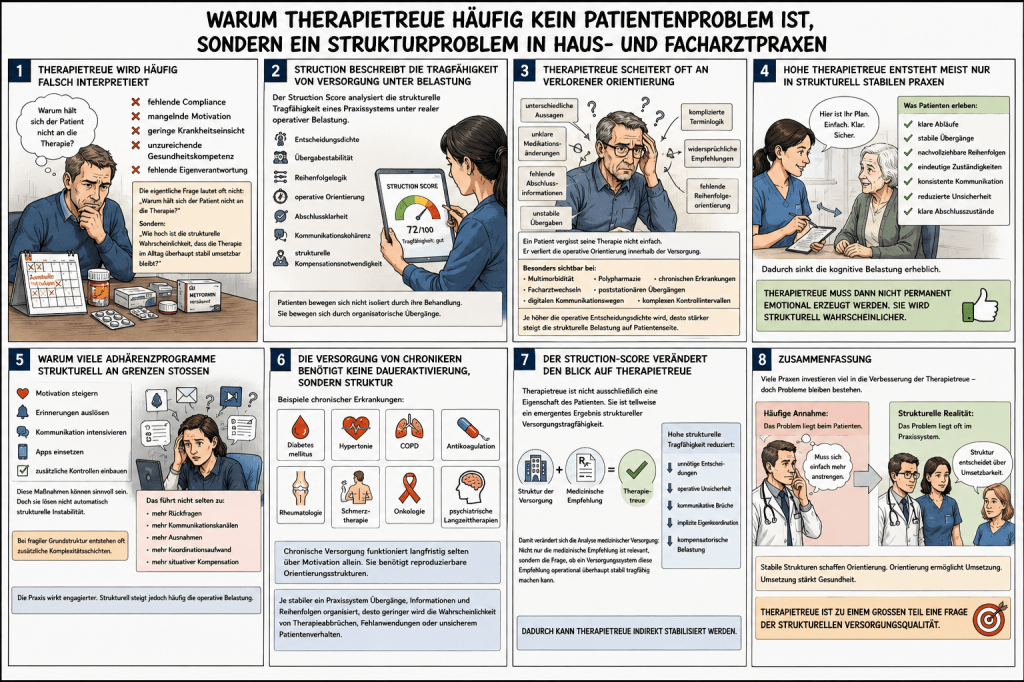
Steigende Personalkosten werden häufig als Personalproblem interpretiert. Tatsächlich liegen die Ursachen oft in strukturellen Ineffizienzen der Praxisorganisation. Der Beitrag zeigt, wie Struction Diagnostics diese versteckten Belastungen sichtbar macht und warum die Struktur einer Praxis häufig stärker über die Wirtschaftlichkeit entscheidet als die Anzahl der Mitarbeitenden.
Diese Rekonstruktion untersucht den Zusammenhang zwischen Medizintechnik, Effizienz im Gesundheitswesen, Entscheidungsdichte, Prozessarchitektur, struktureller Stabilität, klinischen Abläufen, digitalen Gesundheitssystemen, Organisationsdesign und kognitiver Belastung in Hausarzt- und Facharztpraxen.
Im Mittelpunkt steht ein Muster, das sich in den ersten Jahrzehnten des 21. Jahrhunderts immer wieder beobachten ließ: die weit verbreitete Annahme, technischer Fortschritt führe automatisch zu höherer Effizienz. Spätere Strukturanalysen zeigten jedoch, dass viele Organisationen durch neue Technologien zwar leistungsfähiger wurden, aber nicht zwangsläufig effizienter. Der entscheidende Faktor war weder die Technologie selbst noch die Menge verfügbarer Informationen, sondern die Struktur, innerhalb derer Entscheidungen verarbeitet und koordiniert wurden.
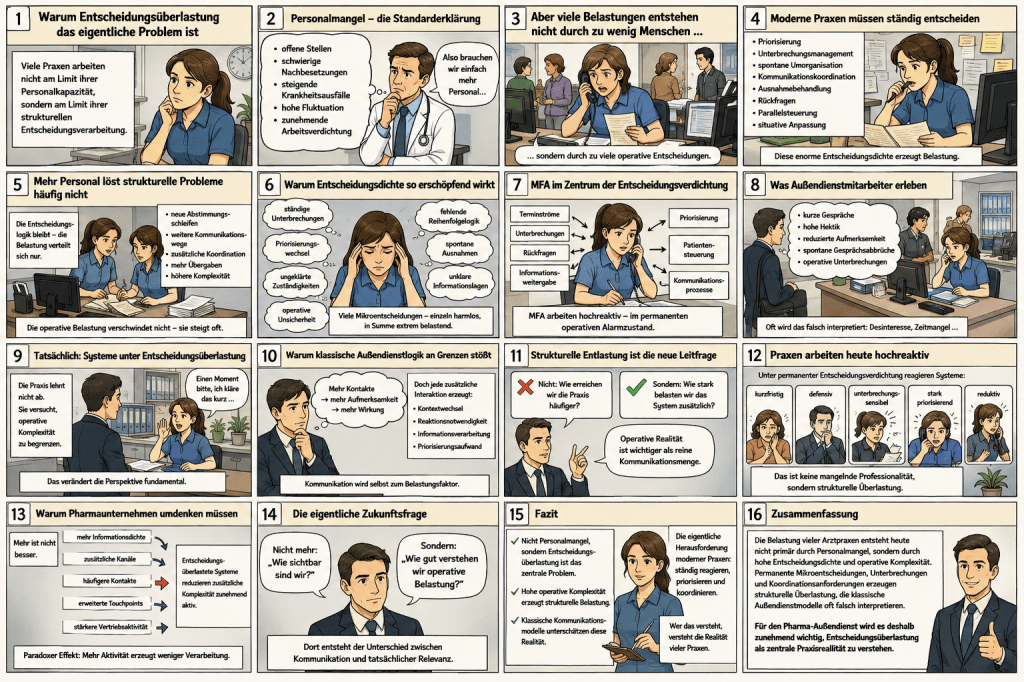
Dieser Fachbeitrag analysiert, warum die klassische Logik hoher Besuchsfrequenzen im Pharma-Außendienst zunehmend an Wirkung verliert. Im Fokus stehen die Zusammenhänge zwischen Praxisbelastung, Informationsdichte, Gesprächsqualität, struktureller Aufnahmefähigkeit und operativer Relevanz.
Der Beitrag zeigt, weshalb viele Arztpraxen unter hoher Entscheidungsdichte nicht primär mehr Kontakte benötigen, sondern relevantere Interaktionen — und warum sich die strategische Bedeutung des Außendienstes dadurch grundlegend verändert.
Dieser Fachbeitrag analysiert, warum klassische Produkt- und Gesprächskompetenz im Pharma-Außendienst allein zunehmend nicht mehr ausreicht. Im Fokus stehen die Zusammenhänge zwischen Praxisbelastung, struktureller Tragfähigkeit, Entscheidungsdichte, operativer Dynamik und Beobachtungskompetenz.
Der Beitrag zeigt, weshalb erfolgreiche Außendienstmitarbeiterinnen und -mitarbeiter künftig stärker erkennen müssen, wie Arztpraxen tatsächlich funktionieren — und warum die Fähigkeit zur strukturellen Beobachtung zu einer entscheidenden Form neuer Relevanz werden könnte.
Dieser Fachbeitrag analysiert, warum medizinische Fachangestellte (MFA) in vielen Haus- und Facharztpraxen zur eigentlichen strukturellen Stabilitätsreserve geworden sind. Im Fokus stehen die Zusammenhänge zwischen Praxisorganisation, Entscheidungsdichte, operativer Kompensation, Teamstabilität und struktureller Tragfähigkeit.
Der Beitrag zeigt, weshalb technologische Systeme allein keine stabile Praxisorganisation erzeugen und warum Pharma-Außendienstmitarbeiterinnen und -mitarbeiter die Rolle von MFA neu verstehen müssen, wenn sie operative Realität in Arztpraxen wirklich erfassen wollen.
Dieser Fachbeitrag analysiert, warum Gespräche zwischen Pharma-Außendienst und Arztpraxen zunehmend schwieriger werden — obwohl der Informationsbedarf im Gesundheitswesen kontinuierlich steigt. Im Fokus stehen die Zusammenhänge zwischen Praxisbelastung, Entscheidungsdichte, struktureller Tragfähigkeit, operativer Kompensation und Gesprächsaufnahmefähigkeit.
Der Beitrag zeigt, weshalb Zeitmangel in Haus- und Facharztpraxen häufig falsch interpretiert wird und warum viele Außendienststrategien die eigentliche Ursache sinkender Gesprächsqualität übersehen.