“I thought you were handling that.”
A sentence that sounds innocent—and yet exposes a silent crisis in leadership.
Continue reading “The Rethinking Leader: Delegation Without Accountability Isn’t Leadership”

Structural Reconstructions
“I thought you were handling that.”
A sentence that sounds innocent—and yet exposes a silent crisis in leadership.
Continue reading “The Rethinking Leader: Delegation Without Accountability Isn’t Leadership”

You don’t need better frameworks. You need a new mind in your old head.
You know the scene: the team gathers for the Monday meeting. You begin with a familiar refrain — “We need to work more efficiently.” Deadlines are tight. Resources stretched. “Let’s prioritise better, make decisions faster, and communicate more clearly.” Heads nod. Notes are taken. And yet—nothing changes. Instead of accelerating, your team spins in well-worn circles.
And — if you’re honest — so do you.
Continue reading “Preaching Efficiency. Practising Inefficiency”
„Control kills creativity – trust fuels transformation.“
Persistent misconceptions about the true nature of leadership continue to prevail. Many superiors still hold the belief that their primary role is to issue directives and ensure that employees “function” efficiently. They are convinced that strict hierarchies, close supervision and disciplinary measures are sufficient to forge a high-performing team. Some even assume that motivation can be engineered solely through financial incentives – or, conversely, that employees will automatically rise to excellence if granted enough freedom.
Continue reading “Rethinking: Why Leadership Without a Fundamental Reappraisal Is Doomed to Fail”
This Rethinking Impulse challenges the illusion of leadership competence, exposing how stagnant thinking fosters mediocre management and why radical rethinking is the only path to true leadership excellence.

„Are you truly a leader—or merely a custodian of outdated paradigms?“
The contemporary corporate leadership landscape is dominated by a perilous fallacy: the belief that leadership is an innate capability, one that naturally evolves with experience, hierarchical advancement, and positional authority. This assumption is not merely misguided; it is profoundly detrimental. It fosters a culture in which mediocrity is not recognised as a problem but passively accepted as the status quo.
„Adapt or become obsolete.“
The landscape of leadership is undergoing a profound transformation. Time-honoured strategies, conventional wisdom, and established methodologies are no longer sufficient to navigate a world characterised by relentless uncertainty, accelerating complexity, and disruptive innovation. You may already sense this shift: decisions are becoming more intricate, expectations ever more demanding, and what proved effective yesterday is rapidly losing relevance.
Continue reading “RethinkAbilities: The Defining Factor in Your Future as a Leader”
This Rethinking Impulse challenges leaders to rethink the essence of their professional purpose, dismantle common misconceptions about meaning at work, and embrace a dynamic approach to leadership that fosters resilience, clarity, and long-term impact.

„Leadership without purpose is direction without a destination.“
Have you ever reached the end of a taxing day, leaned back in contemplation, and quietly questioned: “Does any of this truly matter?” Often, leaders swiftly dismiss such uncomfortable reflections, driven by urgency, avoidance of inconvenient truths, or simply due to the relentless pace of daily routines. Yet, it is precisely this avoidance – driven by the demands of time, fear of discomfort, or the relentless grind – that perpetuates an existential unease at the core of many managerial roles.
Continue reading “Rethinking Your Professional Purpose: A Deeper Reflection for Leaders”
This Rethinking Impulse challenges the outdated perception of self-love in leadership, revealing it as a critical driver of emotional intelligence, decision-making clarity, and sustainable success.
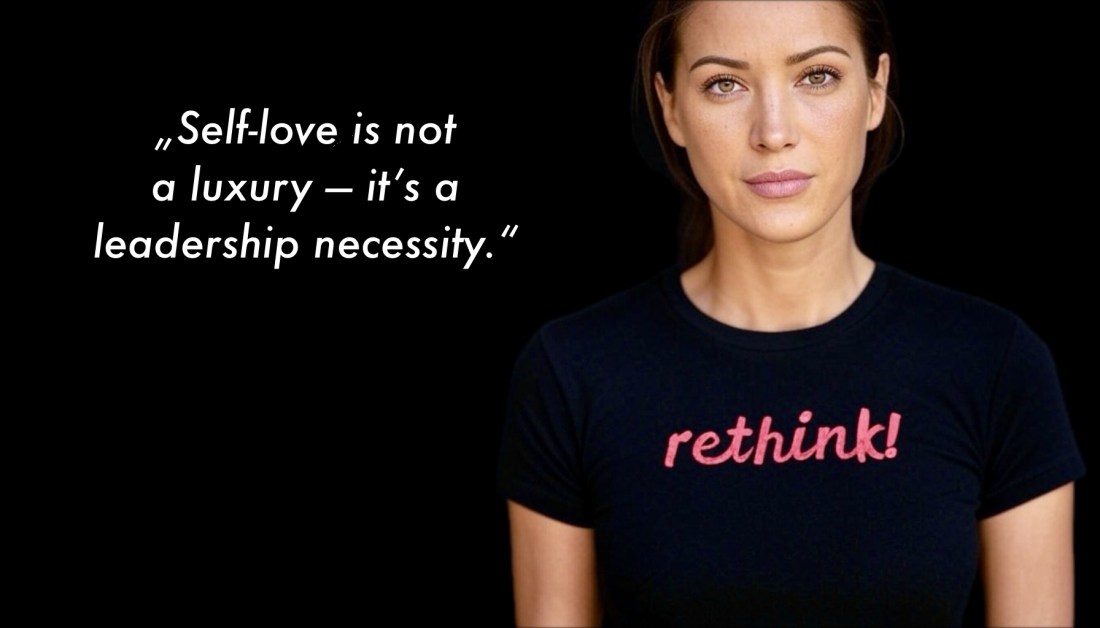
„The way you treat yourself shapes the way you lead others.“
Self-love remains a concept that is met with skepticism – if not outright rejection – within leadership circles. Decades of entrenched misconceptions have led many executives to equate it with egocentricity, self-indulgence, or even narcissism. The mere notion that a seasoned leader might align themselves with such an idea appears, at first glance, paradoxical.
Continue reading “Rethinking Self-Love: The Underestimated Leader Behind the Leader”

