Continue reading “The Everyday Lives That Worked Only Because Nothing Went Wrong”From 2049, one thing became clear: everyday life had become fragile long before anything actually failed.
Tag: self-organisation
The Small Decisions That Quietly Occupied the Day
Continue reading “The Small Decisions That Quietly Occupied the Day”They thought they were making many small decisions. From 2049, they were living in environments that kept demanding them.
The Everyday Systems That Could No Longer Absorb Reality · R2049
Continue reading “The Everyday Systems That Could No Longer Absorb Reality · R2049”The fragile systems of the 2020s were the ones in which nothing was allowed to fail.
Where Things Get Stuck on the Way to Where They Belong
Continue reading “Where Things Get Stuck on the Way to Where They Belong”Clutter often begins not where things belong, but somewhere on the way there.
When “Sometime” Becomes Urgent
Continue reading “When “Sometime” Becomes Urgent”Some things become urgent not because they are important, but because we never gave them a time.
When Compensation Starts to Feel Normal · R2049 Method
Some things cost us time every day, although we stopped noticing them as problems long ago.
Intro
This article explores how hidden compensation becomes embedded in everyday routines. Using ordinary examples from the home, digital life and personal organisation, it shows why small inefficiencies often remain unnoticed precisely because people adapt to them successfully. The article examines invisible friction, habitual workarounds, unnecessary process steps, structural compensation, routine behaviour and the practical value of observing everyday systems before trying to optimise them.
Continue reading “When Compensation Starts to Feel Normal · R2049 Method”Every Process Begins Somewhere: Struction.Everyday
Summary
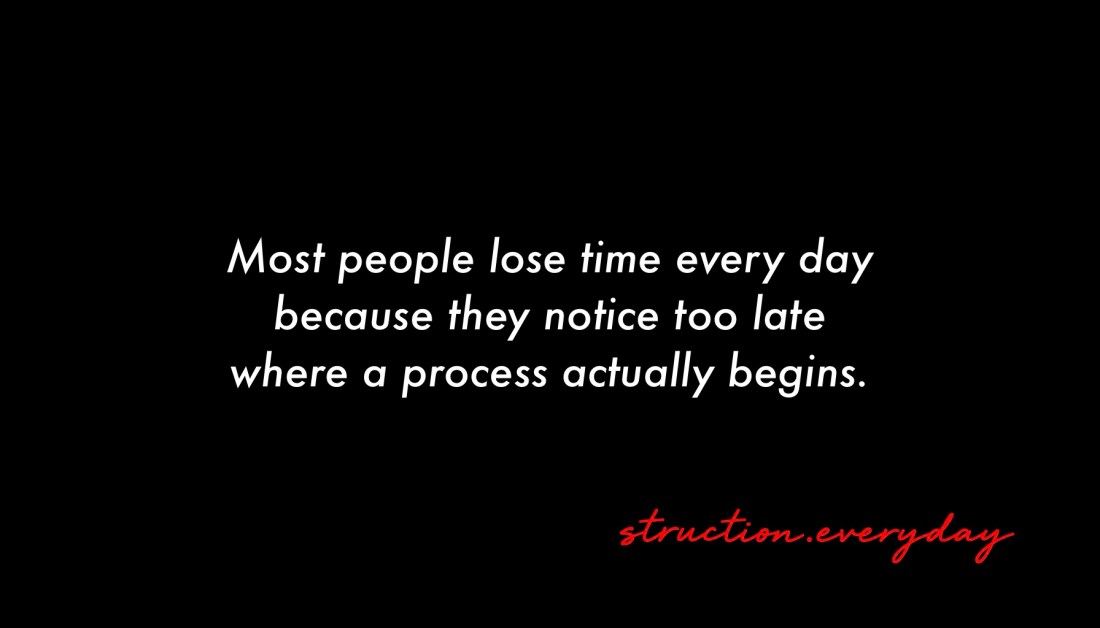
Most everyday problems appear to be unrelated events. In reality, they often share the same hidden structure. Many difficulties do not arise when we perform a task, but much earlier—at the moment when a new piece of information, a request, an obligation or an idea first enters our personal system. Once that entry has happened without structure, the resulting interruptions, misunderstandings and duplicated effort are often inevitable. Struction therefore begins neither with productivity techniques nor with better planning. It begins with learning to recognise where every process truly starts.
Continue reading “Every Process Begins Somewhere: Struction.Everyday”Why Everyday Overload Begins at the Point of Entry
Summary
Everyday overload is not caused solely by the number of tasks a person has to complete. It often begins much earlier, when messages, requests, ideas, appointments and obligations enter personal attention without a defined organisational point of entry. Each unstructured arrival opens a mental process before its relevance, urgency or required action has been determined.
Struction examines this overlooked beginning. It separates the arrival of a new matter from its later assessment and processing. By directing incoming information to a clear point of entry, people can reduce mental load, repeated deliberation, unnecessary context switching and duplicated effort. Personal organisation therefore does not begin with planning or prioritisation. It begins with the way a new process is received.
Continue reading “Why Everyday Overload Begins at the Point of Entry”“I Need to Organise Myself Better.” · R2049 · LifeStruct
Intro
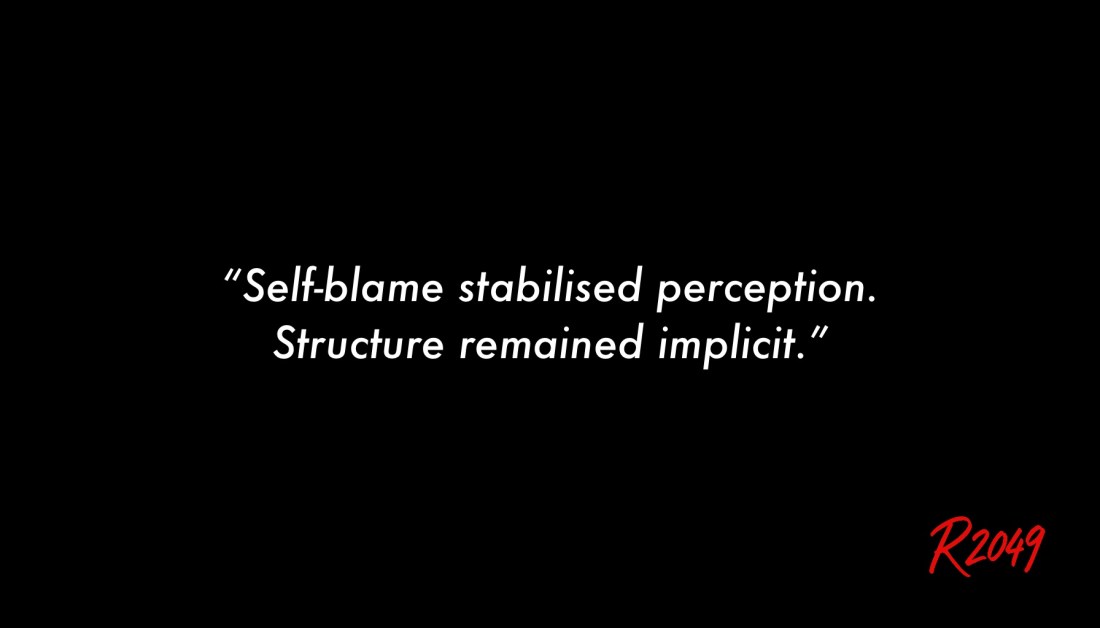
This LifeStruct reconstruction examines the common self-attribution “I need to organise myself better.”
It analyses how individual self-blame in everyday coordination often compresses structural opacity.
From the 2049 perspective, personal organisation was frequently a proxy for unarticulated decision architecture and implicit load distribution.