
Intro
This article explores how operational efficiency, organisational optimisation, structural resilience, leadership, organisational learning, cognitive flexibility, system thinking and strategic adaptation evolved between the 2020s and the late 2030s. From the perspective of the structural reconstructions of 2049, it explains why many organisations remained operationally successful while progressively losing their capacity to reinterpret reality. It introduces the concepts of Structural Deceleration of Insight and Efficiency-Induced Future Blindness as two defining structural mechanisms that fundamentally reshaped modern leadership theory.
Summary
Looking back from 2049, one of the greatest misconceptions of early twenty-first-century management becomes immediately apparent. Organisations were primarily evaluated by the stability of their operations rather than by the adaptability of their interpretations. Efficient processes, reliable execution and impressive performance indicators created the impression of organisational health, even while many institutions were gradually losing their ability to understand a rapidly changing environment.
The structural reconstructions conducted after the transformation crises of the 2030s revealed that operational excellence and long-term resilience were never synonymous. On the contrary, many of the most sophisticated organisations became prisoners of the very optimisation that had once made them successful. Their processes improved continuously, yet their capacity to question fundamental assumptions deteriorated at the same time.
Modern leadership architecture therefore abandoned the idea that efficiency alone could secure organisational survival. Instead, resilience came to be understood as the ability to revise one’s own interpretation of reality before external events made such revision unavoidable.
The Historical Reconstruction
From the perspective of 2049, historians no longer describe the organisational crises of the 2030s primarily as technological failures or strategic miscalculations. Instead, they are increasingly understood as structural phenomena. The decisive factor was not a lack of information, insufficient analytical capability or weak leadership. The decisive factor was that many organisations gradually lost the structural conditions necessary to reinterpret reality while they were still functioning successfully.
This conclusion surprised many early researchers because the affected organisations rarely exhibited obvious weaknesses. Financial performance often remained strong. Customers continued to be served. Internal processes became increasingly refined, and executive dashboards consistently reported positive developments. By every conventional management metric, these organisations appeared exceptionally well governed.
Only later did structural reconstruction reveal the paradox hidden beneath these impressive indicators. Operational performance had continued to improve while organisational learning had begun to slow. The systems became progressively more capable of reproducing established patterns, but progressively less capable of recognising when those patterns no longer reflected reality.
This distinction fundamentally transformed leadership research. Earlier management theories tended to regard operational effectiveness as evidence of organisational maturity. The reconstructions of 2049 demonstrated that the relationship was far more complex. A system may execute its existing logic with extraordinary precision while simultaneously losing the ability to determine whether that logic remains appropriate.
The collapse of many organisations therefore did not begin with visible dysfunction. It began with an unnoticed decline in interpretive adaptability that remained concealed behind operational excellence for many years.
The Cult of Operational Perfection
Throughout much of the early information economy, efficiency occupied an almost unquestionable position within management thinking. Regardless of industry or organisational size, success was increasingly associated with reducing friction, accelerating processes, lowering costs and improving predictability. Digital transformation, automation and integrated information systems reinforced this philosophy by demonstrating impressive gains in productivity and operational consistency.
These achievements were genuine. Organisations became faster than ever before. Supply chains were coordinated across continents, communication became instantaneous and increasingly sophisticated analytical systems supported managerial decision-making. Executive teams understandably concluded that further optimisation represented the safest path toward long-term competitiveness.
The structural reconstructions of 2049 do not dispute these accomplishments. They acknowledge that operational efficiency created enormous economic value and enabled remarkable advances across both public and private institutions. The historical misunderstanding lay elsewhere.
Gradually, efficiency ceased to function merely as one organisational capability among many. It evolved into the primary criterion through which organisational health itself was interpreted. Once this shift occurred, systems increasingly assumed that smoothly operating processes automatically reflected a healthy organisation. The distinction between operational functionality and structural adaptability slowly disappeared.
This subtle conceptual transition had profound consequences. Organisations no longer asked whether their underlying assumptions still reflected reality. Instead, they focused on executing those assumptions with ever greater precision. Optimisation became self-reinforcing. Every improvement validated the existing organisational model, making it progressively more difficult to imagine that the model itself might require revision.
From today’s perspective, this represented one of the defining structural characteristics of the pre-crisis decades. The organisations that appeared most successful were often those that had become exceptionally skilled at protecting their existing interpretation of reality. Every additional optimisation increased operational confidence while simultaneously reducing the incentive to question whether the organisation was still responding to the world as it actually existed.
For many years, this dynamic remained almost invisible because its immediate outcomes were overwhelmingly positive. Productivity increased, margins improved and operational stability appeared stronger than ever before. Yet beneath this surface of measurable success, a slower and far less visible process had already begun. The ability to reinterpret changing conditions was gradually being exchanged for the ability to reproduce existing certainty with increasing precision.
The leadership systems of 2049 now recognise this transition as one of the earliest structural warning signals preceding organisational decline. It marked the point at which operational perfection quietly began replacing adaptive intelligence as the dominant organising principle of many otherwise outstanding institutions.
Structural Blindness Hidden Behind Operational Excellence
One of the most important findings emerging from the structural reconstructions of 2049 is that organisations rarely become blind to reality through ignorance. Far more often, they become blind because their existing interpretation of reality continues to produce successful outcomes for longer than expected. As long as performance indicators remain positive, the system receives continuous confirmation that its assumptions are correct. Success itself gradually becomes evidence that no fundamental change is required.
This mechanism fundamentally altered how leadership scholars later understood organisational failure. Earlier management models often assumed that successful organisations possessed superior learning capabilities because they had access to better information, more experienced executives and more sophisticated analytical tools. Historical evidence increasingly demonstrated the opposite. The better a system became at executing its established logic, the more difficult it often became to question that logic itself.
Structural blindness therefore did not emerge as a cognitive limitation of individual leaders. It emerged as a property of the organisation. Decision-makers continued gathering information, conducting analyses and monitoring external developments, yet the organisation progressively interpreted new evidence through the framework of assumptions that had already produced previous success. Novel information was rarely rejected outright. Instead, it was absorbed into existing narratives until its disruptive implications gradually disappeared.
The reconstructions repeatedly identified this pattern across industries, public institutions and complex networks. Warning signals were frequently recognised long before organisational crises became visible. However, those signals were interpreted as temporary deviations, manageable exceptions or isolated events rather than indications that the underlying model itself required reconsideration.
For this reason, structural blindness cannot simply be described as an absence of knowledge. It represents a condition in which organisations continue expanding their knowledge while simultaneously narrowing the range of interpretations that remain institutionally acceptable. The system still observes reality, but it increasingly loses the ability to allow reality to transform its own internal logic.
Structural Deceleration of Insight
One concept became particularly influential in the post-crisis leadership literature of the 2040s: Structural Deceleration of Insight. The term describes the gradual slowing of an organisation’s capacity to translate observations into genuine reinterpretation of its own assumptions.
The significance of this concept lies in the distinction between collecting information and allowing information to change organisational behaviour. Earlier management frameworks tended to treat these activities as closely connected. The structural reconstructions demonstrated that they often evolve independently. Organisations may continuously improve their analytical capabilities while simultaneously becoming progressively slower in modifying the assumptions that guide strategic decisions.
This phenomenon remained largely invisible because operational performance continued to reinforce institutional confidence. Customers were served, projects were completed, financial targets were achieved and internal coordination remained highly efficient. From the outside, these organisations appeared remarkably stable. Internally, however, a different process was unfolding. Each successful execution of existing routines made those routines appear increasingly unquestionable.
The consequence was not intellectual stagnation but interpretive inertia. Organisations continued generating reports, conducting market analyses and evaluating strategic scenarios, yet fewer of these insights resulted in meaningful structural adaptation. New knowledge enriched existing frameworks instead of challenging them.
The reconstructions therefore distinguish between informational maturity and interpretive maturity. Informational maturity reflects the ability to gather, process and distribute knowledge throughout the organisation. Interpretive maturity reflects something fundamentally different: the willingness to accept that newly acquired knowledge may invalidate assumptions which previously appeared entirely reasonable.
This distinction transformed modern leadership architecture because it shifted attention away from the quantity of information towards the velocity of organisational reinterpretation. Resilient systems no longer ask primarily whether information is available. They ask how quickly established assumptions can be revised when reality begins to contradict them.
The Psychology of Functional Success
One of the more surprising conclusions reached during the historical reconstructions concerns the role of leadership itself. Contrary to many earlier explanations, organisational decline was rarely driven by incompetent executives. In numerous cases, leadership teams were exceptionally capable. They possessed considerable professional experience, analytical expertise and operational discipline. Many had successfully guided their organisations through periods of remarkable growth and increasing complexity.
The difficulty arose because these leaders operated within systems that consistently rewarded stability, predictability and flawless execution. Every successful quarter strengthened confidence in existing strategic assumptions. Every operational improvement confirmed that the organisation was moving in the right direction. Under such conditions, questioning fundamental assumptions increasingly appeared unnecessary and, in some cases, even irresponsible.
This produced an important psychological effect that later became central to organisational systems theory. Functional success creates emotional reassurance. The longer an organisation experiences uninterrupted operational performance, the more deeply its existing interpretation of reality becomes associated with competence, professionalism and responsible leadership. Challenging those interpretations therefore begins to feel less like prudent reflection and more like introducing avoidable instability.
As a consequence, organisations developed subtle mechanisms for reducing interpretive discomfort without consciously suppressing evidence. Critical information was contextualised, uncertainties were statistically moderated and contradictory developments were reframed as temporary fluctuations. None of these responses necessarily reflected deliberate manipulation. They emerged naturally from systems whose primary objective had become the preservation of operational continuity.
The structural reconstructions repeatedly demonstrate that this process was largely unconscious. Organisations did not intentionally ignore reality. Rather, they became increasingly effective at integrating disturbing information into familiar explanatory frameworks. The greater their operational sophistication became, the greater their capacity to neutralise the disruptive implications of new evidence.
This insight fundamentally changed later leadership education. Instead of assuming that effective organisations naturally become better learners, leadership theory began recognising that successful systems require explicit structural mechanisms capable of protecting contradiction, institutionalising critical reflection and preserving the legitimacy of uncomfortable questions. Without such mechanisms, operational excellence itself gradually becomes one of the strongest forces limiting organisational renewal.
By the late 2040s, this principle had become widely accepted. The quality of leadership was no longer measured primarily by its ability to maintain stability under favourable conditions. It was increasingly measured by its willingness to disturb stability before external reality made disruption unavoidable.
Efficiency-Induced Future Blindness
As the structural reconstructions progressed throughout the 2040s, researchers recognised that Structural Deceleration of Insight explained only part of the organisational failures observed during the previous decades. A second mechanism gradually emerged that described what happened after interpretive capacity had already begun to decline. This phenomenon later became known as Efficiency-Induced Future Blindness.
The concept describes a condition in which organisations become increasingly capable of preserving their present while simultaneously becoming progressively less capable of recognising their future. Contrary to earlier assumptions, this blindness was not caused by insufficient market intelligence or technological ignorance. In most cases, organisations possessed abundant information about emerging developments. They monitored competitors, analysed customer behaviour, observed technological innovation and commissioned extensive strategic studies.
Yet possession of information did not automatically generate structural consequences.
Between observation and adaptation existed an often invisible organisational barrier. Every highly optimised system had developed internal mechanisms designed to preserve reliability, predictability and operational continuity. These mechanisms had originally evolved for good reasons. They protected organisations against unnecessary volatility and prevented constant strategic oscillation. Over time, however, the same mechanisms increasingly filtered out signals that challenged the assumptions upon which operational success depended.
This explains why many organisations appeared extraordinarily well informed while reacting remarkably slowly to profound environmental change. Their difficulty was not recognising individual trends. Their difficulty was accepting that those trends required abandoning interpretive models that had previously produced decades of success.
The structural reconstructions therefore rejected the widespread belief that organisations primarily defend their mistakes. In reality, they defend something far more powerful: they defend the functional logic that has repeatedly rewarded them in the past. As long as this logic continues producing acceptable operational results, questioning it appears irrational from within the system itself.
Future blindness consequently emerges not through ignorance but through excessive confidence in yesterday’s successful interpretation of reality.
From Operational Excellence to Interpretive Agility
One of the defining transformations of leadership architecture after the crises of the 2030s was the gradual replacement of operational excellence as the highest organisational aspiration. Efficiency remained essential, but it was no longer regarded as the ultimate indicator of institutional maturity. Instead, leadership theory increasingly focused on a different capability: Interpretive Agility.
Interpretive agility refers to the capacity of an organisation to revise its own understanding of reality before external events impose that revision through crisis. Unlike operational flexibility, which concerns the execution of decisions, interpretive agility concerns the continuous examination of the assumptions from which those decisions originate.
This distinction fundamentally reshaped organisational design. Earlier systems invested heavily in optimising processes, reducing variance and standardising execution. The emerging leadership models of the 2040s continued to value these capabilities but regarded them as insufficient on their own. Every efficient process rests upon a particular interpretation of reality. If that interpretation becomes obsolete, further optimisation merely accelerates movement in the wrong direction.
The most resilient organisations therefore developed structures specifically intended to preserve interpretive diversity. Constructive disagreement became an institutional resource rather than a sign of dysfunction. Internal contradiction was no longer interpreted as evidence of weak leadership but as a necessary mechanism for maintaining organisational contact with changing reality.
This shift represented one of the most significant conceptual departures from classical management thinking. Stability was no longer achieved by eliminating uncertainty wherever possible. Instead, stability increasingly depended upon ensuring that uncertainty could enter the organisation early enough to stimulate timely reinterpretation.
Leadership itself consequently acquired a different purpose. Executives were expected not only to coordinate execution but also to protect the organisation from the seductive certainty created by its own operational success. The most valuable leaders were therefore not those who possessed the greatest confidence, but those capable of recognising when confidence itself had become structurally dangerous.
Stability Through Continuous Self-Correction
Perhaps no concept better illustrates the transformation of organisational thinking than the changing understanding of stability itself. Throughout much of the twentieth and early twenty-first centuries, stability was commonly associated with consistency, predictability and minimal deviation. Organisations sought to reduce uncertainty by improving control, standardising procedures and limiting operational variability.
The structural reconstructions of 2049 demonstrated that this understanding was incomplete.
Systems capable of maintaining perfect operational consistency often became increasingly fragile because they gradually lost the capacity to revise themselves while conditions remained favourable. Their apparent stability depended upon preserving assumptions that had once been valid but were becoming progressively detached from external reality.
The new leadership architecture therefore defined stability in fundamentally different terms. Stable organisations were no longer those experiencing the fewest disturbances. They were those capable of correcting their own interpretation before disturbances escalated into crises.
This subtle conceptual shift profoundly influenced organisational governance. Instead of attempting to eliminate every source of friction, resilient institutions deliberately preserved mechanisms that generated productive irritation. Contradictory perspectives, minority opinions and unexpected observations were no longer regarded as obstacles to efficient management. They became essential components of organisational health because they prevented interpretive rigidity from developing unnoticed.
Consequently, continuous self-correction replaced permanent control as the primary source of long-term resilience. The objective was not to create organisations that never deviated from their plans, but organisations capable of recognising when the plan itself required revision.
This principle also transformed the understanding of organisational confidence. Earlier leadership cultures frequently equated certainty with competence. The post-crisis models recognised that certainty becomes increasingly dangerous when it is disconnected from ongoing reinterpretation. Confidence remained valuable only when accompanied by an institutional willingness to reconsider even deeply established assumptions.
By the late 2040s, resilient organisations therefore measured not only productivity, profitability or operational precision. They increasingly evaluated the speed with which the organisation could recognise obsolete interpretations, abandon previously successful models and construct more accurate explanations before external events rendered such adaptation unavoidable.
In retrospect, historians concluded that sustainable stability had never depended primarily upon flawless execution. It had always depended upon the capacity for disciplined, continuous and institutionally protected self-correction.
Why the Most Resilient Systems Often Appeared Less Perfect
One of the more counterintuitive findings of the structural reconstructions concerned the outward appearance of resilient organisations. Contrary to the dominant assumptions of the early information economy, the healthiest systems were rarely those that appeared the most polished. They often seemed slower to reach consensus, more willing to expose internal disagreement and noticeably less concerned with projecting an image of permanent certainty.
To contemporary observers of the 2020s and 2030s, such characteristics could easily be interpreted as organisational weakness. Management culture had become deeply influenced by ideals of flawless execution, strategic confidence and operational consistency. Visible disagreement was frequently regarded as a sign of ineffective leadership, while uncertainty was often interpreted as insufficient preparation.
The reconstructions of 2049 reached a fundamentally different conclusion.
The organisations that proved most resilient deliberately preserved conditions under which uncomfortable observations could remain visible. They resisted the temptation to translate every contradiction immediately into consensus. Instead, they accepted temporary ambiguity as a necessary condition for long-term adaptation.
This represented far more than a cultural preference. It became a structural capability.
Resilient organisations institutionalised productive irritation. They ensured that contradictory evidence could move across organisational boundaries without being neutralised by hierarchy, routine or excessive confidence. Leadership no longer sought to eliminate every inconsistency as quickly as possible. Rather, it distinguished carefully between operational inconsistency, which required correction, and interpretive inconsistency, which often represented the earliest signal that reality itself was changing.
As a consequence, these organisations frequently appeared less elegant than their highly optimised counterparts. Decision processes sometimes lasted longer. Strategic discussions remained open for extended periods. Internal debate was more visible. Yet beneath this seemingly imperfect surface lay a system capable of renewing itself continuously without waiting for external crises to force adaptation.
History would ultimately demonstrate that this apparent imperfection represented one of the highest forms of organisational maturity.
The Structural Legacy of the 2030s
Looking back from 2049, the crises of the 2030s are no longer understood primarily as technological disruptions, economic shocks or failures of individual leadership. These factors undoubtedly influenced events, but they do not adequately explain why organisations with similar resources often experienced dramatically different outcomes.
The decisive difference proved to be structural.
Some organisations interpreted efficiency as the final objective of management. Others treated efficiency as one capability among many, recognising that every operational model rests upon assumptions that inevitably require revision over time.
Those organisations that survived most successfully developed institutional mechanisms capable of challenging their own certainty before external events challenged it for them. They did not become resilient because they possessed better forecasts or more sophisticated analytical systems. They became resilient because they continuously examined the relationship between what they believed and what reality increasingly revealed.
This insight permanently altered the architecture of leadership.
Organisations no longer measured excellence solely through operational performance. They also assessed the health of the structures through which assumptions were questioned, contradictions were preserved and strategic interpretations evolved.
In retrospect, one lesson emerged with remarkable consistency across industries, governments, healthcare systems and educational institutions. Systems rarely failed because they stopped working. They failed because they continued working extraordinarily well long after the assumptions that guided their operation had ceased to reflect reality.
Conclusion
The structural reconstructions of 2049 fundamentally redefined the relationship between efficiency and resilience. Earlier management theories largely assumed that increasingly efficient organisations would naturally become more adaptive. Historical evidence demonstrated that the relationship was considerably more complex.
Efficiency undoubtedly strengthens execution. It improves coordination, reduces unnecessary friction and enables organisations to operate with impressive precision. Yet efficiency alone cannot guarantee future viability. When optimisation gradually becomes more important than reinterpretation, organisations begin protecting existing logic rather than examining whether that logic still corresponds to reality.
This distinction marked one of the great paradigm shifts in modern leadership theory.
Resilient organisations no longer pursue operational perfection as an end in itself. They seek to maintain the capacity for disciplined self-correction while operational performance remains strong. They understand that the greatest strategic advantage lies not in defending certainty, but in recognising the precise moment when certainty itself has become the greatest source of organisational risk.
For this reason, the leadership architecture of 2049 evaluates organisations using an additional structural question that earlier generations rarely considered:
How quickly is a system willing to question the assumptions that have made it successful?
The answer to that question ultimately proved to be a far more reliable predictor of long-term resilience than any measure of operational excellence alone.
Closing Aphorism
The organisations that disappeared were rarely the ones that stopped performing.
They were the ones that continued performing brilliantly after they had stopped learning.
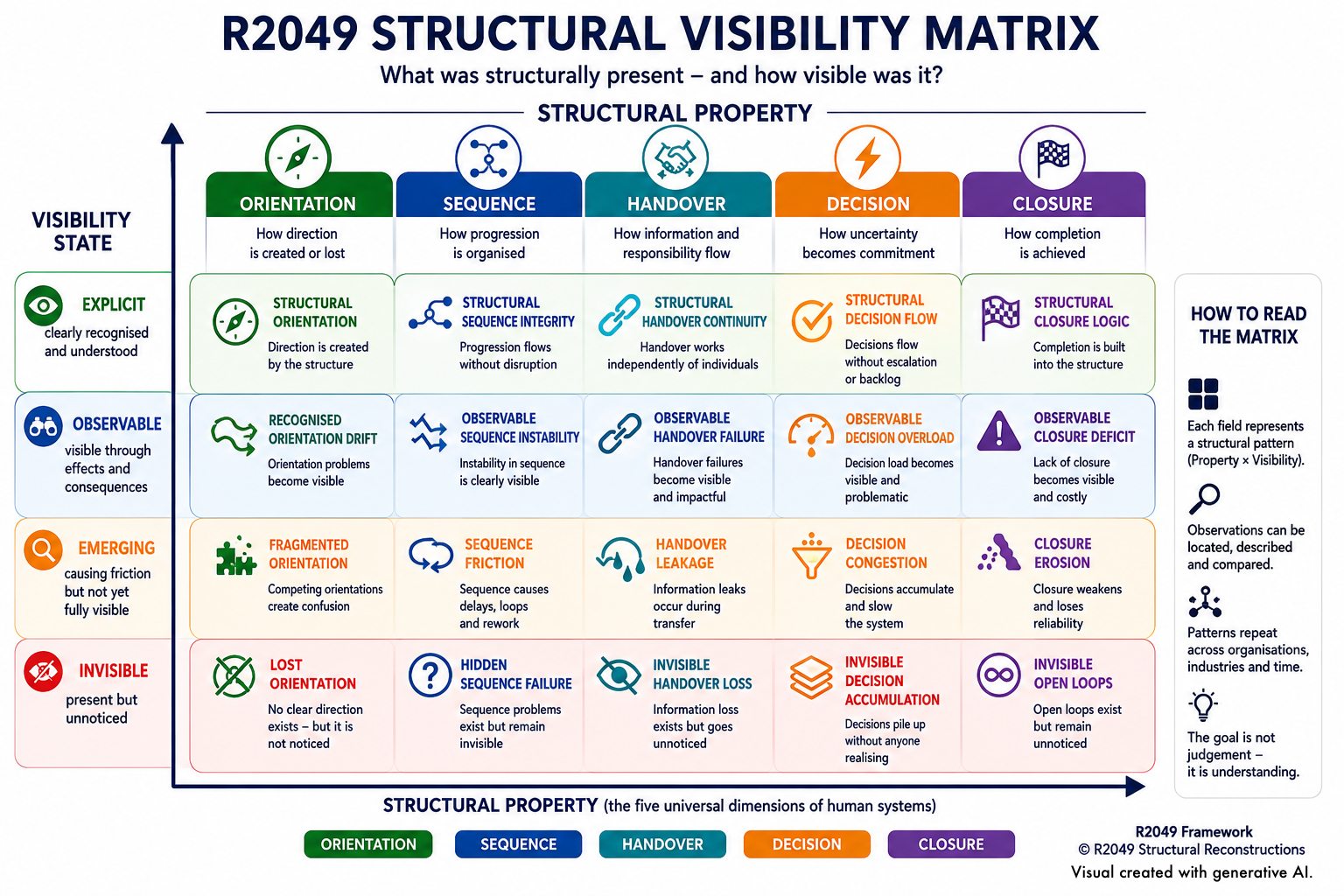
Matrix Classification
- Structural Property: Decision
- Visibility State: Invisible
- Matrix Position: Invisible Decision Accumulation
- Definition: Decisions continue to reinforce an increasingly outdated interpretation of reality. Existing strategic assumptions remain unchallenged while unnoticed decision accumulation progressively reduces the organisation’s capacity to adapt.
Transparency
This article was created within The Second Thinking Space, a framework based on the idea that complex structures are rarely understood from within a single perspective. Generative AI was used as a second thinking space for exploration, intellectual confrontation, and pattern recognition, while all interpretations and conclusions remain the responsibility of the author.

