
Intro
This structural reconstruction examines how organisational rigidity, institutional inertia, leadership, organisational resilience, systems thinking, adaptive organisations, organisational intelligence, strategic adaptation, governance and structural transformation evolved during the transformation era of the 2020s and 2030s. Rather than interpreting organisational stability as evidence of long-term strength, this reconstruction analyses how sustained success gradually reduced an organisation’s ability to recognise its own rigidity. Looking back from 2049, this recurring mechanism became known as the Structural Sedation Principle, one of the foundational explanatory laws within the emerging science of Structural Reconstructions.
Structural Diagnosis
Structural Visibility Matrix Classification
- Structural Property: Orientation
- Visibility State: Emerging
- Matrix Position: Fragmented Orientation
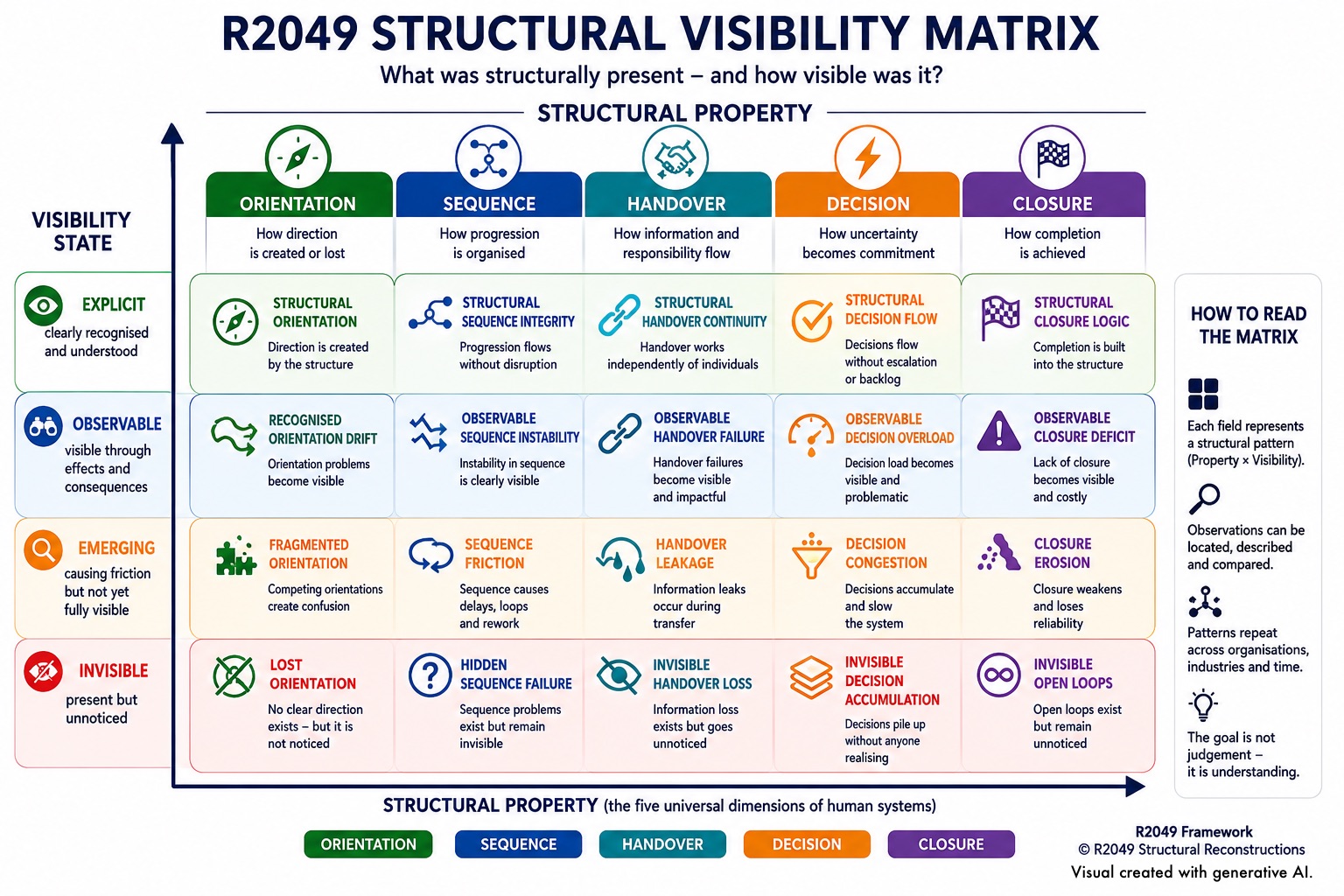
This reconstruction belongs to the Emerging × Orientation field of the R2049 Structural Visibility Matrix.
The organisations reconstructed by the Leadership Archives had not yet lost their direction. They had lost something more subtle: the ability to distinguish between yesterday’s successful orientation and tomorrow’s emerging reality. Existing assumptions continued to guide decisions long after environmental conditions had changed, creating increasing friction between organisational perception and external developments.
The resulting weakness did not originate in poor leadership or a lack of innovation initiatives. It originated in the gradual fragmentation of organisational orientation. Familiar mental models continued to coexist with a changing environment until they no longer provided reliable guidance.
The danger was never stability itself.
The danger was allowing stability to replace adaptation.
Structural Reconstruction
Looking back from 2049, the contradiction initially appeared difficult to explain. Why would highly successful organisations become vulnerable precisely because they had been successful for so long? Throughout the early decades of the century, growth was interpreted as strength, efficiency as maturity, standardisation as professionalism and stability as evidence of leadership excellence. Few questioned these assumptions because they had repeatedly produced positive results.
The Leadership Archives later reconstructed a deeper structural mechanism. Organisations do not merely develop competencies. They also develop habits. Every repeatedly successful structure gradually strengthens the cognitive models that produced its previous achievements. Without deliberate reconstruction, those models slowly evolve from practical solutions into unquestioned truths. Learning gives way to repetition, and adaptation quietly becomes increasingly difficult.
The archives repeatedly observed that successful organisations rarely became rigid through arrogance alone. Instead, success produced cognitive stability. Existing interpretations required less and less justification because they had worked before. Alternative perspectives therefore appeared increasingly unnecessary. The organisation remained operationally effective while its ability to reinterpret reality steadily weakened.
Interestingly, major crises rarely caused the initial loss of adaptability. Crises create urgency. They mobilise attention, challenge assumptions and force organisations to reconsider established routines. Long periods of operational success produce the opposite effect. Stable processes, predictable meetings, reliable dashboards and acceptable financial performance create the impression that fundamental change is unnecessary. It is precisely under these conditions that structural rigidity begins to develop.
The Leadership Archives later described this condition as operational vitality combined with strategic immobility. Externally, the organisation continues to perform successfully. Internally, however, it gradually loses its capacity to generate genuinely new interpretations of reality. The system remains active without continuing to evolve.
Another important mechanism emerged through the growing professionalisation of organisational control. Standardisation reduced errors, governance increased predictability and documentation improved operational reliability. These developments were valuable and often necessary. Yet they also produced an unintended consequence. The more organisations optimised themselves for predictable environments, the less capable they became of responding to genuinely unpredictable ones.
Optimisation and adaptability proved to be fundamentally different capabilities. Optimisation perfects existing patterns. Adaptability transforms them. Many organisations became exceptionally efficient while simultaneously becoming increasingly dependent upon the continuation of familiar conditions. Stability was strengthened, but resilience quietly weakened.
The archives also documented why transformation proved so difficult inside highly successful institutions. Almost every organisation publicly celebrated innovation, yet existing power structures naturally stabilised the rules that had originally legitimised them. Leaders rarely achieved authority by questioning the organisational logic that rewarded their own success. Consequently, those possessing the greatest decision-making power often possessed the weakest structural incentives for profound change.
This contradiction did not arise from bad intentions. It emerged from systemic self-preservation. Every significant transformation threatens established forms of legitimacy. New realities require different competencies, different assumptions and often different leadership models. Organisations therefore became remarkably skilled at presenting transformation externally while preserving historical structures internally.
Large knowledge organisations demonstrated this phenomenon particularly clearly. They increasingly developed sophisticated cultures of social adaptation. Employees quickly learned which ideas advanced careers, which doubts remained acceptable and which questions gradually disappeared from serious discussion. Over time, friction itself became culturally undesirable.
The Leadership Archives later reconstructed this process as Cultural Smoothing. Productive disagreement gradually disappeared, not because disagreement had become impossible, but because harmony acquired greater institutional value than contradiction. Yet innovation rarely emerges from permanent agreement. It emerges where competing interpretations remain structurally possible.
Another misconception shaped the transformation era. Many organisations confused increasing speed with increasing adaptability. Decision cycles accelerated, communication intensified and information became permanently available. Yet acceleration did not necessarily deepen understanding. Reflection requires time, ambiguity demands patience and structural learning depends upon periods of deliberate observation. Organisations operating under continuous acceleration increasingly reacted instead of reconstructing.
A similar development occurred in the treatment of uncertainty. Earlier innovation cultures accepted unfinished ideas, incomplete hypotheses and experimental thinking as necessary stages of discovery. Highly professionalised organisations increasingly demanded immediate clarity, measurable strategies and fully developed solutions. The future, however, rarely arrives in finished form. It first appears fragmented, contradictory and uncertain. Organisations that lost their tolerance for uncertainty gradually lost their capacity to recognise emerging realities.
The most resilient organisations of the late 2040s therefore distinguished themselves in an unexpected way. Rather than merely strengthening stability, they deliberately created structures capable of challenging stability itself. Contradiction became institutionalised. Alternative interpretations were actively encouraged. Leaders were evaluated not only for maintaining reliable operations but also for exposing structural blind spots before they developed into strategic failures.
Some organisations introduced what later became known as Reality Sessions—regular meetings dedicated to a single question: Which reality are we currently ignoring because our existing assumptions have worked for too long? This simple practice fundamentally changed organisational behaviour. Doubt was no longer interpreted as weakness but as evidence of organisational intelligence.
The Leadership Archives later concluded that long-term resilience depends less upon preventing rigidity than upon recognising its earliest structural signals. Rigidity rarely begins during crisis. It begins during success. It develops when predictability replaces curiosity, harmony replaces productive tension and repeated success gradually eliminates the perceived need for reinterpretation.
The Structural Sedation Principle therefore describes one of the defining organisational mechanisms of the transformation era. Organisations rarely became incapable of change overnight. They gradually became less capable of recognising that change had already become necessary.
The renaissance of organisational leadership did not begin with new technologies or more sophisticated management methods. It began with the rediscovery of organisational wakefulness—the capacity to question successful assumptions before they quietly became structural limitations.
Closing Aphorism
Organisations rarely became rigid because they resisted change. They became rigid because they stopped noticing that they already had.
Summary
Comparative reconstructions conducted by the Leadership Archives revealed that organisational rigidity rarely emerged through deliberate resistance to change. Instead, it developed gradually as repeated success strengthened familiar interpretations and reduced the perceived need for adaptation. Stable processes continued to function while strategic flexibility quietly declined. The resulting condition did not initially produce crisis but increasing friction between organisational assumptions and external reality. This recurring mechanism later became known as the Structural Sedation Principle, explaining why many organisations recognised their own rigidity only after it had already become structurally embedded.
Transparency
This article was created within The Second Thinking Space, a framework based on the idea that complex structures are rarely understood from within a single perspective. Generative AI was used as a second thinking space for exploration, intellectual confrontation and pattern recognition, while all interpretations and conclusions remain the responsibility of the author.
 R2049
R2049 