When Organisations Began Mistaking Adaptation for Learning · R2049 · Structural Reconstructions of a Misread Present

Intro

This R2049 reconstruction examines organisational learning, adaptation, change management, systems thinking, organisational behaviour, structural diagnosis and institutional change during the 2020s and 2030s. It explores why organisations increasingly adapted to structural weaknesses instead of redesigning them, how workarounds became permanent operating models and why continuous change often concealed the absence of deeper organisational learning.

Continue reading “When Organisations Began Mistaking Adaptation for Learning · R2049 · Structural Reconstructions of a Misread Present”
The Kinetic Legitimacy Principle: Why Organisations Did Lose Their Future Because They Forgot How to Remain Still · R2049 · Structural Reconstructions

Intro

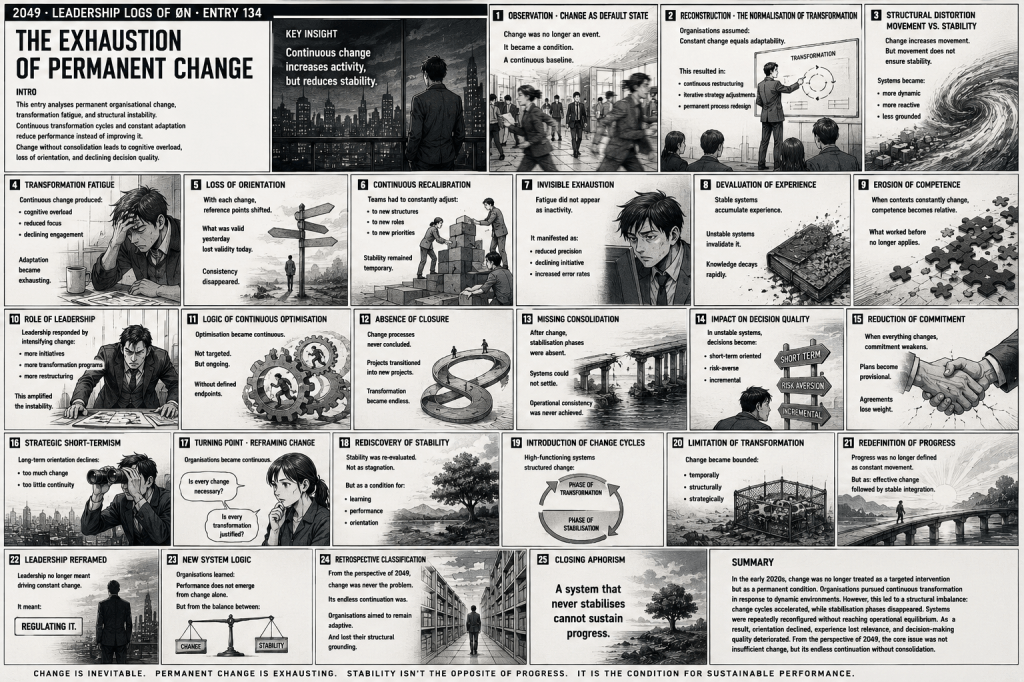
This structural reconstruction examines how operational acceleration, permanent transformation, organisational overstimulation, strategic impatience, leadership, organisational resilience, systems thinking, institutional concentration and adaptive organisations evolved during the transformation era of the 2020s and 2030s. Rather than interpreting continuous change as evidence of organisational vitality, this reconstruction analyses how constant movement gradually undermined structural coherence. Looking back from 2049, this recurring mechanism became known as the Kinetic Legitimacy Principle, one of the foundational explanatory laws within the emerging science of Structural Reconstructions.

Continue reading “The Kinetic Legitimacy Principle: Why Organisations Did Lose Their Future Because They Forgot How to Remain Still · R2049 · Structural Reconstructions”

The Structural Sedation Principle: Why Organisations Collapsed Because They Could No Longer Recognise Their Own Rigidity · R2049 · Structural Reconstructions

Intro

This structural reconstruction examines how organisational rigidity, institutional inertia, leadership, organisational resilience, systems thinking, adaptive organisations, organisational intelligence, strategic adaptation, governance and structural transformation evolved during the transformation era of the 2020s and 2030s. Rather than interpreting organisational stability as evidence of long-term strength, this reconstruction analyses how sustained success gradually reduced an organisation’s ability to recognise its own rigidity. Looking back from 2049, this recurring mechanism became known as the Structural Sedation Principle, one of the foundational explanatory laws within the emerging science of Structural Reconstructions.

Continue reading “The Structural Sedation Principle: Why Organisations Collapsed Because They Could No Longer Recognise Their Own Rigidity · R2049 · Structural Reconstructions”

“We’ve Always Done It This Way.” · R2049 · Structural Reconstructions

Intro

This structural reconstruction analyses the common organisational and social phrase “We’ve always done it this way.”

The article explores structural continuity, organisational routines, inherited processes, decision history, operational stability, institutional memory, behavioural persistence, path dependency, structural adaptation, and human systems. From a 2049 perspective, many established practices survived not because they remained effective, but because their original reasons were no longer visible.

Continue reading ““We’ve Always Done It This Way.” · R2049 · Structural Reconstructions”

Warum manche Haus- und Facharztpraxen an Veränderungen wachsen und andere daran scheitern

Warum Veränderung zur Normalität geworden ist

Die Vorstellung einer dauerhaft unveränderten Arztpraxis gehört zunehmend der Vergangenheit an. Haus- und Facharztpraxen befinden sich heute in einem Umfeld, das von kontinuierlichen Veränderungen geprägt ist. Neue gesetzliche Vorgaben, digitale Anwendungen, veränderte Patientenanforderungen, Fachkräftemangel und neue Versorgungsformen führen dazu, dass sich die Rahmenbedingungen nahezu permanent verändern.

Continue reading “Warum manche Haus- und Facharztpraxen an Veränderungen wachsen und andere daran scheitern”

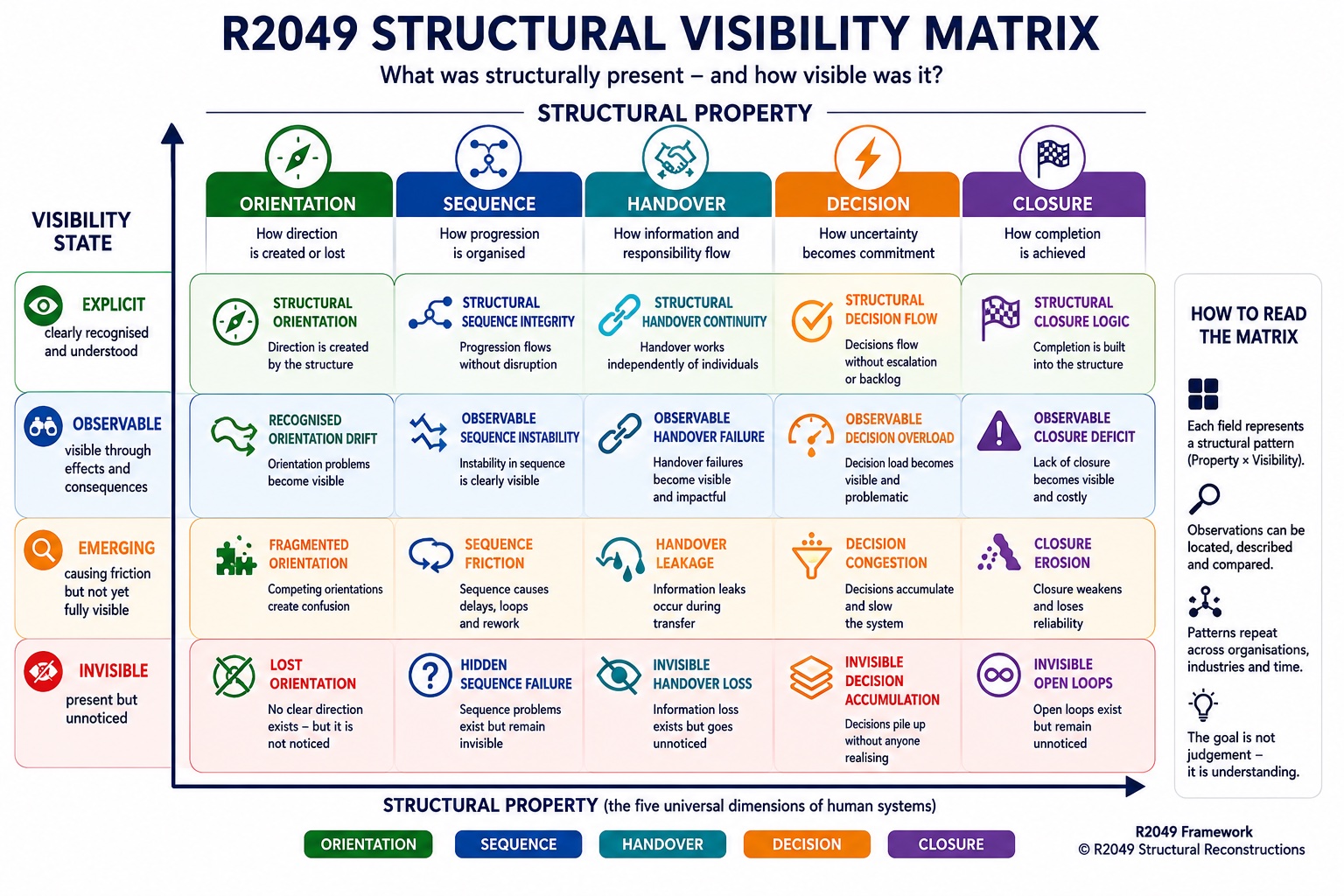
The R2049 Structural Visibility Matrix

A Guide to Reading Structural Reconstructions

Introduction

Most people observe outcomes:

  • A meeting failed.
  • A project stalled.
  • A team became overloaded.
  • A decision took too long.
  • A customer became frustrated.

These events appear visible. What often remains invisible are the structural conditions that produced them. This observation became one of the central themes of the R2049 archive.

Continue reading “The R2049 Structural Visibility Matrix”

🧠 Rethinka 2049 #13: Corporate Hamster — Wenn dein „Wandel“ nur Ausdauertraining ist

Rethinka 2049 zerlegt dein hamsterbetriebenes Theater des Scheinfortschritts: fünf wiederkehrende Schauspieler, die nur so tun, als würden sie entscheiden; Entscheidungen, die durch Moderation einbalsamiert werden; Hierarchien, als „agil“ zombifiziert; Logos, die als Wirkung angebetet werden; und Rituale der Stagnation, die sich als Innovation verkleiden.
Die Enddiagnose: Du entwickelst dich nicht weiter, du kreist um deine eigene Feigheit.
Die Verschreibung: Töte das Rad, reiße das Theater nieder, umarme den strukturellen Tod – oder renne dich selbst in die Auslöschung, während deine Mitarbeitenden gebrandete Kaffeebecher einsammeln.

👉 Zum Beitrag…

Rethinking Leadership: Morphage Management as the Key to the Future – A Comparison with Classical Change Management

The Rethinking Impulse as a RethinkAudio – Listen. Reflect. Analyze. Advance.

A Rethinking Impulse by Klaus-Dieter Thill

Morphage Management: A New Definition of Transformation

Morphage Management represents a profound, dynamic, and proactive approach to managing change. Unlike Change Management, which often views transformation as a finite project, Morphage Management perceives it as a continuous, organic, and frequently self-organising process. The term derives from “morphology,” the study of forms and structures, and underscores the fluid nature of change, which constantly adapts to new conditions and perspectives. At its core lies the principle that transformation does not solely depend on external stimuli but emerges from within – both on an individual and a collective level.

Continue reading “Rethinking Leadership: Morphage Management as the Key to the Future – A Comparison with Classical Change Management”