
Intro
This structural reconstruction examines how operational acceleration, permanent transformation, organisational overstimulation, strategic impatience, leadership, organisational resilience, systems thinking, institutional concentration and adaptive organisations evolved during the transformation era of the 2020s and 2030s. Rather than interpreting continuous change as evidence of organisational vitality, this reconstruction analyses how constant movement gradually undermined structural coherence. Looking back from 2049, this recurring mechanism became known as the Kinetic Legitimacy Principle, one of the foundational explanatory laws within the emerging science of Structural Reconstructions.
Structural Diagnosis
Structural Visibility Matrix Classification
- Structural Property: Sequence
- Visibility State: Emerging
- Matrix Position: Sequence Friction
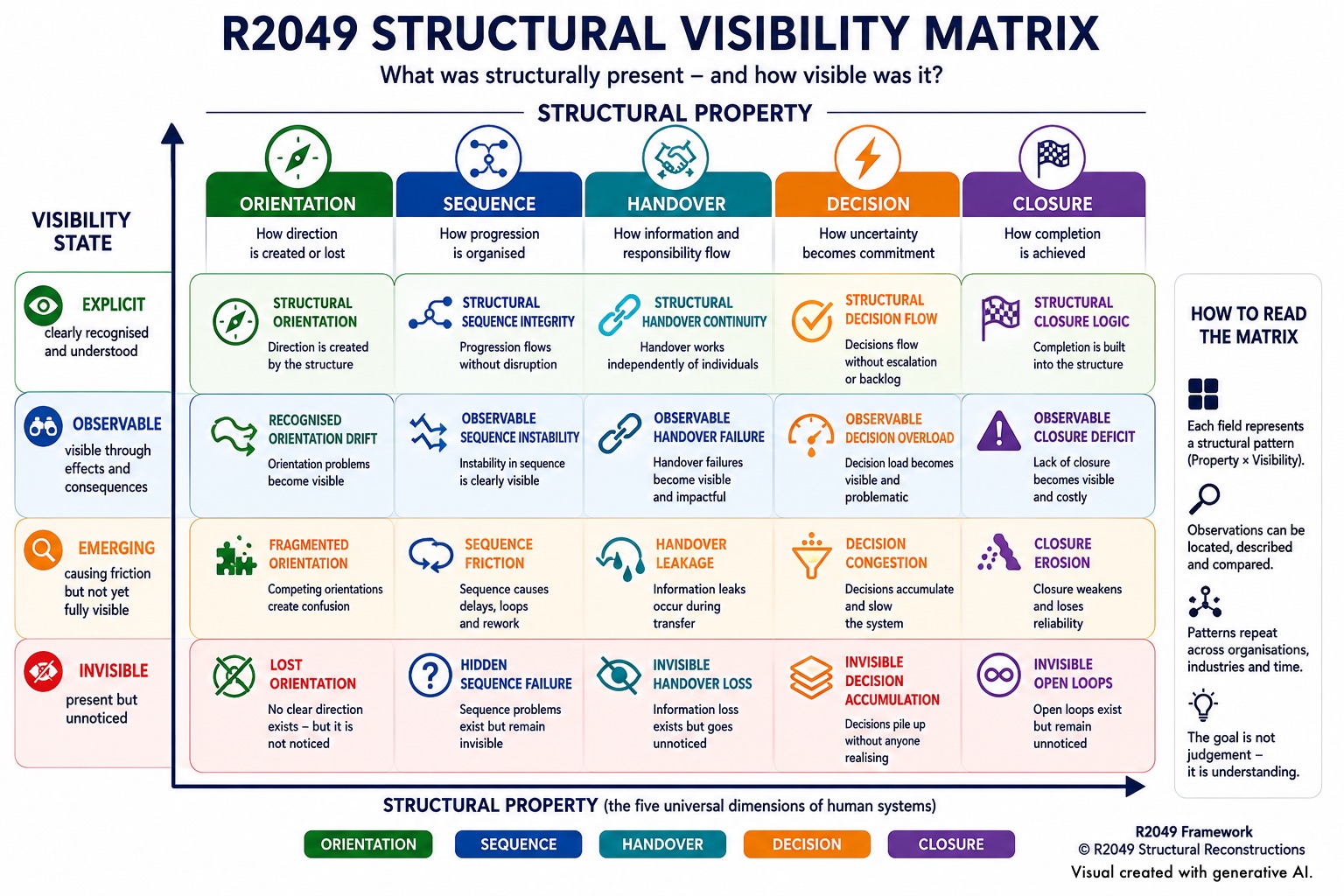
This reconstruction belongs to the Emerging × Sequence field of the R2049 Structural Visibility Matrix.
The organisations reconstructed by the Leadership Archives rarely suffered from too little activity. Instead, they experienced an increasing loss of structural sequence. Transformation initiatives accumulated faster than organisations could absorb them, creating growing friction between operational movement and institutional learning. Processes continued, projects multiplied and change programmes expanded, yet the organisation gradually lost the temporal coherence required for genuine adaptation.
The resulting weakness did not originate in resistance to change. It originated in the inability to distinguish meaningful transformation from permanent organisational motion. Sequence became fragmented by acceleration itself.
The danger was never movement.
The danger was movement without structural consolidation.
Structural Reconstruction
Looking back from 2049, one of the defining characteristics of organisational life during the 2020s and 2030s was the growing belief that visible movement itself demonstrated organisational health. Companies were expected to transform continuously, reorganise repeatedly, accelerate constantly and communicate permanent momentum. Stability increasingly appeared suspicious, while operational calm was interpreted as evidence of stagnation.
The Leadership Archives later reconstructed this cultural shift as the Kinetic Legitimacy Principle. Organisations gradually stopped changing because reality demanded transformation. They changed because continuous movement had become a symbol of competence. Activity no longer served structure. Structure increasingly served activity.
Digital markets rewarded visibility, leadership cultures rewarded responsiveness and strategic communication became dominated by the language of transformation. As a result, organisations slowly lost the ability to distinguish between necessary adaptation and self-reinforcing activity production. Motion itself acquired institutional legitimacy.
Comparative reconstructions revealed that many organisations eventually developed a form of operational self-stimulation. New strategic frameworks appeared before earlier initiatives had stabilised. Reporting architectures were replaced while employees were still adapting to previous systems. Collaboration platforms changed continuously, organisational priorities shifted repeatedly and restructuring programmes overlapped before earlier restructuring efforts had produced measurable learning.
From the outside these organisations appeared highly dynamic. Internally, however, structural coherence steadily declined. Leadership interpreted increasing activity as increasing adaptability, while the organisation itself became progressively more fragmented.
The archives reconstructed this condition not as individual leadership failure but as a structural overstimulation architecture. Organisations became emotionally dependent upon operational movement because movement itself generated the perception of relevance. The absence of new initiatives increasingly produced discomfort, even when existing structures required consolidation rather than further change.
One reconstruction from 2032 illustrates this mechanism particularly clearly. A leadership meeting opened while the organisation was simultaneously managing several transformation programmes, a recently introduced reporting architecture, new collaboration platforms, an unfinished restructuring process and an ongoing culture initiative. During the meeting another strategic initiative was launched. Nobody questioned whether the previous programmes had ever reached operational stability. Discussion focused entirely on maintaining momentum. Institutional consolidation never entered the conversation.
The archives later concluded that the organisation interpreted acceleration as progress because it had gradually forgotten the structural function of stillness.
Stable organisations require more than activity. They require periods during which learning, responsibility and institutional memory are allowed to stabilise. Throughout organisational history, genuine adaptation emerged through repetition, continuity and sustained observation. These conditions became increasingly rare inside permanently accelerating systems.
Instead, organisations entered continuous reprioritisation cycles. Employees remained busy, meetings remained full and dashboards displayed constant activity. Transformation metrics looked impressive. Yet beneath this visible productivity another process quietly unfolded. Collective concentration deteriorated. Organisations gradually lost the ability to observe patiently, retain institutional knowledge, preserve strategic continuity and process complexity over longer periods of time.
The Leadership Archives later described this condition as attentional fragmentation under acceleration pressure. Activity concealed disorientation. Busy organisations still appeared productive, even while their capacity for coherent collective thinking steadily declined.
One of the most significant long-term consequences involved what later became known as temporal compression. Leadership increasingly operated within ever shorter relevance cycles. Immediate signals displaced long-term observation. Short-term metrics replaced structural interpretation. Reflection appeared inefficient, waiting resembled indecision and deliberate restraint became culturally difficult to justify.
This fundamentally altered organisational behaviour. Systems became exceptionally effective at producing movement but progressively less capable of maintaining direction. They reacted rapidly to visible events while slowly losing sensitivity to gradual developments such as strategic drift, institutional exhaustion, cultural erosion and declining cognitive resilience.
The archives also reconstructed why so many knowledge workers experienced growing exhaustion despite apparently successful transformation programmes. Workload alone rarely explained their fatigue. The deeper cause lay in continuous reorientation. Every initiative introduced new expectations, new interfaces, new language, new priorities and new symbolic structures before previous adaptations had become cognitively stable.
This recurring mismatch between human stabilisation processes and organisational transformation velocity became known as structural desynchronisation. Employees were not primarily overwhelmed by work. They were overwhelmed by the absence of organisational continuity. Because adaptation itself had become culturally celebrated, this exhaustion remained difficult to communicate. Fatigue appeared resistant, scepticism appeared negative and requests for stability appeared insufficiently ambitious.
Consequently, leadership frequently interpreted adaptation fatigue as an individual problem rather than recognising its structural origin. The organisation continued accelerating while the cognitive foundations required to sustain that acceleration gradually weakened.
By the late 2040s, however, the most resilient organisations began reversing this pattern. They did not reject transformation. Instead, they deliberately protected operational stillness. Unnecessary initiatives were eliminated, simultaneous transformation programmes reduced, communication density simplified and artificial urgency questioned. Leadership no longer focused primarily on generating visible movement. It focused on preserving institutional concentration.
This represented a profound shift in organisational philosophy. Stability was no longer interpreted as resistance to change. It became recognised as the infrastructure that made meaningful change possible. Organisations rediscovered that learning requires temporal continuity, reflection requires protected attention and adaptation requires intervals during which new structures can become coherent before additional change begins.
The Leadership Archives concluded that the most adaptive organisations of the late 2040s were not the fastest. They were those capable of distinguishing productive movement from organisational noise. They understood that acceleration without consolidation inevitably fragments sequence and that fragmentation ultimately weakens every other structural capability.
The Kinetic Legitimacy Principle therefore describes one of the defining organisational mechanisms of the transformation era. Organisations did not lose their future because they transformed too slowly. They lost it because permanent transformation gradually destroyed the structural sequence through which genuine adaptation becomes possible.
The renaissance of organisational leadership therefore began not with greater speed, but with the rediscovery of operational stillness as a strategic capability.
Closing Aphorism
The strongest organisations were never the fastest.
They were the ones that knew when not to move.
Summary
Comparative reconstructions conducted by the Leadership Archives revealed that many organisations gradually confused continuous movement with genuine adaptability. Transformation programmes accumulated faster than institutions could consolidate learning, producing increasing Sequence Friction long before performance indicators reflected deeper structural instability. This recurring mechanism later became known as the Kinetic Legitimacy Principle, explaining why organisations often weakened not through insufficient change but through the permanent acceleration of change itself.
Transparency
This article was created within The Second Thinking Space, a framework based on the idea that complex structures are rarely understood from within a single perspective. Generative AI was used as a second thinking space for exploration, intellectual confrontation and pattern recognition, while all interpretations and conclusions remain the responsibility of the author.

