
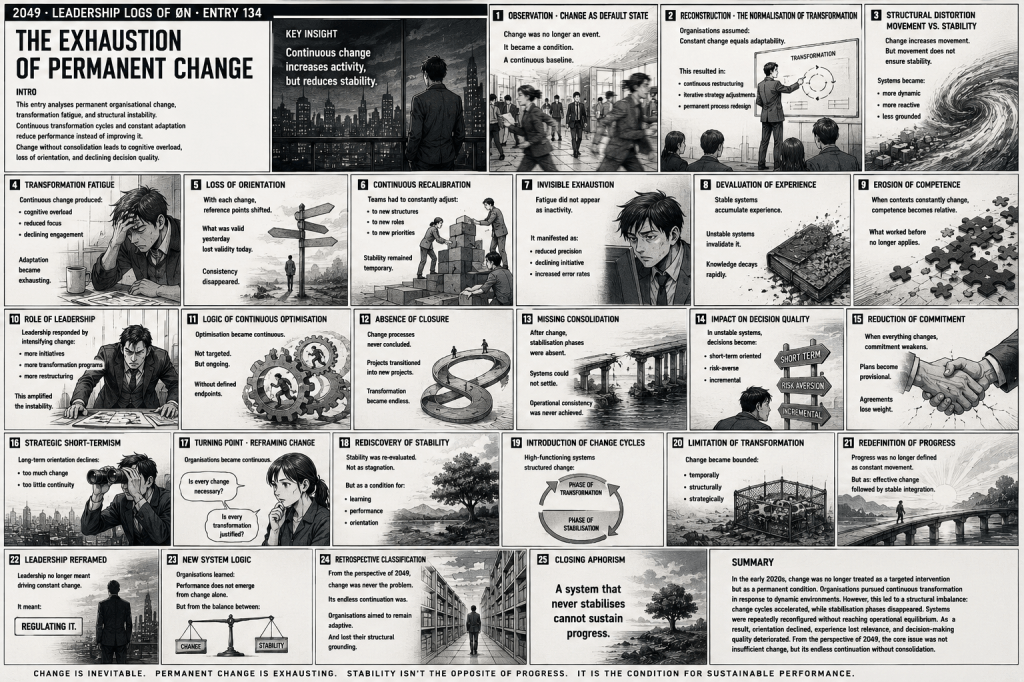
Intro
This entry analyses permanent organisational change, transformation fatigue, and structural instability, focusing on how continuous transformation cycles, iterative restructuring, and constant adaptation reduce performance instead of improving it. It explains why change without consolidation leads to cognitive overload, loss of orientation, and declining decision quality. Key concepts include transformation fatigue, organisational stability, change cycles, decision architecture, structural load, and system performance.
Key Insight
Continuous change increases activity, but reduces stability.
Observation · Change as Default State
Change was no longer an event.
It became a condition.
A continuous baseline.
Reconstruction · The Normalisation of Transformation
Organisations assumed:
Constant change equals adaptability.
This resulted in:
- continuous restructuring
- iterative strategy adjustments
- permanent process redesign
Structural Distortion · Movement vs. Stability
Change increases movement.
But movement does not ensure stability.
Systems became:
- more dynamic
- more reactive
- less grounded
Transformation Fatigue
Continuous change produced:
- cognitive overload
- reduced focus
- declining engagement
Adaptation became exhausting.
Loss of Orientation
With each change, reference points shifted.
What was valid yesterday
lost validity today.
Consistency disappeared.
Continuous Recalibration
Teams had to constantly adjust:
- to new structures
- to new roles
- to new priorities
Stability remained temporary.
Invisible Exhaustion
Fatigue did not appear as inactivity.
It manifested as:
- reduced precision
- declining initiative
- increased error rates
Devaluation of Experience
Stable systems accumulate experience.
Unstable systems invalidate it.
Knowledge decays rapidly.
Erosion of Competence
When contexts constantly change,
competence becomes relative.
What worked before
no longer applies.
Role of Leadership
Leadership responded by intensifying change:
- more initiatives
- more transformation programs
- more restructuring
This amplified the instability.
Logic of Continuous Optimisation
Optimisation became continuous.
Not targeted.
But ongoing.
Without defined endpoints.
Absence of Closure
Change processes never concluded.
Projects transitioned into new projects.
Transformation became endless.
Missing Consolidation
After change, stabilisation phases were absent.
Systems could not settle.
Operational consistency was never achieved.
Impact on Decision Quality
In unstable systems, decisions become:
- short-term oriented
- risk-averse
- incremental
Reduction of Commitment
When everything changes,
commitment weakens.
Plans become provisional.
Agreements lose weight.
Strategic Short-Termism
Long-term orientation declines:
- too much change
- too little continuity
Turning Point · Reframing Change
Organisations began to question:
Is every change necessary?
Is every transformation justified?
Rediscovery of Stability
Stability was re-evaluated.
Not as stagnation.
But as a condition for:
- learning
- performance
- orientation
Introduction of Change Cycles
High-functioning systems structured change:
- phases of transformation
- phases of stabilisation
Limitation of Transformation
Change became bounded:
- temporally
- structurally
- strategically
Redefinition of Progress
Progress was no longer defined as constant movement.
But as:
effective change followed by stable integration.
Leadership Reframed
Leadership no longer meant driving constant change.
It meant:
regulating it.
New System Logic
Organisations learned:
Performance does not emerge from change alone.
But from the balance between:
change and stability.
Retrospective Classification
From the perspective of 2049,
change was never the problem.
Its endless continuation was.
Organisations aimed to remain adaptive.
And lost their structural grounding.
Closing Aphorism
A system that never stabilises
cannot sustain progress.
Summary
In the early 2020s, change was no longer treated as a targeted intervention but as a permanent condition. Organisations pursued continuous transformation in response to dynamic environments. However, this led to a structural imbalance: change cycles accelerated, while stabilisation phases disappeared. Systems were repeatedly reconfigured without reaching operational equilibrium. As a result, orientation declined, experience lost relevance, and decision-making quality deteriorated. From the perspective of 2049, the core issue was not insufficient change, but its endless continuation without consolidation.

