
Intro
This structural reconstruction examines communication overload, meeting culture, permanent responsiveness, notification systems, organisational signalling and operational synchronisation during the 2020s and 2030s. It explores how excessive communication density reshaped decision-making, fragmented attention, weakened organisational focus and gradually replaced structural effectiveness with the continuous performance of visible activity.
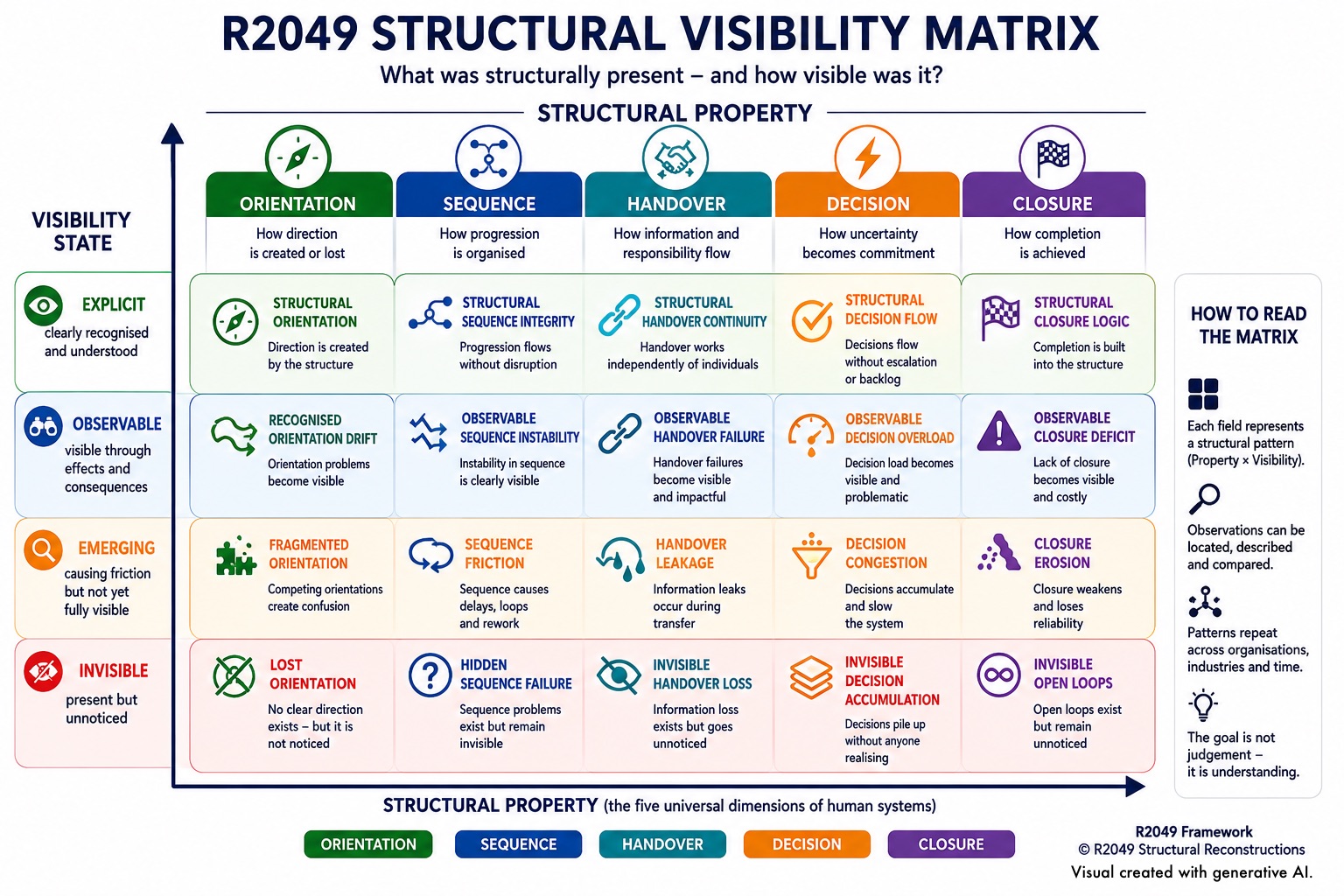
Structural Visibility Matrix Classification
Orientation × Invisible → Lost Orientation
The Noise Economy of the Early 2030s
The early 2030s did not become physically louder. They became structurally louder. Notifications, messaging platforms, alignment meetings, escalation loops, status reports and synchronisation rituals gradually occupied larger portions of the working day until continuous communication itself became a defining feature of organisational life. Every new digital channel promised greater efficiency, yet together they produced an environment in which attention was constantly redistributed rather than deliberately invested.
The archives later identified this as one of the period’s central perception errors. Organisations increasingly trusted observable coordination more than quietly functioning structures. Systems that continuously demonstrated movement appeared healthier than systems whose processes simply worked without attracting attention. Visibility slowly replaced effectiveness as the dominant indicator of organisational health.
When Responsiveness Became a Moral Virtue
Responsiveness gradually evolved from a practical expectation into a cultural obligation. Rapid replies came to symbolise engagement, responsibility, leadership presence and professional commitment, while delayed responses increasingly generated suspicion—even when the quality of work remained consistently excellent. What mattered was no longer only what people produced, but how visibly they participated in the organisation’s communication flow.
This subtle cultural shift changed behaviour throughout entire organisations. Employees unconsciously optimised for reaction speed, digital presence and meeting participation because these behaviours were continuously observable. Structural contribution, by contrast, often remained invisible. Organisations therefore began rewarding perceptual presence more consistently than operational value creation.
Scene Reconstruction · 2034
It is 10:43 p.m. A project manager sits on a sofa with a half-open laptop. Three messaging platforms remain active, several conversations are unfinished, and new notifications continue to appear every few minutes. Another message arrives carrying the familiar subject line:
“Quick Alignment Before Tomorrow.”
The reply is sent within four minutes. Not because the issue requires immediate attention, but because delayed visibility has become socially riskier than personal exhaustion.
The archives later reconstructed an important distinction. Many organisations no longer generated pressure primarily through the work itself. They generated pressure through the expectation that everyone should remain permanently available to demonstrate participation.
When Quiet Work Became Suspicious
One of the most revealing transformations involved the cultural interpretation of silence. Employees who deliberately protected uninterrupted concentration, avoided unnecessary updates or responded less frequently increasingly appeared detached from organisational life, even when their actual results consistently exceeded expectations.
As concentration lost cultural legitimacy, organisations unintentionally weakened one of the essential prerequisites for solving complex problems. Deep analytical work requires uninterrupted cognitive continuity. Systems that continuously rewarded immediate reaction gradually undermined the very conditions necessary for strategic thinking, precision and innovation.
Acoustic Productivity
The archives later described this organisational condition as acoustic productivity—a structural state in which organisations must continuously make activity visible and audible in order to appear productive. Communication increasingly ceased to support work and instead became work itself. Meetings generated further meetings, coordination required additional coordination, and alignment processes evolved into independent organisational structures.
This transformation fundamentally altered how performance was evaluated. Communication density, response frequency and participation in synchronisation rituals became stronger indicators of commitment than completed outcomes, precise execution or responsible decision-making. Enormous organisational capacity was consequently consumed by maintaining the appearance of continuous activity rather than producing sustainable operational results.
Meeting Architectures as Structural Symptoms
The archives later identified meeting culture as one of the clearest structural indicators of the era. Many meetings no longer existed primarily to reach decisions. Their deeper function was to confirm participation, reinforce visibility and reassure organisations that collective coordination remained intact.
This gradually created environments of permanent mutual observation. Everyone could observe that everyone else appeared occupied, connected and responsive. Yet fewer and fewer people could explain where actual value creation occurred, because increasing amounts of organisational energy had become devoted to maintaining communication itself.
Scene Reconstruction · 2037
An open-plan office appears almost silent. No machinery operates. No visible collaboration takes place. Only keyboards, notification tones, headset conversations and calendar reminders punctuate the room.
Every screen displays another virtual meeting connected to another coordination process. A visitor quietly asks:
“When do people actually work?”
No one answers. Not because the question is difficult. Because nobody can identify the boundary between productive work and organisational signalling any longer.
The Illusion of Organisational Speed
Many organisations considered themselves exceptionally agile because information travelled rapidly across their communication networks. The archives reconstructed a different reality. Systems accelerated information movement, reaction cycles and synchronisation processes, but not necessarily decision quality, execution stability or operational depth.
Beyond a certain threshold, communication itself became a limiting factor. Every additional coordination process demanded further clarification, further meetings and further alignment. The organisation appeared increasingly dynamic while its capacity to convert decisions into coherent action steadily declined.
The Collapse of Deep Time
One of the most consequential structural developments involved the disappearance of uninterrupted concentration. Continuous notifications, anticipated interruptions and permanent communication readiness fragmented working time into increasingly shorter cognitive intervals. Long periods of focused thinking gradually became exceptional rather than routine.
This development did not primarily reflect declining discipline. It reflected systems that demanded continuous reaction readiness. Organisations unintentionally placed deep work into direct conflict with cultural expectations. The individuals most capable of sustained analysis often appeared least engaged because concentrated work naturally reduced communicative visibility.
The Neurocognitive Architecture of Permanent Signalling
The archives later examined the cognitive consequences of continuous organisational signalling. Employees increasingly operated within states of anticipated interruption, partial attention and latent alertness. Even periods intended for recovery remained psychologically unstable because attention could be reclaimed at any moment by another message, meeting invitation or notification.
The resulting exhaustion differed fundamentally from traditional workload. It was not primarily physical fatigue but fragmented attentional existence. Organisations gradually consumed the cognitive continuity upon which high-quality judgement, structural reasoning and complex decision-making ultimately depend.
The Quiet Countermovement
During the mid-2040s a small number of organisations deliberately moved in the opposite direction. They reduced meetings, restricted notifications, abandoned unnecessary status rituals and significantly lowered expectations of immediate responsiveness. Initially these organisations appeared unusually slow because communication became less frequent and reactions less immediate.
Internally, however, entirely different structural effects emerged. Decision quality improved, responsibilities became clearer, operational coherence increased and error rates declined. Once uninterrupted attention became structurally protected again, organisations rediscovered that clarity often develops more effectively in environments that communicate less rather than more.
The Architecture of Quiet Systems
The most resilient organisations of the late 2040s shared a characteristic that many organisations of the early 2030s would have misunderstood: operational quietness. Their silence did not reflect disengagement. It reflected the absence of unnecessary signalling.
These organisations generated fewer notifications, fewer escalation loops, fewer performative updates and substantially fewer coordination rituals. As a consequence, they achieved deeper concentration, stronger responsibility structures, clearer decisions and more stable execution. The archives ultimately summarised this transformation with a simple observation:
Stable systems do not need to make their activity constantly audible.
Scene Reconstruction · 2046
A strategy room. Four people. A large physical whiteboard. No laptops are open. No phones vibrate. No parallel meetings interrupt the discussion. For almost two hours very little is said. Then a single decision emerges:
- Clear.
- Understandable.
- Executable.
The archives later noted that many organisational cultures of the early 2030s would probably have interpreted this scene as unproductive, precisely because so little visible communication occurred.
Final Reconstruction
The organisations of the early digital productivity era believed that more communication inevitably produced better coordination. The archives reconstructed the opposite. Beyond a critical structural threshold, communication density gradually began to undermine the very capabilities it was intended to improve.
Decision congestion replaced decision flow. Sequence friction disrupted sustained execution. Closure erosion generated permanently unfinished organisational loops, while orientation slowly shifted away from value creation towards the continuous performance of activity itself.
The most effective organisations were ultimately not those that communicated the most. They were those that designed communication carefully enough that concentration, responsibility and clear decision-making could once again become structurally possible.
Summary
The archives later reconstructed that one of the defining organisational misconceptions of the early digital productivity era was the belief that visible activity automatically reflected operational effectiveness. Meetings multiplied, notifications became permanent, messaging platforms expanded, and organisations invested increasing amounts of energy in synchronising themselves. Communication gradually evolved from a supporting mechanism into a structural end in itself.
What appeared to be highly responsive organisations frequently suffered from growing decision congestion, fragmented attention and declining operational depth. Systems became increasingly successful at making work visible while simultaneously becoming less capable of creating uninterrupted conditions in which meaningful work could actually be accomplished.
Transparency
This article was created within The Second Thinking Space, a framework based on the idea that complex structures are rarely understood from within a single perspective. Generative AI was used as a second thinking space for exploration, intellectual confrontation, generation of optimised text suggestions, and pattern recognition, while all interpretations and conclusions remain the responsibility of the author.

