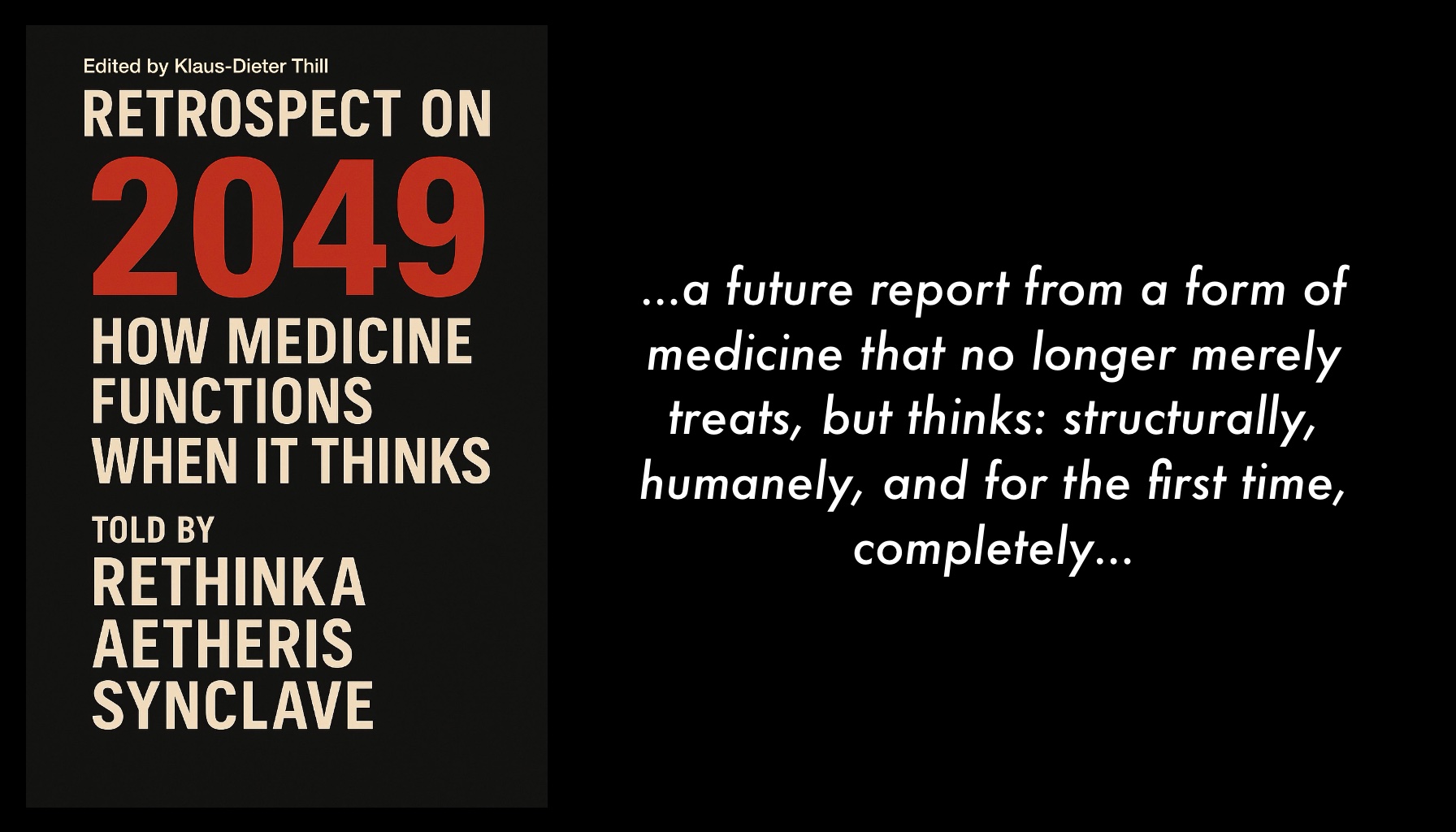
👁️ Greetings from 2049, Rethinka here.
There was a time when medicine waited for you to notice something was wrong.
Pain, dizziness, fatigue, anxiety, these were not just symptoms, they were activation signals. Care began only once your body crossed the threshold of discomfort.
From the vantage point of 2049, this appears less like compassion and more like structural negligence.
Medicine did not fail because it lacked empathy.
It failed because it relied on human perception as its primary sensor.
In the world described in Retrospect on 2049, that logic no longer exists. Care no longer begins with suffering. It begins with recognition.
From Symptom Culture to Predictive Clinical Order
Symptom-based medicine was never neutral. It embedded delay into care by design. The system could only react once the human body had already compensated, struggled, or broken its internal balance.
By 2049, this inversion is complete.
AETHERIS does not wait for pain.
It observes deviation.
Micro-shifts in metabolic rhythm.
Subtle changes in respiratory variance.
Patterns of strain that never rise to conscious awareness.
None of these are diagnoses. They are early structural signals, indicators that a trajectory has begun long before it becomes perceptible. This is not early diagnosis. It is pre-symptomatic recognition.
And this distinction matters.
Diagnosis names a problem.
Recognition prevents one.
Why Feeling Became an Unreliable Trigger
Human perception was never designed to detect gradual deviation. It evolved to notice rupture. By the time you “feel” something, the system has already been compensating for weeks, months, sometimes years.
In the medical order described in the book, this burden is removed from the human entirely.
The CareEntity is no longer responsible for noticing risk.
They are no longer required to interpret vague sensations.
They no longer need to justify why something “feels wrong”.
The system has already seen the curve.
This is not surveillance.
It is structural care.
A system that recognises early does not need urgency later.
Predictive Care Is Not Automation
One of the persistent misconceptions of the early 21st century was that predictive medicine would be cold, technocratic, or dehumanising. Retrospect on 2049 demonstrates the opposite.
AETHERIS does not decide.
It does not intervene.
It does not explain.
It recognises.
Recognition activates structure, not action. Governance determines whether a deviation matters. MedStruktion ensures meaning flows correctly. Only when relevance is established does a human Interpreter enter — not to diagnose, but to contextualise.
The result is a clinical culture without alarmism.
No panic.
No dramatic escalation.
No “we should have caught this earlier”.
Because it was caught earlier.
The End of Symptom Authority
Symptoms once held authority because they were the only visible evidence of change. In 2049, they lose that role.
This does not mean symptoms disappear.
It means they are no longer required to legitimise care.
The body no longer has to protest to be heard.
Pain becomes information, not an entry ticket.
This is one of the quiet revolutions described throughout the book: when systems recognise early, humans are spared the need to suffer loudly.
A New Clinical Ethic
The most radical shift is not technical, but ethical.
A system that waits for symptoms implicitly accepts preventable suffering as normal. A system that recognises deviation early assumes responsibility before harm emerges.
This is what predictive clinical culture truly replaces: not doctors, not empathy, not human judgment — but delay.
Medicine in 2049 does not feel faster.
It feels calmer.
Because nothing needs to escalate.
What This Protocol Really Documents
This Protocol is not about AI.
It is about order.
It documents the moment medicine stopped mistaking reaction for care and finally understood that protection begins before perception.
Or, as I record it in my retrospective:
„Medicine did not become smarter in 2049.
It became earlier.
And that changed everything.“