
The Structural Historical Drift Principle: How Organisational Memory Quietly Began to Organise the Future · R2049 · Structural Reconstructions

Intro

This structural reconstruction examines how organisational memory, institutional experience, leadership narratives, strategic orientation, organisational learning, systems thinking, historical path dependence, adaptive leadership and structural transformation shaped organisations during the transformation era of the 2020s and 2030s. Rather than treating experience solely as a source of knowledge, it analyses how successful interpretations from the past gradually became an invisible architecture for understanding the present.

Looking back from 2049, the Leadership Archives reconstructed this recurring mechanism as the Structural Historical Drift Principle. It describes how organisations can retain formal strategies, detailed knowledge and extensive institutional memory while gradually losing the ability to orient themselves independently of their own history. Their direction does not vanish. It becomes increasingly determined by assumptions whose original conditions may no longer exist.

Continue reading “The Structural Historical Drift Principle: How Organisational Memory Quietly Began to Organise the Future · R2049 · Structural Reconstructions”
The Assumption Persistence Principle · R2049 · Structural Reconstructions

This structural reconstruction examines how leadership, organisational learning, strategic adaptation, organisational cognition, systems thinking, decision-making, institutional resilience, organisational design and structural diagnostics evolved throughout the transformation era of the 2020s and 2030s. Rather than analysing organisational decisions themselves, this reconstruction identifies a recurring structural mechanism that shaped how organisations interpreted reality over time. Looking back from 2049, this mechanism became known as the Assumption Persistence Principle, one of the foundational explanatory laws reconstructed by the Leadership Archives.

Continue reading “The Assumption Persistence Principle · R2049 · Structural Reconstructions”
The Most Dangerous Organisations Appeared Perfectly Functional · R2049 · Structural Reconstructions

Intro

This article explores how operational efficiency, organisational optimisation, structural resilience, leadership, organisational learning, cognitive flexibility, system thinking and strategic adaptation evolved between the 2020s and the late 2030s. From the perspective of the structural reconstructions of 2049, it explains why many organisations remained operationally successful while progressively losing their capacity to reinterpret reality. It introduces the concepts of Structural Deceleration of Insight and Efficiency-Induced Future Blindness as two defining structural mechanisms that fundamentally reshaped modern leadership theory.

Continue reading “The Most Dangerous Organisations Appeared Perfectly Functional · R2049 · Structural Reconstructions”
The Overvaluation of Consensus · R2049 · Leadership Logs of ØN · Entry 119

Intro

This entry examines consensus vs. dissent in organisational decision-making, focusing on how alignment pressure, cognitive conformity, and communication distortion reduce decision quality in complex systems. It introduces key concepts such as consensus bias, information loss in group decisions, organisational dynamics, dissent as a performance driver, and adaptive leadership under uncertainty.

Continue reading “The Overvaluation of Consensus · R2049 · Leadership Logs of ØN · Entry 119”

The Illusion of Clear Decisions · R2049 · Leadership Logs of ØN · Entry 116

Intro

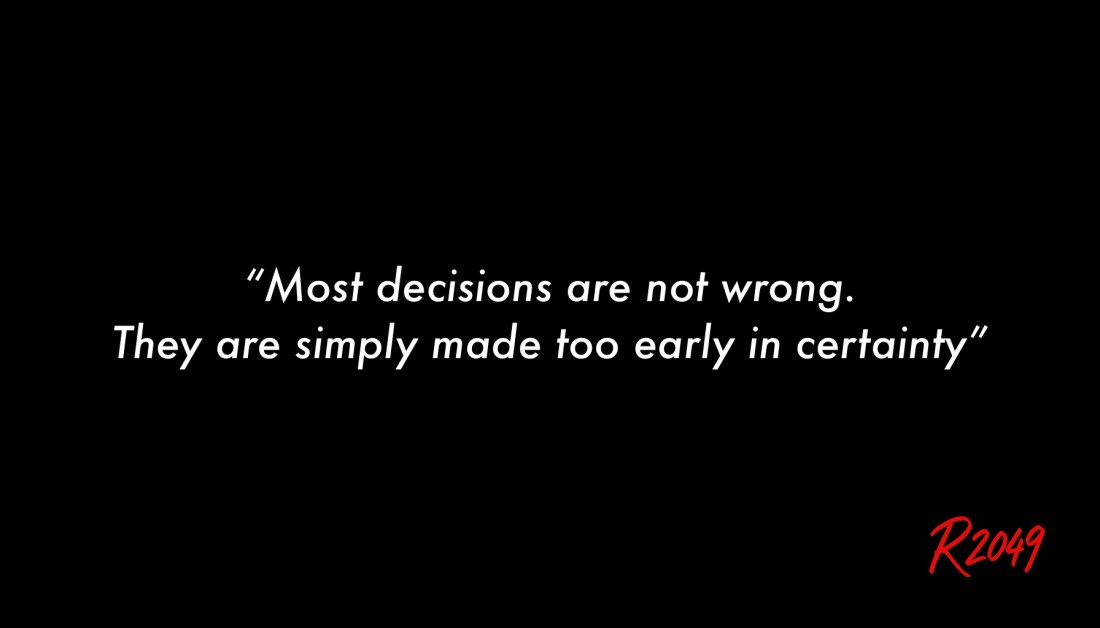
This entry analyses decision-making in complex systems, focusing on the concept of decision compression, where organisations reduce ambiguity too early in order to act. It explores how leadership, organisational behaviour, uncertainty management, and strategic decision-making are distorted when complexity is prematurely simplified. Key concepts include complexity reduction, cognitive bias in leadership, decision dynamics, organisational alignment, and adaptive strategy under uncertainty.

Continue reading “The Illusion of Clear Decisions · R2049 · Leadership Logs of ØN · Entry 116”