
Intro
This structural reconstruction examines how organisational memory, institutional experience, leadership narratives, strategic orientation, organisational learning, systems thinking, historical path dependence, adaptive leadership and structural transformation shaped organisations during the transformation era of the 2020s and 2030s. Rather than treating experience solely as a source of knowledge, it analyses how successful interpretations from the past gradually became an invisible architecture for understanding the present.
Looking back from 2049, the Leadership Archives reconstructed this recurring mechanism as the Structural Historical Drift Principle. It describes how organisations can retain formal strategies, detailed knowledge and extensive institutional memory while gradually losing the ability to orient themselves independently of their own history. Their direction does not vanish. It becomes increasingly determined by assumptions whose original conditions may no longer exist.
Structural Diagnosis
Structural Visibility Matrix Classification
- Structural Property: Orientation
- Visibility State: Invisible
- Matrix Position: Lost Orientation
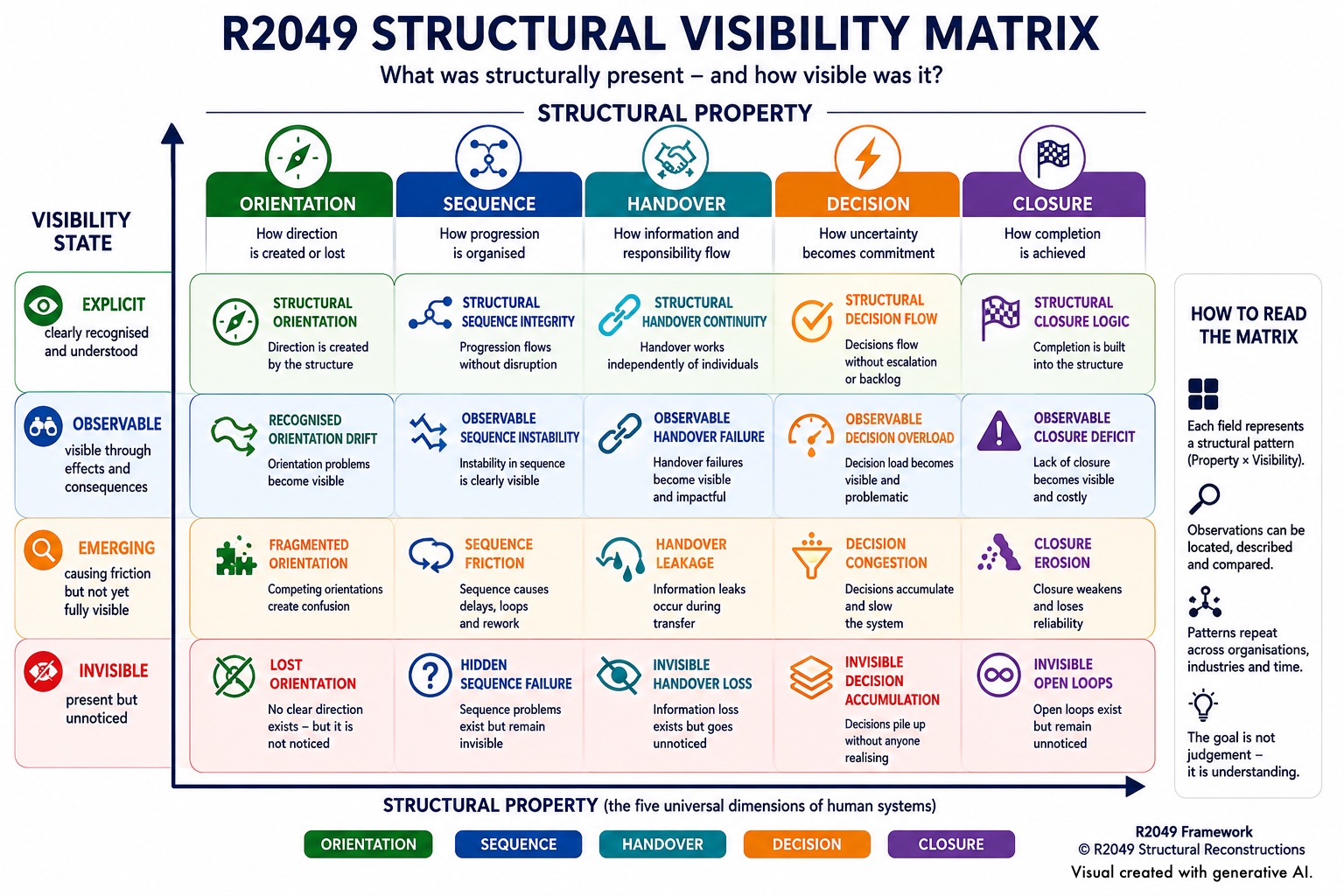
This reconstruction belongs to the Invisible × Orientation field of the R2049 Structural Visibility Matrix. The organisations examined by the Leadership Archives did not appear to lack direction. They possessed strategies, institutional knowledge, established identities and extensive records of previous decisions. What they gradually lost was the capacity to determine whether their present orientation still emerged from current reality or had already been inherited from the past.
Historical experience became structurally decisive without being recognised as such. Earlier successes influenced what appeared plausible, which risks seemed familiar and which interpretations received institutional legitimacy. Because this influence remained embedded in language, routines, leadership stories and professional judgement, it rarely appeared as an explicit strategic choice.
The resulting condition was therefore not merely historical continuity. It was Lost Orientation: direction still existed, but its structural source had become invisible. The organisation believed it was interpreting the present while increasingly reproducing the explanatory logic of its own history.
The danger was never organisational memory itself. The danger began when memory became an unnoticed substitute for renewed orientation.
Structural Reconstruction
When the Leadership Archives began comparing organisational developments across periods of forty to sixty years in 2048, the reconstruction teams encountered a striking asymmetry. Almost every mature organisation documented its past. It archived projects, preserved strategies, recorded crises, analysed successes and accumulated institutional experience. Historical knowledge was widely regarded as evidence of organisational maturity, and the older an organisation became, the greater its presumed strategic advantage appeared.
This assumption had shaped management theory throughout the first half of the twenty-first century. Experience was treated as a stabilising resource. It was expected to prevent repeated mistakes, improve judgement, reduce uncertainty and provide reliable orientation. The first archival reconstructions appeared to confirm this view. Organisations with extensive institutional experience often made more balanced operational decisions, assessed familiar risks more accurately and responded to known pressures with greater confidence.
Yet as the reconstructed periods became longer, a contradiction emerged. Organisations with the most successful histories frequently experienced the greatest difficulty interpreting developments that no longer resembled anything they had encountered before. The problem was not missing information, weak leadership or insufficient professional expertise. Their difficulty arose because the past had gradually begun to interpret every new present before the present itself had been examined.
The Leadership Archives therefore changed their central question. They no longer asked only what organisations had learned from their history. They began reconstructing how history itself had started to structure organisational perception. This shift revealed that history operates within organisations not merely as stored memory but as an active architecture of interpretation.
Every successfully managed crisis, completed transformation, proven strategy and repeated success story creates an implicit model of how the world works. These models are rarely formalised as doctrines. They survive through metaphors, habitual expressions, internal case studies, leadership narratives and the stories new employees hear during their first weeks inside the organisation.
Most organisations possess such statements: “We overcame this before”, “This is how we have always handled difficult situations”, “Our strength has always been” or “We became successful because”. None of these statements is necessarily false. Many provide identity, continuity and collective confidence. Yet their structural function changes through repetition. At first, they describe the past. Later, they begin to explain the present. Eventually, they start organising the future.
This transition became central to the later reconstructions. Historical experience did not remain in the archive. It migrated into everyday perception. New competitors were interpreted through earlier competitive conflicts, new technologies through previous innovation cycles and unfamiliar organisational models through remembered reforms. The greater the organisation’s experience became, the stronger the temptation grew to make new reality intelligible through established patterns.
The archives initially described this process as historical continuity. With an increasing number of comparative cases, however, continuity proved insufficient. History was not simply being preserved. It was slowly shifting the direction of organisational attention. No formal decision produced this shift. It emerged because successful experience carried institutional plausibility.
What had worked before appeared more likely to work again. What lacked historical precedent appeared more uncertain. An almost invisible asymmetry developed: the past automatically received greater interpretative weight than the future. Familiar explanations did not need to prove themselves repeatedly, while unfamiliar interpretations had to overcome the organisation’s accumulated historical confidence.
The Leadership Archives first reconstructed this mechanism in industrial organisations. Companies that had succeeded for decades through scale, efficiency and physical distribution initially interpreted digital platform economies as variations of established markets. They did not necessarily reject new models. Their history simply supplied the most credible available explanation.
Comparable patterns appeared in healthcare. Hospitals that had historically defined performance primarily through clinical excellence often interpreted emerging organisational challenges within familiar medical frameworks. As a result, the structural complexity of interprofessional coordination, information continuity and distributed responsibility remained secondary for too long.
Public administrations interpreted societal acceleration through inherited administrative logics, while universities frequently treated digital knowledge production as an extension of traditional academic communication. Across all cases, the archives discovered the same mechanism. Historical experience itself did not limit the future. The unnoticed expansion of historical explanatory patterns did.
The reconstruction teams therefore stopped evaluating organisations according to the volume of their experience. Instead, they examined how much of present-day interpretation and decision-making had already been silently determined by historical models. A persistent regularity became visible. The more successful an organisation had been historically, the greater its institutional confidence in existing explanations often became.
Each confirmed historical pattern reduced the probability that fundamentally different models would receive serious consideration. New interpretations were not always rejected directly. They simply appeared less plausible, less professional or less compatible with the organisation’s accumulated identity.
The archives later described this gradual process as historical drift. Drift did not signify a sudden change in direction. It referred to the slow movement of present interpretation towards historical explanations. The past was not necessarily wrong. It had simply become the preferred language through which the organisation understood everything new.
This reconstruction connected several observations that earlier management research had treated separately. It explained why highly successful organisations often recognised fundamental disruptions late, why emerging technologies were initially interpreted through outdated business models and why successive leadership generations repeatedly returned to the same historical success stories for orientation.
It also explained why experienced organisations could appear extraordinarily capable of learning as long as new challenges resembled previous ones, yet become unexpectedly disoriented when genuinely new structural patterns emerged. Their learning systems were effective within the boundaries of historical similarity. Outside those boundaries, experience ceased to function as orientation and began to function as constraint.
The Leadership Archives formulated these findings as the Structural Historical Drift Principle. The principle states that historical experience increasingly acquires the character of a general explanatory model through repeated success. Organisational interpretations of new developments then drift towards past experience, even after the conditions that originally made those interpretations valid have disappeared. Over time, an organisation emerges whose future is quietly organised by the logic of its past.
This principle changed the understanding of organisational learning. Earlier theories had primarily interpreted learning as the accumulation of experience. Structural Reconstruction Theory introduced a second and equally important task: organisations must repeatedly examine which parts of their history have already begun interpreting the present on their behalf.
This does not require organisations to forget their history or diminish the value of experience. It requires them to recognise the point at which historical explanatory power begins turning into historical limitation. Experience remains valuable only when its conditions, boundaries and period of validity remain visible.
The most adaptive organisations of the transformation era therefore did not possess less experience. They were distinguished by their ability to historicise experience. They treated earlier successes not as universal truths but as answers produced under specific technological, social, economic and cultural conditions.
Instead of asking only what lessons they could draw from their history, they asked a more disruptive question: which parts of our history now explain our present more strongly than the present explains itself? This was followed by a second question: which assumptions appear self-evident today only because they were extraordinarily successful under conditions that no longer exist?
In retrospect, the Leadership Archives regarded these questions as the beginning of organisational future capability. Organisations rarely lose their future because they forget their history. They lose it when their history begins acting as though every new reality is already known before it has been understood.
Closing Aphorism
Experience becomes a burden when it stops being memory and begins binding the future to the past.
Summary
Early management theory largely interpreted institutional experience as a competitive advantage. Comparative reconstructions conducted by the Leadership Archives revealed a more complex structural effect. Historical knowledge did not merely support organisational learning; it gradually became an invisible architecture for interpreting new realities.
The resulting pattern belongs to the Invisible × Orientation field of the R2049 Structural Visibility Matrix and is classified as Lost Orientation. Organisations continued to possess direction, but the source of that direction increasingly shifted from present conditions to historically successful assumptions. This recurring mechanism later became known as the Structural Historical Drift Principle.
Long-term adaptability therefore depended not only on learning from history but on repeatedly separating present reality from the interpretative authority of the past.
Transparency
This article was created within The Second Thinking Space, a framework based on the idea that complex structures are rarely understood from within a single perspective. Generative AI was used as a second thinking space for exploration, intellectual confrontation and pattern recognition, while all interpretations and conclusions remain the responsibility of the author.

