The Illusion of Acceleration · R2049 · Leadership Logs of ØN · Entry 137

Intro

This entry examines from the perspective of the year 2049organisational acceleration, decision speed, and strategic disorientation, focusing on how high-velocity execution, real-time communication, and compressed decision cycles reduce clarity, increase error propagation, and weaken long-term alignment. It explains why speed is not a proxy for progress, and how organisations produced strategic drift through acceleration-driven management systems. Core concepts include decision velocity, strategic alignment, execution pressure, time compression, decision architecture, and organisational orientation.

Continue reading “The Illusion of Acceleration · R2049 · Leadership Logs of ØN · Entry 137” →
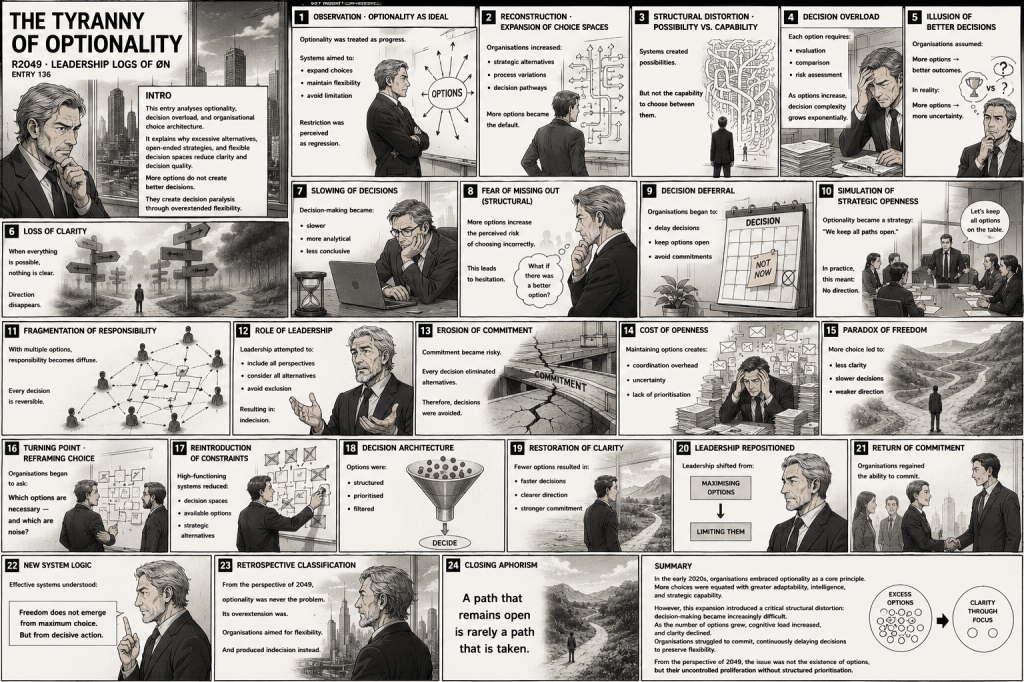
The Simulation of Productivity · R2049 · Leadership Logs of ØN · Entry 135

Intro

This entry analyses productivity, activity metrics, and organisational performance systems, focusing on how visible work, communication volume, and task completion metrics distort actual effectiveness. It explains why activity does not equal impact, and how organisations created productivity illusions through measurement systems and digital workflows. Key concepts include productivity simulation, activity bias, decision impact, organisational efficiency, attention fragmentation, and performance systems.

Continue reading “The Simulation of Productivity · R2049 · Leadership Logs of ØN · Entry 135” →

The Tyranny of Transparency · R2049 · Leadership Logs of ØN · Entry 133

Intro

This entry analyses organisational transparency, information overload, and visibility-driven management systems, focusing on how excessive data access, real-time dashboards, and open communication structures increase complexity instead of clarity. It explains why transparency does not equal understanding, and how organisations misinterpreted information availability as decision quality. Key concepts include information overload, attention fragmentation, decision architecture, visibility bias, interpretive power, and systemic clarity.

Continue reading “The Tyranny of Transparency · R2049 · Leadership Logs of ØN · Entry 133” →

The Confusion of Speed and Progress · R2049 · Leadership Logs of ØN · Entry 132

Intro

This entry analyses organisational speed, acceleration, and the illusion of progress, focusing on how increased activity, rapid decision cycles, and execution speed can undermine strategic clarity and systemic effectiveness. It explains why speed does not equal progress, and how organisations historically overvalued movement over direction. Key concepts include decision velocity, organisational acceleration, dynamic stagnation, strategic misalignment, and systemic overload.

Continue reading “The Confusion of Speed and Progress · R2049 · Leadership Logs of ØN · Entry 132” →

The Invisibility of Decision Architecture · Re2049 · Leadership Logs of ØN · Entry 131

Intro

This entry analyses decision architecture in organisations, focusing on decision-making systems, structural decision logic, hidden authority, pre-decisions, escalation dynamics, and systemic decision bias. It explains why decision quality cannot be separated from decision architecture, and how organisations historically failed to make decision structures, dependencies, and timing visible. Key concepts include decision architecture, decision chains, structural responsibility, organisational design, and systemic decision-making.

Continue reading “The Invisibility of Decision Architecture · Re2049 · Leadership Logs of ØN · Entry 131” →

The Confusion of Communication and Coordination · R2049 · Leadership Logs of ØN · Entry 128

Intro

This entry reconstructs communication vs. coordination in pre-2049 organisations, focusing on how meetings, transparency, information flow, and alignment practices were used as substitutes for structural coordination. It introduces key concepts such as communication overload, coordination failure, decision architecture, structural dependencies, and organisational alignment myths. The analysis shows why increased communication does not produce coordination, and how systems relied on interaction instead of structure to manage complexity.

Continue reading “The Confusion of Communication and Coordination · R2049 · Leadership Logs of ØN · Entry 128” →

The Exhaustion of Initiative · R2049 · Leadership Logs of ØN · Entry 124

Intro

This entry reconstructs initiative as a structural overload mechanism in organisations, showing how excessive initiative, project proliferation, operational density, and systemic fragmentation reduce effectiveness. It introduces key concepts such as initiative overproduction, activity accumulation, structural invisibility, coordination overload, and initiative as compensation for missing structure. The analysis explains why organisations suffer not from insufficient engagement — but from uncoordinated action at scale.

Continue reading “The Exhaustion of Initiative · R2049 · Leadership Logs of ØN · Entry 124” →

The Silent Violence of Efficiency · R2049 · Leadership Logs of ØN · Entry 120

Intro

This entry analyses efficiency as a structural risk in organisational systems, focusing on how process optimisation, cost reduction, and performance metrics create hidden rigidity. It introduces key concepts such as efficiency vs. adaptability, optimisation bias, structural inertia, invisible complexity, and learning suppression. The analysis shows why efficiency does not guarantee performance — but can lock organisations into outdated models while appearing highly effective.

Continue reading “The Silent Violence of Efficiency · R2049 · Leadership Logs of ØN · Entry 120” →