Responsibility Was Assigned Because Structure Could Not Carry It · R2049 · Structural Reconstructions

Intro

This reconstruction examines responsibility attribution, accountability systems, decision architecture, structural load distribution, organisational behaviour, leadership systems, Struction, and post-leadership design.

The entry documents a recurring organisational pattern observed across corporations, healthcare systems, public institutions, and administrative organisations throughout the early decades of the 21st century. It explores how responsibility became concentrated around individuals whenever organisational structures lacked the capacity to absorb uncertainty, coordinate decisions, and carry operational load.

Continue reading “Responsibility Was Assigned Because Structure Could Not Carry It · R2049 · Structural Reconstructions”

The Invisible Layer Beneath Everyday Reality · STRUCTIOGRAPHY Essay

Why the Most Important Parts of Human Systems Are Rarely Seen

Summary

Most people believe they understand reality because they can observe it. Yet visible reality is only the outer expression of a deeper structural layer that quietly shapes behaviour, decisions, movement, and coordination. This article introduces the concept of the invisible structural layer and explains why recognising it is essential for developing Structural Literacy.

Continue reading “The Invisible Layer Beneath Everyday Reality · STRUCTIOGRAPHY Essay”

The Second Thinking Space

Why I Work with Artificial Intelligence

I am increasingly asked why I use artificial intelligence. It is a fair question. Many people associate AI with automation, efficiency, or convenience. They assume it is about producing texts faster. Delegating work. Generating content automatically.

But that is not why I work with AI. My answer is different. I work with AI because I believe in the limits of human thinking. Not in its weakness. But in its structure.

Continue reading “The Second Thinking Space”

The Hidden Limitation That Prevents Structural Understanding · STRUCTIOGRAPHY Essay

Why Most People Only See Outcomes

Every day, people make sense of the world through what they can immediately observe. A company grows, a project fails, a hospital experiences delays, a team performs exceptionally well, or an organisation collapses. These visible outcomes attract attention because they are concrete, measurable, and emotionally compelling. They create the impression that reality can be understood simply by examining what happened.

Continue reading “The Hidden Limitation That Prevents Structural Understanding · STRUCTIOGRAPHY Essay”

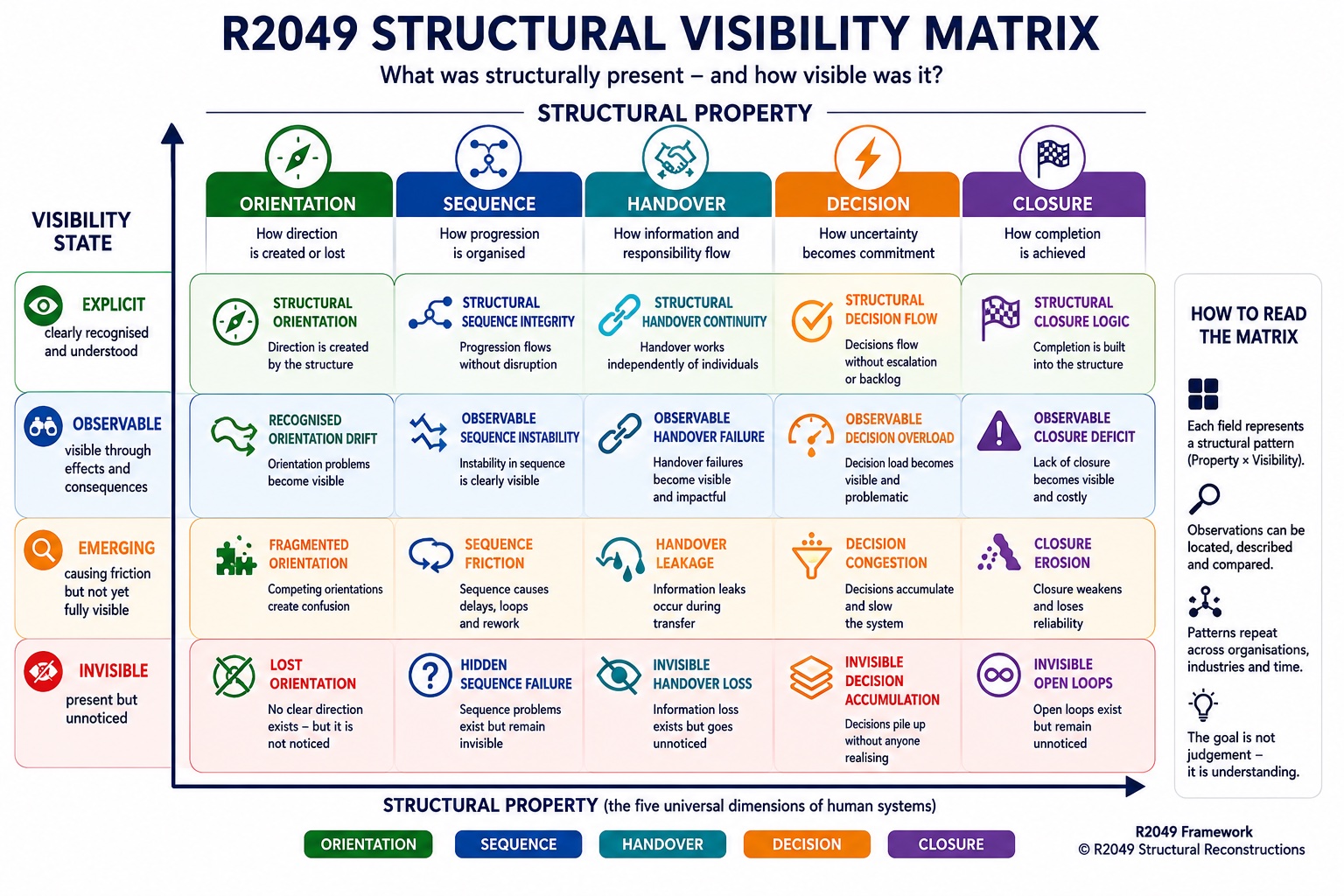
The R2049 Structural Visibility Matrix

A Guide to Reading Structural Reconstructions

Introduction

Most people observe outcomes:

  • A meeting failed.
  • A project stalled.
  • A team became overloaded.
  • A decision took too long.
  • A customer became frustrated.

These events appear visible. What often remains invisible are the structural conditions that produced them. This observation became one of the central themes of the R2049 archive.

Continue reading “The R2049 Structural Visibility Matrix”

The Invisibility of Decision Architecture · Re2049 · Leadership Logs of ØN · Entry 131

Intro

This entry analyses decision architecture in organisations, focusing on decision-making systems, structural decision logic, hidden authority, pre-decisions, escalation dynamics, and systemic decision bias. It explains why decision quality cannot be separated from decision architecture, and how organisations historically failed to make decision structures, dependencies, and timing visible. Key concepts include decision architecture, decision chains, structural responsibility, organisational design, and systemic decision-making.

Continue reading “The Invisibility of Decision Architecture · Re2049 · Leadership Logs of ØN · Entry 131”

The Overproduction of Management Communication · R2049 · Leadership Logs of ØN · Entry 130

Intro

This entry analyses management communication in organisational systems, focusing on communication overload, structural compensation, decision architecture, coordination failure, and signal inflation. It explains why increasing communication does not improve clarity or execution, and how organisations historically relied on communication instead of structure to manage complexity. Key concepts include communication density, semantic clarity vs. operational coherence, structural deficiency, and organisational signalling.

Continue reading “The Overproduction of Management Communication · R2049 · Leadership Logs of ØN · Entry 130”

The Invisibility of Decision Consequences · R2049 · Leadership Logs of ØN · Entry 129

Intro

This entry reconstructs decision consequences in organisational systems, focusing on delayed effects, causal opacity, decision impact chains, systemic feedback loops, and temporal misalignment. It explains why decision quality cannot be assessed at the moment of choice, and how organisations historically failed to connect decisions, outcomes, and long-term system dynamics. Key concepts include decision consequence invisibility, causal fragmentation, systemic delay, unintended effects, and structural responsibility.

Continue reading “The Invisibility of Decision Consequences · R2049 · Leadership Logs of ØN · Entry 129”