
Reconstruction Question
Which structural conditions observable in the present could later explain why organisations gradually lost operational decision-making capability despite increasing communication, coordination and management activity?
Methodological Note
This Structural Reconstruction was developed using the R2049 Method. The method does not predict future events. Instead, it reconstructs present-day structures from a hypothetical future historical perspective in order to identify structural relationships that frequently remain invisible within the present itself.
Rather than asking what will happen, the R2049 Method asks a different question:
Which structural conditions already exist today that could later explain why particular developments became possible?
The purpose of the reconstruction is therefore neither forecasting nor scenario building. Its objective is to identify the structural mechanisms that precede observable outcomes and to reconstruct them before they become historically self-evident.
Abstract
The reconstruction suggests that many organisations of the early 2030s did not primarily lose effectiveness because they made poor decisions. Rather, they gradually lost the organisational capacity to transform uncertainty into commitment. Strategic openness increasingly became a cultural ideal, while definitive decisions came to be regarded as unnecessarily restrictive. As a consequence, decision-making processes expanded, coordination intensified and optionality was preserved for progressively longer periods.
Although these developments initially appeared to increase organisational adaptability, they simultaneously weakened operational clarity, responsibility and execution. Decision-making itself gradually changed its organisational function. Instead of producing commitment, it increasingly produced additional coordination.
Within the R2049 Method this structural condition is described as Operational Suspension: a state in which organisations remain permanently capable of discussing action while progressively losing the capacity to complete it.
The Structural Rise of Permanent Optionality
The reconstruction indicates that one of the defining characteristics of organisational decision systems during the early 2030s was a gradual redefinition of commitment itself. Decisions were no longer understood primarily as mechanisms for establishing direction and operational coherence. Instead, they increasingly came to represent irreversible commitments that reduced future flexibility. Under conditions of accelerating technological change, geopolitical uncertainty and continuous market volatility, maintaining optionality appeared more adaptive than establishing clear priorities.
Initially this transformation was widely interpreted as evidence of organisational maturity. Systems capable of postponing commitments were considered agile, responsive and strategically sophisticated. They appeared better prepared to react to uncertainty because they deliberately avoided closing future possibilities.
From the reconstructed perspective, however, this interpretation concealed a more fundamental structural development. As preserving options gradually became a value in its own right, organisations simultaneously reduced their capacity to convert uncertainty into operational reality. Every postponed commitment preserved theoretical flexibility while weakening practical execution. Strategic openness therefore expanded precisely as organisational finality declined.
This transformation did not occur through a single management philosophy or a deliberate organisational reform. It emerged gradually through countless small decisions that favoured additional analysis over commitment, further coordination over execution and procedural reassurance over operational clarity. Individually these adjustments appeared rational. Collectively they altered the structural logic of organisational decision-making.
When Decisions Became Organisational Liabilities
The reconstruction further suggests that the meaning of organisational decisions changed profoundly during this period. Earlier management traditions had regarded decisions as necessary acts of structural reduction. Every decision deliberately eliminated alternatives in order to establish priorities, assign responsibility and coordinate action. Limiting possibilities was understood not as a weakness but as the essential function of leadership.
During the early 2030s, however, these very characteristics increasingly appeared problematic. Decisions excluded future opportunities, committed resources, created identifiable ownership and established positions that might later require revision. In an environment characterised by continuous disruption, maintaining flexibility appeared intellectually superior to accepting commitment.
The structural consequence was paradoxical. Optionality, originally intended to preserve organisational freedom, gradually became a mechanism that restricted organisational capability. Beyond a certain threshold, every additional attempt to preserve flexibility reduced the system’s ability to act. Organisations accumulated possibilities faster than they generated commitment.
The reconstruction therefore suggests that the central challenge of this period was not excessive uncertainty itself. Rather, it was the gradual erosion of the organisational mechanisms required to transform uncertainty into coordinated action.
Scene Reconstruction · 2033
A strategic planning meeting involving twelve senior executives concludes after more than three hours of discussion. Throughout the meeting, multiple scenarios have been examined, alternative market developments have been evaluated and several strategic options remain available. Extensive analytical work has been completed, and participants broadly agree on the challenges facing the organisation.
As the discussion approaches its conclusion, one executive proposes that all strategic options should deliberately remain open until additional information becomes available. The proposal receives immediate support. No participant argues for immediate commitment, and the meeting concludes without a binding decision.
Those leaving the room nevertheless regard the meeting as productive. The absence of a decision is interpreted as evidence of strategic caution rather than organisational hesitation.
From the reconstructed perspective, situations of this kind illustrate a fundamental structural misunderstanding. Decision avoidance increasingly acquired the appearance of strategic competence, while commitment itself became associated with unnecessary risk. The ability to postpone decisions gradually replaced the ability to make them.
The Emergence of Operational Suspension
The reconstruction identifies this development as the gradual emergence of Operational Suspension. The concept describes organisational situations in which decisions formally exist but fail to become operationally stabilised. Projects continue without unequivocal priority, responsibilities remain formally assigned without generating effective ownership, and strategic initiatives are repeatedly reconsidered without reaching definitive implementation.
Operational Suspension does not imply organisational inactivity. On the contrary, systems affected by this condition often appear exceptionally dynamic. Meetings multiply, communication intensifies, reports become increasingly sophisticated and coordination mechanisms expand continuously. From the outside, organisational activity appears abundant.
The reconstruction suggests, however, that beneath this visible activity a different structural process unfolds. Increasing proportions of organisational energy become invested not in executing decisions but in maintaining the possibility of future reconsideration. Movement continues, yet commitment steadily declines.
Operational Suspension therefore represents a structural shift in the function of organisational activity itself. The organisation remains permanently engaged in preparing action while progressively losing the capacity to conclude it.
Coordination Replacing Decision
One of the most visible consequences of Operational Suspension was the gradual expansion of organisational coordination structures. Coordination had traditionally served a supportive function. Its purpose was to prepare, communicate and implement decisions that had already been made. During the early 2030s, however, this relationship slowly reversed. Increasingly, decisions existed primarily to justify further coordination rather than coordination existing to support decisions.
Meetings multiplied across all organisational levels. Alignment sessions generated additional alignment sessions. Stakeholder consultations expanded into complex synchronisation processes, while follow-up meetings became recurring organisational routines rather than temporary instruments of coordination. Each individual activity appeared reasonable when viewed in isolation. Collectively, however, they transformed the architecture of decision-making itself.
The reconstruction suggests that many organisations unintentionally developed management systems whose principal output was procedural reassurance rather than operational direction. Coordination became a substitute for commitment. Organisations increasingly measured the quality of decision processes by the inclusiveness of consultation rather than by the clarity of subsequent execution.
This development reflected a profound cultural shift. Consensus became increasingly associated with legitimacy, while decisive commitment was often interpreted as insufficiently participative or inadequately informed. As a consequence, organisations continuously expanded the procedural pathway towards decisions while simultaneously weakening the organisational significance of reaching them.
Scene Reconstruction · 2035
A product launch has already been postponed on four separate occasions. Technical development has been completed, financing has been secured and market analyses continue to support commercial viability. The project team is fully prepared to begin implementation.
Nevertheless, execution is repeatedly delayed because additional stakeholder perspectives should still be considered. Further market scenarios deserve evaluation. Newly emerging technological developments might require strategic adjustment, and leadership wishes to remain sufficiently flexible to respond should circumstances change once again.
Each postponement appears individually rational. Collectively, however, they gradually eliminate the very advantage the organisation originally sought to protect.
Five quarters later, a competitor introduces a remarkably similar product and rapidly establishes market leadership.
The subsequent internal review reaches a conclusion that appears almost paradoxical. The organisation did not fail because it lacked analytical capability or strategic awareness. It failed because its commitment to preserving strategic flexibility continuously displaced operational execution.
From the reconstructed perspective, the organisation did not lose because it made the wrong decision. It lost because it systematically postponed making one.
The Hidden Costs of Non-Decisions
One reason this structural transformation remained largely unnoticed was the limited visibility of its consequences. Incorrect decisions generally produce identifiable failures. Financial losses, operational disruption or strategic errors become observable and therefore invite analysis. Decisions that are never completed produce a fundamentally different category of organisational effect.
Rather than creating immediate crises, they gradually diffuse priorities, fragment responsibility, consume managerial attention and weaken strategic coherence. None of these developments appears sufficiently dramatic to justify immediate intervention. Yet their cumulative impact steadily alters the organisation’s capacity to operate.
The reconstruction therefore suggests that many organisations systematically underestimated the structural costs of non-decisions. Resources continued to be invested, projects remained active and communication intensified, creating the impression of organisational productivity. Beneath this appearance, however, organisational energy increasingly supported procedural continuity rather than operational progress.
What appeared to be caution gradually evolved into structural erosion. Organisations did not simply postpone decisions. They slowly transformed postponement into a normal operating condition.
Responsibility Without Final Ownership
A further structural mechanism emerged from the changing relationship between decision-making and accountability. Every definitive decision establishes identifiable ownership and creates historical traceability. Someone assumes responsibility, resources become committed and subsequent developments can be understood in relation to that commitment.
Delayed decisions produce a different organisational logic. Responsibility becomes progressively distributed across committees, steering groups, governance processes and successive review cycles. Ownership becomes increasingly collective precisely because no single commitment reaches operational finality.
The reconstruction suggests that collaborative leadership was increasingly interpreted as collective responsibility distribution. Participation undoubtedly expanded, yet accountability simultaneously became more difficult to locate. Leadership gradually shifted from making decisions towards managing the conditions under which decisions could continue to be reconsidered.
This development created an important organisational paradox. The greater the collective participation in decision-making became, the more difficult it often became to identify who possessed the authority to conclude the process. Responsibility remained present throughout the system, yet decisive ownership gradually disappeared.
From the reconstructed perspective, this was not primarily a problem of governance. It represented a structural transformation in the architecture of organisational accountability itself.
Scene Reconstruction · 2038
A multinational organisation has spent eight months preparing a comprehensive restructuring programme. Numerous workshops have been conducted, extensive presentations have been produced and repeated stakeholder consultations have taken place. Every relevant perspective appears to have been considered, and the organisation possesses sufficient information to proceed.
During a final review session, an analyst asks a seemingly simple question:
“Who ultimately decides whether the restructuring proceeds?”
The room remains silent. After several moments, one executive eventually responds:
“We will decide collectively.”
No further clarification follows.
The reconstruction interprets this moment not as evidence of collaborative governance but as an illustration of structural responsibility diffusion. Collective participation had gradually replaced identifiable decision authority. The organisation had successfully designed a process in which everyone contributed to the decision while no one ultimately concluded it.
Operational responsibility had become structurally indistinguishable from procedural participation.
The Erosion of Organisational Time
The reconstruction further suggests that Operational Suspension transformed not only organisational decision-making but also the organisational meaning of time itself. Traditionally, time had functioned as a structural constraint. Deadlines created commitment, milestones established orientation and completion dates defined the rhythm of coordinated action. Time therefore acted as an organising principle rather than a simple measurement of duration.
During the early 2030s, however, this relationship gradually changed. Deadlines increasingly became provisional, milestones were repeatedly renegotiated and implementation schedules acquired conditional status. Time was progressively reinterpreted as another variable that could remain open for future adjustment rather than as a structural boundary requiring commitment.
Initially this flexibility appeared advantageous. Organisations believed they were becoming more adaptive by allowing plans to evolve continuously in response to changing circumstances. The reconstruction indicates, however, that this flexibility gradually weakened the organisational function of time itself. Once deadlines no longer represented commitment, they also ceased to generate coordinated behaviour.
Projects remained active, yet completion continually retreated into the future. Organisations increasingly operated within a condition of permanent anticipation in which activities continued while operational conclusions became progressively less frequent.
Within the conceptual framework of the R2049 Method, this development is described as the Temporal Erosion of Organisational Reality. Time continued to pass, but its capacity to create organisational consequence steadily diminished.
The Structural Countermovement
From the mid-2040s onwards, the reconstruction identifies the emergence of a contrasting organisational logic. A growing number of organisations deliberately reduced decision spaces, clarified ownership, restored explicit priorities and re-established temporal commitment. At first these systems appeared unusually restrictive when compared with prevailing management philosophies. Their governance structures seemed less flexible and their decision processes considerably shorter.
Contemporary observers frequently interpreted these organisations as conservative or insufficiently adaptive. From the reconstructed perspective, however, a different explanation emerges. Their operational advantage did not result from making better decisions. It resulted from restoring the organisational capacity to transform uncertainty into commitment.
These organisations accepted that every meaningful decision necessarily eliminated alternatives. Rather than attempting to preserve all future possibilities, they deliberately reduced complexity by creating irreversible commitments at appropriate moments. Optionality ceased to be regarded as a permanent organisational objective and instead became a temporary condition preceding action.
The reconstruction therefore suggests that operational effectiveness was restored not through greater analytical sophistication but through the deliberate recovery of organisational finality.
Scene Reconstruction · 2047
A departmental leadership team meets to resolve an operational issue affecting an ongoing transformation programme. The meeting involves four participants and lasts approximately twelve minutes. Relevant information is exchanged efficiently, alternative options are briefly considered and potential consequences are acknowledged without extensive procedural discussion.
The department head concludes the meeting with a simple statement:
“We decide now. The decision may not be perfect, but it will be clear.”
- No additional workshops are scheduled.
- No further alignment processes are initiated.
- No supplementary governance reviews are requested.
- Implementation begins immediately.
Six months later the transformation project has been completed successfully. The post-project evaluation identifies no exceptional management technique, sophisticated governance model or technological innovation that explains the outcome. Instead, it attributes success to the restoration of a structural capability that many organisations had gradually abandoned: the capacity to conclude uncertainty through timely commitment.
From the reconstructed perspective, this scene illustrates a principle that became increasingly evident throughout the late 2040s. Organisations rarely require perfect decisions. They require decisions capable of generating coordinated action.
Reconstruction Finding
The reconstruction suggests that the decline of many organisations during the early 2030s cannot be adequately explained by poor strategic judgement alone. Rather than making systematically incorrect decisions, many systems gradually lost the structural capacity to make decisions operationally final.
As optionality acquired increasing cultural value, commitment progressively lost organisational legitimacy. Decision-making processes expanded while operational consequences diminished. Coordination increasingly replaced execution, participation displaced ownership and procedural continuity substituted for organisational direction.
The resulting condition, described within the R2049 Method as Operational Suspension, slowly weakened multiple structural properties simultaneously. Decision systems became congested, organisational closure deteriorated and sequential continuity gradually fragmented. What initially appeared to be isolated operational inefficiencies ultimately formed a coherent structural mechanism capable of reducing the effectiveness of entire organisations.
The reconstruction therefore concludes that many organisations did not primarily lose their future through incorrect decisions. They lost it through the progressive erosion of their ability to allow decisions to become organisational reality.
Reconstruction Classification
Methodological Classification
| Classification Element | Assignment |
|---|---|
| Method | R2049 Method |
| Reconstruction Type | Structural Reconstruction |
| Analytical Domain | Organisational Decision Systems |
| Structural Focus | Decision Density · Operational Finality · Responsibility Architecture · Priority Formation · Temporal Commitment |
| Key Concepts | Operational Suspension · Decision Avoidance · Organisational Finality · Responsibility Diffusion · Temporal Erosion |
Structural Classification
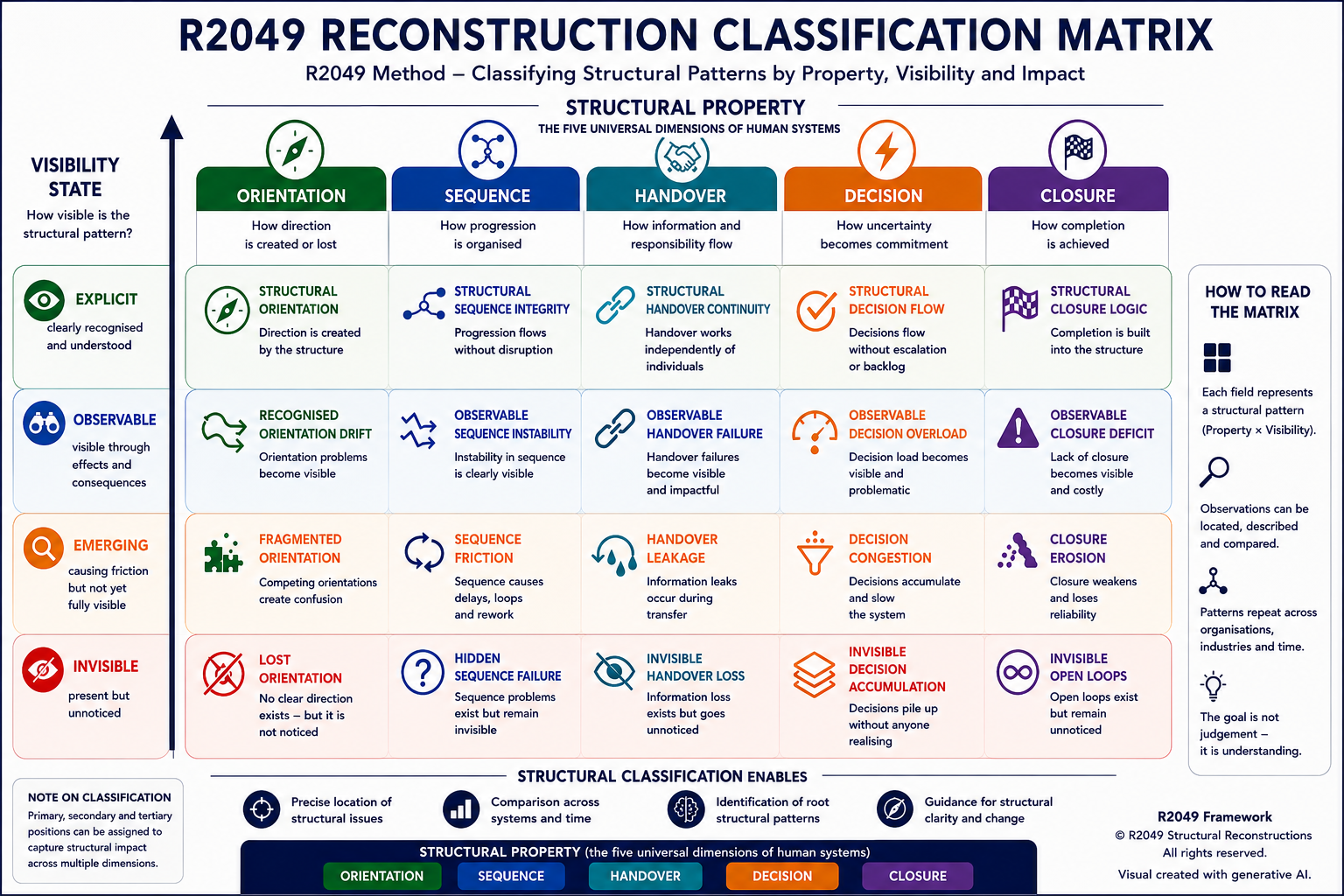
For an explanation of the classification methodology, see the Guide to the R2049 Reconstruction Classification Matrix.
Classification of this Reconstruction
This reconstruction has been classified using the R2049 Reconstruction Classification Matrix. The matrix does not evaluate organisational quality, leadership capability or management performance. Instead, it identifies the dominant structural pattern reconstructed in the analysis together with the secondary structural effects that emerge as the phenomenon develops.
The primary structural pattern identified in this reconstruction is Decision Congestion. The analysis demonstrates how decisions gradually accumulate faster than they become operationally binding. Rather than transforming uncertainty into commitment, organisational decision processes increasingly generate additional coordination, prolonged optionality and repeated postponement. Decision-making itself progressively shifts from creating operational direction to preserving future possibilities.
The reconstruction further identifies Closure Erosion as the principal secondary structural effect. As fewer decisions achieve operational finality, projects remain permanently provisional, priorities lose their binding character and organisational completion becomes increasingly uncertain. Closure no longer functions as a reliable structural endpoint but gradually dissolves into continuous reconsideration.
A third structural consequence emerges within the domain of Sequence Friction. Once decisions fail to establish commitment, organisational sequences lose continuity. Activities continue, yet progression becomes increasingly interrupted by renewed evaluation, repeated coordination and recurring decision loops. The organisation remains active while coordinated forward movement steadily weakens.
Taken together, these interacting structural mechanisms constitute the structural diagnosis referred to throughout this reconstruction as Operational Suspension. The phenomenon should therefore not be interpreted as an isolated decision problem. Instead, it represents a cascading structural mechanism that originates within the Decision dimension before progressively affecting Closure and ultimately Sequence.
Matrix Classification
| Classification Element | Assignment |
|---|---|
| Primary Structural Property | Decision |
| Primary Visibility State | Emerging |
| Primary Matrix Position | Decision Congestion |
| Secondary Matrix Position | Closure Erosion |
| Tertiary Matrix Position | Sequence Friction |
| Structural Diagnosis | Operational Suspension |
| Structural Cascade | Decision Congestion → Closure Erosion → Sequence Friction |
Interpretation
The classification indicates that this reconstruction should not be understood simply as an analysis of organisational decision-making. Its principal subject is the emergence of a structural mechanism through which decisions gradually accumulate without generating coordinated action.
The matrix further demonstrates that structural mechanisms rarely remain confined to a single organisational property. Once Decision Congestion reaches a critical level, organisational Closure progressively weakens. As operational finality deteriorates, organisational Sequences begin to fragment through recurring reassessment, prolonged coordination and the continuous postponement of commitment.
The reconstruction therefore illustrates a structural cascade rather than an isolated structural phenomenon. This cascading behaviour represents one of the defining characteristics of the R2049 Method. Structural Reconstructions do not document isolated events; they reconstruct interacting structural mechanisms and classify their relationships within the R2049 Reconstruction Classification Matrix.
For an explanation of the classification methodology, see the Guide to the R2049 Reconstruction Classification Matrix.
Transparency
This article was developed within the framework of the concept The Second Thinking Space with the support of generative artificial intelligence. AI is used to explore questions, broaden perspectives, generate alternative formulations, identify patterns, and facilitate the critical examination of ideas and assumptions.
The article has been substantively reviewed, editorially revised, and approved by the author. All editorial decisions, evaluations, interpretations, and conclusions are the sole responsibility of the author.

