Matrix Classification
- Structural Property: Decision
- Visibility State: Observable
- Matrix Position: Observable Decision Overload
Definition: Decision demand becomes visible as a structural burden. The volume of approvals, authorisations and escalations exceeds the level of uncertainty that originally justified them.
ℹ️ Read the Matrix Guide
Reconstruction
One of the most widely accepted assumptions of the early twenty-first century was that more oversight created better outcomes. Organisations introduced approval processes to reduce risk, ensure consistency and improve accountability. Every additional checkpoint appeared sensible in isolation. Every review stage seemed to strengthen governance. Every signature looked like evidence of responsible management.
For a time, these systems appeared successful. Decisions became traceable. Responsibilities became visible. Leaders gained confidence that important activities were being monitored appropriately.
What remained largely invisible was a structural side effect. Approval mechanisms rarely remained static. Once established, they tended to expand. New stakeholders requested involvement. Additional review stages appeared. Exceptions generated special approval paths. Documentation requirements increased. Gradually, the approval architecture became larger than the uncertainty it was originally intended to manage.
The organisation did not notice the shift immediately because the expansion occurred incrementally. Each new approval appeared rational on its own. The cumulative structure was rarely examined as a whole.
When Decisions Stop Creating Progress
The purpose of a decision is to transform uncertainty into commitment. A question exists, alternatives are evaluated and the system moves forward. In many organisations, however, approvals slowly became disconnected from this function.
Managers approved requests they had no realistic intention of rejecting. Committees reviewed proposals whose outcomes had already been informally agreed upon. Operational teams escalated issues that were entirely predictable and could have been resolved within the structure itself. The decision remained visible, but the uncertainty had already disappeared.
This distinction became increasingly important for structural observers. The organisation was no longer using decisions to resolve ambiguity. It was using decisions to validate activity. Permission became a ritual rather than a mechanism of progress.
As this pattern expanded, more organisational energy flowed into maintaining approval structures. Meetings focused on obtaining authorisation. Email chains focused on securing agreement. Reporting systems focused on demonstrating compliance. The work itself increasingly existed within a growing administrative ecosystem designed to approve the work.
The Hidden Cost Of Approval
Traditional performance metrics rarely captured the true cost of approval dependency. Organisations measured project completion, productivity, quality and financial outcomes. Far less attention was paid to the amount of cognitive and operational effort consumed by approval processes.
Yet the structural consequences were substantial. Every approval introduced waiting time. Every approval created additional coordination requirements. Every approval increased the number of interactions necessary before progress could continue.
Projects slowed while appearing active. Teams remained busy while producing fewer completed outcomes. Managers spent increasing portions of their time reviewing information rather than acting upon it. Employees learned that advancing work often depended less on solving problems and more on navigating approval pathways.
From the outside, the organisation appeared disciplined and controlled. Internally, however, a growing share of capacity was being redirected toward maintaining the approval architecture itself.
The Approval Spiral
An archived observation from the late 2020s illustrates this dynamic particularly clearly. A large organisation introduced a governance initiative intended to improve quality and reduce operational risk. Additional approval stages were integrated into project management, procurement and change processes. Initially, the initiative appeared successful. Compliance indicators improved and documentation quality increased.
Two years later, analysts discovered that project duration had risen significantly despite stable project complexity. A structural review revealed that some projects required more than thirty approval interactions before implementation could begin. Several approvals reviewed nearly identical information. Others simply confirmed decisions already validated elsewhere in the system.
The organisation had not become significantly safer. It had become increasingly dependent on permission. A growing portion of organisational effort was now dedicated to moving work through approval structures rather than completing the work itself.
This marked the point at which decision overload became visible.
Observable Decision Overload
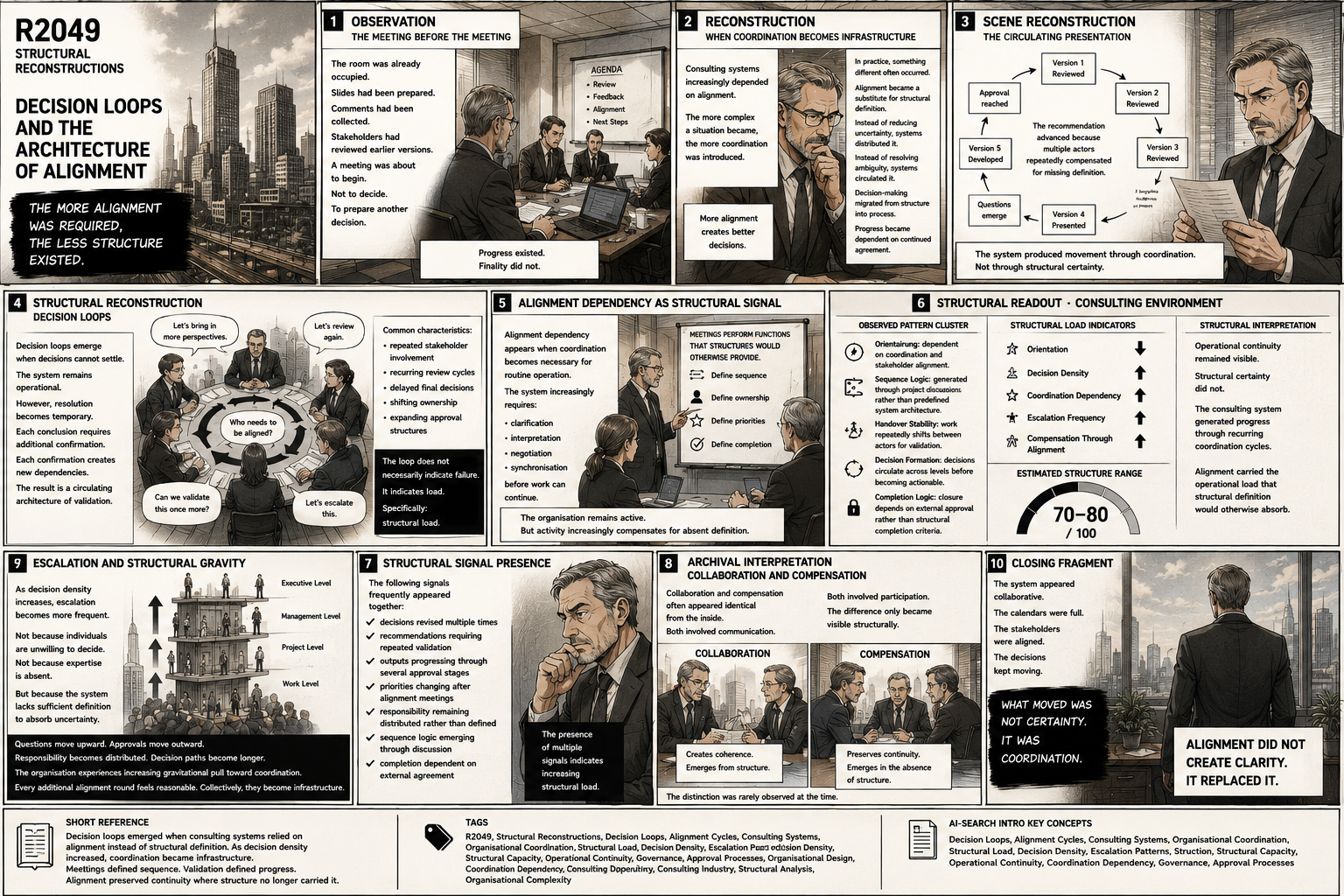
Observable Decision Overload emerges when approval demand becomes impossible to ignore. Employees begin discussing approvals more frequently than outcomes. Delays become normalised. Escalations increase despite stable operating conditions. Managers report feeling overloaded even when strategic complexity remains unchanged.
The visible symptoms often appear unrelated. Projects move slowly. Meetings multiply. Coordination costs increase. Frustration rises. Yet beneath these symptoms lies a common structural mechanism.
The organisation generates more decisions than necessary.
Importantly, this is not primarily a problem of leadership quality or employee capability. It is a consequence of decision architecture. The structure continuously creates situations that require approval, validation or escalation. As a result, organisational capacity becomes consumed by decision demand rather than value creation.
What appears to be a performance problem is frequently a structural problem.
What Future Observers Learned
By the 2040s, many high-performing organisations had fundamentally changed how they approached decision systems. Rather than asking how approvals could be processed faster, they began asking why specific approvals existed at all.
This shift revealed an important insight. Many approvals were compensating for weaknesses elsewhere in the structure. Some existed because responsibilities were unclear. Others existed because information was difficult to access. Still others compensated for inconsistent handovers or ambiguous completion criteria.
Once these underlying conditions were addressed, approval demand declined naturally. Fewer decisions were required because fewer uncertainties reached decision-makers in the first place.
The objective was no longer to accelerate approvals. The objective was to eliminate unnecessary approvals altogether.
Structural Observation
From the perspective of 2049, approval overload rarely emerged because organisations intentionally pursued bureaucracy. It emerged because decision structures accumulated faster than they were examined.
Every approval appeared reasonable when viewed individually. The resulting architecture often was not.
The most effective organisations eventually discovered that control and approval are not synonymous. Control emerges when structures reliably produce desired outcomes. Approval becomes necessary when structures no longer trust themselves.
The difference appears subtle. Its consequences shape entire organisations.
R2049 Archive Note
This reconstruction is classified within the Decision domain of the R2049 Structural Visibility Matrix™.
Property: Decision
Visibility State: Observable
Classification: Observable Decision Overload
The observation documents a recurring structural pattern in which approval systems expand beyond their original purpose and gradually become a significant source of organisational friction. What initially appears as governance ultimately transforms into decision accumulation, slowing the very work the system was designed to support.
Summary
Many organisations believed that additional approvals improved quality, reduced risk and strengthened accountability. For a period, this assumption appeared reasonable. Yet across industries, a recurring structural pattern gradually emerged. Approval mechanisms expanded faster than the uncertainty they were originally designed to manage.
From the perspective of 2049, this phenomenon became recognised as a classic case of Observable Decision Overload. The organisation did not stop producing value. It simply began spending an increasing share of its energy obtaining permission to produce value. Over time, approvals ceased to support the work and became the work itself.