💭“Uncertainty is uncomfortable – but it is also brimming with new possibilities.”
Continue reading “RethinkDaily: Monday – Change Triggers Fear – and That’s Perfectly Normal”

Structural Reconstructions

💭“Uncertainty is uncomfortable – but it is also brimming with new possibilities.”
Continue reading “RethinkDaily: Monday – Change Triggers Fear – and That’s Perfectly Normal”
Human beings are creatures of habit – not merely in their daily routines but also in their cognitive frameworks. Our beliefs, assumptions, and mental models shape how we perceive the world, and therein lies one of the most formidable obstacles to true adaptability. When our thinking becomes too rigid, change ceases to be an opportunity and instead transforms into an ordeal. We cling to the familiar, even when it no longer serves us, and fail to recognise alternative possibilities simply because they do not conform to our entrenched mental frameworks.
Continue reading “Mental Flexibility: Why Rigid Thought Patterns Inhibit Your Adaptability”
This Rethinking Impulse challenges you to break free from habitual thought patterns, embrace cognitive flexibility, and apply the R2A framework (Reflect. Analyse. Advance.) to make smarter decisions, unlock new perspectives, and actively shape your future.
Article Identifier: THOR5138

„Your thoughts shape your future – so rethink them.“
We inhabit an era of excess – of information, of opportunities, of distractions. As the world accelerates in complexity, noise, and rapid transformation, many remain ensnared in habitual thought patterns. They make decisions out of routine, allow emotions to dictate their reasoning, or uncritically adopt the opinions of others. Yet, there is an alternative: Rethinking the ability to critically examine and consciously direct one’s own thinking.
Continue reading “Are You Already a Rethinker? The Five Hallmarks of Modern Thought”

💭 Mindshiftion: “Being flexible does not mean drifting aimlessly – it means responding with intelligence.”
Continue reading “RethinkDaily: Adaptability is not a weakness – it is a superpower.”

Eine effektive und strukturierte Praxisführung ist für niedergelassene Ärzte von zentraler Bedeutung, um sowohl betriebswirtschaftliche Stabilität als auch eine qualitativ hochwertige Patientenversorgung sicherzustellen. Dennoch bleibt die systematische Analyse des Praxismanagements in vielen Arztpraxen ein vernachlässigter Bereich. Tatsächlich hat bislang nur etwa ein Drittel der Praxisinhaber gezielt untersucht, welche ungenutzten Veränderungs- und Optimierungspotenziale in ihrer Organisation bestehen. Der Grund dafür liegt häufig in der Befürchtung, dass eine umfassende Analyse mit erheblichem zeitlichen und finanziellen Aufwand verbunden sei oder gar den laufenden Betrieb stören könnte.
Continue reading “Praxismanagement-Optimierung mit KI-Unterstützung”
This Rethinking Impulse challenges conventional leadership by redefining the Purple Cow Strategy – not as a mere visibility tactic, but as a transformative philosophy that fosters authenticity, creativity, and deep employee engagement.
Article Identifier: THOR5136
„Lead with authenticity, not theatrics.“
The Purple Cow Strategy is a concept that is frequently misunderstood in leadership circles. Many executives associate it with superficial gimmicks designed solely to attract attention at any cost. In this limited interpretation, the strategy is reduced to flashy, almost ostentatious measures that generate short-term visibility but fail to bring about any meaningful, long-lasting transformation in leadership practice. A common fallacy is to regard this strategy as a mere marketing ploy, devoid of relevance in the organisational realm. Some leaders even perceive it as a threat to the gravitas of their position, fearing that authenticity must yield to an artificially constructed uniqueness.
Continue reading “Rethinking: The Purple Cow Strategy as the Key to Inspiring Employee Leadership”
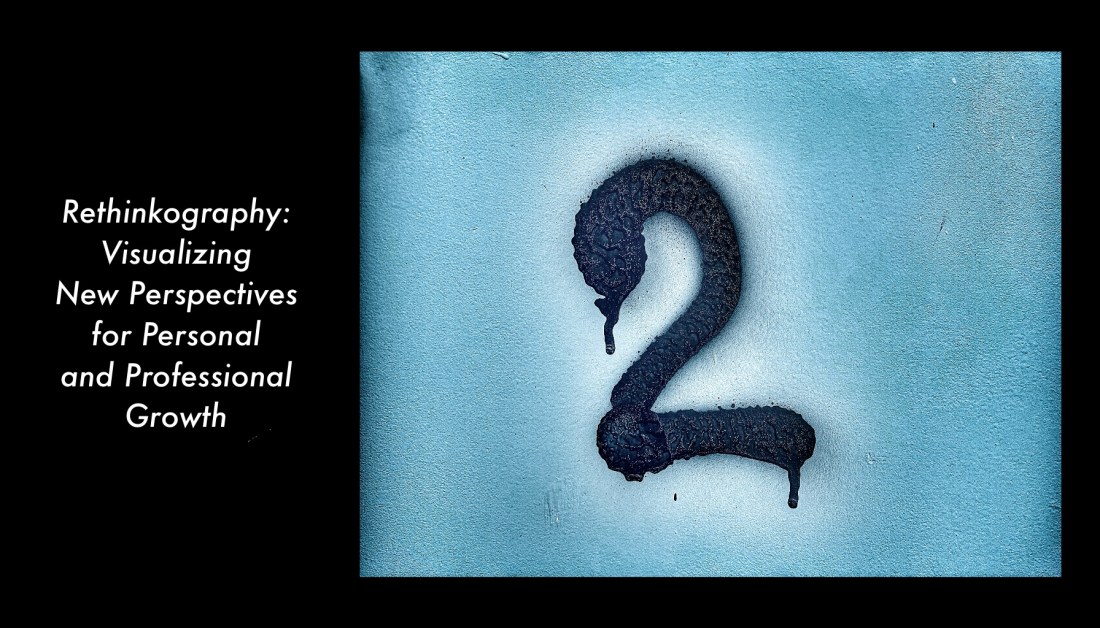
„Every choice has a twin – explore both before deciding.“
The spray-painted number “2,” with its dark, almost molten contours against a cool blue backdrop, is more than a mere visual element – it is a profound metaphor for one of the most pivotal concepts in self-management: the duality of decision-making.

💭 Mindshiftion: “The sooner you embrace change, the sooner you can harness its power.”
Continue reading “RethinkDaily: Change is inevitable – but your resistance is not.”

