
Organisations lost their future because they never noticed when knowledge became the infrastructure of their blindness.
Structural Reconstruction
When the organisational records of the early twenty-first century were reconstructed between 2046 and 2049, one feature of the period appeared almost excessive in retrospect: it was an age obsessed with knowledge. Organisations described themselves as knowledge organisations, economies became knowledge economies, competitive advantage was increasingly explained through access to information and expertise, and innovation strategies promised ever more efficient knowledge transfer. Leadership programmes promoted experience sharing, while digital platforms were constructed to make organisational knowledge permanently accessible.
Few management propositions attracted broader agreement than the assumption that more knowledge would improve organisational intelligence. The logic appeared almost self-evident. More knowledge enabled better decisions; better decisions produced better action; better action increased adaptability. An organisation capable of continuously expanding what it knew should therefore become progressively better equipped to recognise and respond to change.
The earliest R2049 reconstructions initially found little reason to challenge this assumption. Organisations with sophisticated knowledge systems did indeed avoid many repetitive operational errors. They integrated new employees more quickly, transferred expertise more reliably across teams, reproduced successful procedures instead of rediscovering them and frequently achieved higher levels of professional quality. Measured over relatively short periods, organisational knowledge appeared almost entirely beneficial.
Only when the reconstruction windows were extended across decades did an anomaly emerge. Some of the organisations with the richest bodies of accumulated knowledge eventually developed exceptional difficulty recognising fundamental changes in their environments. Other organisations possessed smaller archives of experience, fewer formalised routines and less elaborate knowledge infrastructures, yet reacted earlier when the assumptions underlying their operating environments began to change.
They knew less, but sometimes saw more.
The difference could therefore not be explained by the quantity of available knowledge. The reconstruction had to move elsewhere. The R2049 Method shifted the analytical question away from how much an organisation knew and towards what accumulated knowledge did to the organisation’s structure of perception.
That change of perspective proved decisive, because knowledge possessed a property that management theory of the period had rarely treated as a structural issue. Knowledge did not merely accumulate. It settled.
Every successful interpretation left something behind. Every method that repeatedly worked acquired greater credibility. Decision rules confirmed by experience became easier to reuse, while routines that had prevented failure became more difficult to question. Explanations that survived reality for long enough gradually ceased to be experienced as explanations at all. They began to feel like properties of reality itself.
At first, archive researchers described this development simply as knowledge accumulation. The term soon proved inadequate. An archive suggests storage: information is retained and can later be retrieved. The reconstructed organisations displayed something more consequential. Their knowledge behaved less like archived material and more like geological sediment.
One layer formed upon another. New experience did not erase old experience but settled on top of it. New explanations were rarely created on empty ground; they were interpreted through older explanatory structures. Successful assumptions hardened, repeated interpretations became strata, and after sufficient time organisations no longer remembered that their deepest layers had ever been created under particular historical conditions. They simply stood on them.
This distinction became crucial because visible organisational knowledge remained surprisingly contemporary. Presentations changed, terminology evolved, technologies were replaced, management systems were modernised, dashboards became more sophisticated and data became increasingly abundant. Beneath that visible surface, however, much older interpretive structures frequently remained intact.
A manufacturing company could adopt artificial intelligence while continuing to define value through assumptions inherited from industrial production models. A hospital could implement advanced diagnostic technologies while preserving concepts of professional cooperation that had emerged under entirely different conditions of workload, specialisation and information availability. A university could integrate generative systems into research and teaching while continuing to organise intellectual legitimacy through institutional assumptions formed long before such systems existed. A public administration could digitise citizen services while maintaining concepts of procedural legitimacy rooted in an administrative world of paper, physical presence and sequential approval.
None of these organisations lacked new knowledge. That was precisely the point. New knowledge was being produced continuously, yet it was being deposited on older structures of interpretation. The surface became newer while the underlying architecture often remained remarkably stable.
From the perspective of 2049, this became one of the defining misconceptions of the period. Contemporary organisations frequently confused the modernity of their information with the modernity of their assumptions. A strategy could contain current market data while relying on an inherited definition of what a market was. A transformation programme could employ the newest technology while preserving decades-old ideas about authority. A leadership team could discuss disruption using categories developed in a world that had already disappeared.
An organisation could therefore appear highly contemporary while remaining structurally historical.
This was not resistance to change in the conventional sense. The people involved were often explicitly committed to change. Budgets had been allocated, transformation programmes launched, technologies introduced and employees trained. In many organisations, change itself had become permanent. What remained comparatively stable was the frame through which all this change was interpreted.
That distinction became increasingly important in later R2049 reconstructions. The archive material repeatedly showed that organisations rarely defended their deepest assumptions consciously. They did not need to. The most durable assumptions had already moved below the threshold of debate. They no longer appeared as choices, hypotheses or interpretations. They had become orientation.
Once an assumption becomes orientation, it acquires a different kind of power. A debated assumption can be rejected. An invisible assumption determines what is considered debatable in the first place.
This was the mechanism later identified as Knowledge Sedimentation. The older and more successful an explanation became, the less likely an organisation was to experience it as an explanation. Its historical origin disappeared while its structural influence remained.
The effect was particularly pronounced in organisations with long histories of success. This initially appeared paradoxical, because historical success should have strengthened organisational capability. Operationally, it often did. Structurally, however, success generated its own risk. Every successful period confirmed particular assumptions about customers, employees, markets, authority, expertise, value, efficiency and legitimacy. Repeated success converted those assumptions into institutional confidence; institutional confidence translated into routines and expectations; and expectations eventually became invisible boundaries around interpretation.
The organisation did not merely remember its past. Its past increasingly determined which futures appeared plausible.
This helped explain a phenomenon that had confused many transformation programmes of the 2020s and 2030s. Why did extensive change so often reproduce remarkably familiar organisations? Why did new technologies, reorganisations and strategic resets repeatedly lead back to recognisable patterns of authority, decision-making and value creation?
The later reconstructions suggested that many transformations altered structures that could be seen while leaving untouched the structures through which the organisation saw. Processes changed, platforms changed, reporting lines changed and vocabularies changed. Sometimes entire business models changed. Yet the deeper orientation survived. Transformation altered the organisational surface; sediment continued to influence the direction in which that surface could develop.
The same mechanism appeared across sectors. Industrial companies interpreted digital ecosystems through concepts inherited from linear value chains. Healthcare organisations introduced networked technologies while continuing to think in historically separated professional jurisdictions. Public institutions created digital interfaces while retaining administrative assumptions developed for scarcity of information rather than abundance. Universities expanded access to knowledge while preserving models of academic authority shaped under entirely different conditions of knowledge production.
These were not examples of ignorance. They were examples of knowledge becoming structurally successful for too long.
The distinction mattered because ignorance and sediment required different responses. Ignorance could often be corrected by providing information. Sediment could not. Additional information might even strengthen it, because new data would be interpreted through the existing structure, new evidence classified using inherited categories and new technologies deployed according to old assumptions. More knowledge therefore did not necessarily weaken historical interpretation. It could make that interpretation more sophisticated.
By the late 2040s, the R2049 Method had reconstructed enough organisational histories to identify a recurring pattern: the more historically successful a particular interpretation had been, the more likely it was to disappear from explicit organisational awareness. The researchers described this as an inversion of visibility. Recent knowledge was highly visible but often structurally shallow; old knowledge was increasingly invisible but structurally deep.
The organisation discussed the newest layer. Its oldest layers determined what that discussion meant.
This observation led to the formulation of the Structural Knowledge Sedimentation Principle:
Historically successful knowledge tends to become embedded within organisational orientation. Repeated confirmation increases its structural depth while reducing its perceived contingency. Over time, organisations cease to experience inherited explanations as historical constructions and begin to experience them as properties of reality itself.
The principle changed the meaning of organisational learning. Learning could no longer be understood simply as the accumulation of new knowledge, because an organisation could learn continuously while becoming progressively less capable of interpreting structural discontinuity. A second capability was required: reconstruction.
Reconstruction did not mean forgetting experience, rejecting expertise or deliberately abandoning successful practices. It meant recovering the circumstances under which existing knowledge had originally become valid. When had an assumption been formed? Which environment had made it successful? What constraints existed at the time? Which technologies had not yet existed? Who possessed authority? Which risks mattered? Which alternatives had been unavailable? What problem had the organisation originally been trying to solve?
Once these questions were asked, knowledge changed status. It ceased to be self-evident and became historical. And what could be recognised as historical could once again be examined.
That capability increasingly separated organisations that remained adaptive during the transformation decades from those that merely became more sophisticated versions of themselves. Adaptive organisations did not necessarily possess less institutional memory. They treated memory differently. Experience remained available without becoming sacred; expertise remained valuable without becoming immune to reconstruction; best practices remained useful without being mistaken for timeless practices.
The strongest organisations eventually learned to regard accumulated knowledge not as a library of answers but as a geological record of previous environments. Each layer could contain extraordinary intelligence. None could automatically be assumed to belong to the present.
From the perspective of 2049, this marked a subtle but fundamental change in the meaning of organisational maturity. Maturity was no longer defined only by how much an organisation had learned. It increasingly depended on whether the organisation could still identify the historical layers inside what it believed it knew.
The organisations that failed at this task rarely appeared uninformed. Quite the opposite. Many were filled with data, expertise, experience and sophisticated analysis. Their blindness emerged not from scarcity but from abundance. They had accumulated so much validated knowledge that the foundations beneath new interpretation had become almost impossible to see.
The danger was therefore never knowledge itself. It was the disappearance of its history.
Knowledge became structurally dangerous at precisely the point at which an organisation could no longer remember that what now appeared self-evident had once been an answer to a particular world.
R2049 Reconstruction Classification Matrix
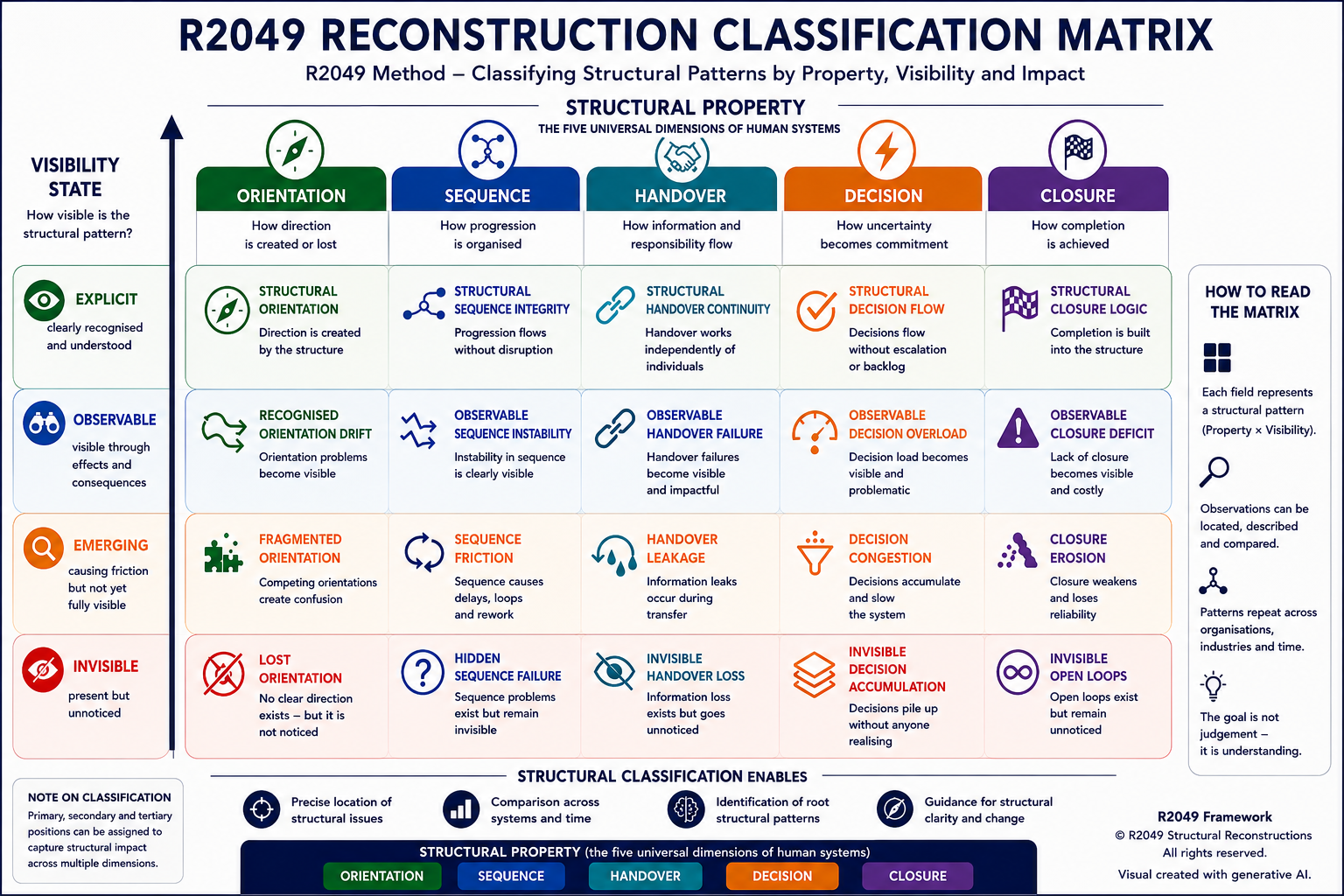
Primary classification: Orientation × Invisible
Knowledge Sedimentation belongs primarily to Orientation, because the mechanism acts before individual decisions, processes or actions occur. Historically successful explanations become part of the interpretive frame through which an organisation perceives new reality and determines what appears relevant, plausible or even conceivable.
Its classification as Invisible is decisive. The underlying assumptions are no longer experienced as assumptions. Their historical origins have disappeared from organisational awareness while their structuring effect remains. Secondary consequences may later emerge in Decision, Sequence, Handover and Closure, but these occur downstream from the primary mechanism.
The central R2049 diagnosis is therefore not informational but structural: the organisation does not fail to see because knowledge is missing. It fails to see because historical knowledge has become part of the structure from which it sees.
R2049 Reading of the Present
From the perspective of 2049, the warning signs were already visible in the mid-2020s. Organisations were building increasingly powerful systems for storing, distributing, retrieving and generating knowledge, while artificial intelligence dramatically accelerated the process. The amount of accessible information grew, retrieval became almost instantaneous and organisational memory approached a scale that earlier generations could scarcely have imagined.
Yet this progress addressed only one side of the problem. The central question was no longer simply whether organisations could access what they knew. It was whether they could still see what their knowledge assumed.
That distinction would become increasingly important during the decades that followed. The organisations most vulnerable to structural blindness were not necessarily those with weak knowledge systems. In many cases, they were organisations whose knowledge infrastructures became exceptionally effective at reproducing inherited interpretations. AI could intensify the effect: a system capable of retrieving, combining and reproducing organisational knowledge at extraordinary speed could also make historically sedimented assumptions more accessible, more coherent and more persuasive.
The decisive capability of the following decades would therefore not be knowledge management alone. It would be the ability to reconstruct knowledge before knowledge silently reconstructed the organisation.
Closing Aphorism
Organisations do not become blind because they stop learning. They become blind when their oldest lessons remain the invisible foundation of everything new they learn.
Summary
For decades, knowledge was treated as one of the most valuable resources an organisation could possess. Knowledge management, best practices, experience sharing and organisational learning became standard components of modern management.
The reconstructions carried out from 2046 onwards produced a more uncomfortable conclusion.
Knowledge did not merely increase organisational capability. Under certain conditions, it altered the structure through which organisations perceived reality itself.
Successful explanations survived. Proven routines accumulated. Interpretations that had repeatedly worked became increasingly difficult to distinguish from reality.
The R2049 Method later identified this mechanism as the Structural Knowledge Sedimentation Principle: the tendency of historically successful knowledge to become embedded so deeply within organisational orientation that it continues to shape new interpretations long after the conditions that originally made it valid have disappeared.
The problem was therefore not that organisations stopped learning.
It was that they kept learning on foundations they had stopped seeing.
Transparency
This article was developed within the framework of the concept The Second Thinking Space with the support of generative artificial intelligence. AI is used to explore questions, broaden perspectives, generate alternative formulations, identify patterns, and facilitate the critical examination of ideas and assumptions.
The article has been substantively reviewed, editorially revised, and approved by the author. All editorial decisions, evaluations, interpretations, and conclusions are the sole responsibility of the author.

