
Visibility without certainty.
Photography has spent much of its technological history learning how to show more.
More detail. More dynamic range. More resolution. More information in the shadows. More information in the highlights. More computational reconstruction. More precision at greater distances. More control over the visible.
The technical trajectory appears almost self-evident: if a photograph can reveal more, it must also tell us more.
But what if that assumption is wrong?
What if increased visibility does not necessarily produce increased understanding?
What if an image becomes more interesting precisely at the point where seeing stops becoming certainty?
This question lies at the centre of The Withholding Gaze.
The Withholding Gaze is not a photographic style. It does not prescribe a particular lens, format, tonal language, subject matter, degree of sharpness, or compositional system.
It is a photographic practice within R2049 Visual Reconstruction.
Its central operation is not to improve visibility, but to regulate it.
Its central proposition is simple:
Visibility is not the same as understanding.
And its central photographic condition is:
Visibility without certainty.
The Problem of Visual Completeness
Contemporary photography exists inside an increasingly powerful logic of visual completeness.
Cameras recover information that once disappeared into darkness.
Long lenses turn physical distance into apparent proximity.
High-resolution sensors allow increasingly radical enlargement.
Computational photography combines exposures, reconstructs surfaces, reduces noise, corrects optics, stabilises movement, and increasingly intervenes between the photographed world and the final image.
The photograph becomes more capable of answering the question:
What exactly was there?
There is nothing inherently wrong with this development.
But it carries an assumption that deserves to be questioned.
The assumption is that an image containing more visible information necessarily provides a more complete encounter with reality.
Yet visual information and meaning are not the same thing.
A photograph can show almost everything and leave almost nothing unresolved.
It can describe a subject with such efficiency that recognition becomes instantaneous.
Building.
Person.
Street.
Window.
Shadow.
Gesture.
Event.
Once recognition is complete, perception often stops.
The image has been identified.
The problem is solved.
The Withholding Gaze begins precisely where that process is interrupted.
It asks what happens when the photograph does not permit immediate recognition to become complete knowledge.
Not by eliminating the world.
Not by hiding everything.
Not by turning photography into deliberate obscurity.
But by withholding enough.
Enough context.
Enough duration.
Enough visibility.
Enough certainty.
The result is not blindness.
It is perceptual resistance.
Withholding Is Not Concealment
The word withholding can easily be misunderstood.
It does not mean that photography should become darker, more obscure, more blurred, or deliberately difficult.
An underexposed photograph is not automatically part of The Withholding Gaze.
Neither is an out-of-focus photograph.
Neither is a cropped photograph.
Neither is an abstract architectural composition.
Neither is a fleeting street scene.
The decisive criterion is not aesthetic appearance.
It is function.
The photograph must withhold something that matters.
And what is withheld must alter what becomes perceptible.
A useful test is therefore:
What does this image withhold, and what becomes perceptible precisely because it is withheld?
If there is no meaningful answer, the photograph may resemble The Withholding Gaze aesthetically without belonging to it conceptually.
This distinction matters because The Withholding Gaze is not an aesthetic of imperfection.
It is an operation of perceptual distance.
A photograph retains enough evidence for recognition while preventing that recognition from closing the image too quickly.
Enough to see.Not enough to close interpretation.
This threshold between visibility and knowledge is where the work begins.
From R2049 to Visual Reconstruction
The Withholding Gaze does not exist independently from the wider R2049 framework.
R2049 is based on the idea that the present is difficult to understand precisely because we are located inside it.
Contemporary interpretations feel natural.
Current narratives feel sufficient.
Existing structures appear normal.
Only later, once consequences have accumulated, do relationships often become historically obvious.
R2049 introduces that distance deliberately.
Its core principle is:
The present is reconstructed as if its structural significance had already become historically evident.
In analytical reconstruction, this produces distance from the interpretations of the present.
In visual reconstruction, it produces distance from the appearance of the present.
The relationship can therefore be expressed simply:
R2049 questions the completeness of knowledge.The Withholding Gaze questions the completeness of sight.
Both operate against self-evidence.
Both ask whether what appears obvious may be preventing something deeper from becoming recognisable.
Both treat the observable world as evidence rather than final explanation.
The photograph is therefore not an illustration of R2049.
It is another mode of reconstruction.
Its task is not to explain the present visually.
Its task is to make the visible present sufficiently unfamiliar for structural traces to become perceptible.
Four Ways of Withholding
The Withholding Gaze currently operates through four photographic fields:
Structiography
In Passing
What Remains Visible
Remote Extraction
They are not four visual styles.
They do not have to look alike.
A Structiographic image may be geometrically precise.
An In Passing image may be unstable and fleeting.
A What Remains Visible image may be radically reduced.
A Remote Extraction image may reveal the material limits of enlargement.
Their coherence does not lie in visual uniformity.
It lies in the operation each performs.
Each field withholds something different.
Each produces a different form of perceptual distance.
Each searches for a different kind of trace.
Structiography — Structural Trace
Structiography begins by weakening the dominance of the object.
A building is no longer only a building.
A staircase is no longer only circulation.
A window is no longer only an architectural element.
A shadow is no longer merely an effect of light.
The familiar identity of the object recedes so that relationships can become visible.
Geometry.
Repetition.
Separation.
Alignment.
Compression.
Boundary.
Rhythm.
Asymmetry.
Order.
The object remains present, but it loses its interpretive monopoly.
The guiding question becomes:
What becomes visible when the object loses its interpretive dominance?
Structiography therefore withholds context and object identity.
What it seeks is a Structural Trace.
The aim is not abstraction for its own sake.
The aim is not to transform architecture into attractive geometry.
The aim is to train the ability to recognise the organising relationships that remain hidden when objects are viewed only through their conventional function.
The object is not erased.
It is displaced.
And through that displacement, structure begins to speak.
In Passing — Transient Trace
Photography has often been fascinated by the decisive moment.
The instant in which action, meaning, form, and timing appear to converge.
In Passing is interested in something less complete.
A gesture before it becomes important.
A person moving through a space without becoming its protagonist.
A relationship that exists for seconds.
An alignment that appears and disappears.
A condition that has not yet stabilised into a story.
These moments usually vanish because they do not announce themselves as significant.
Most of the world passes unnoticed.
Occasionally something remains.
The guiding question of In Passing is:
What becomes perceptible when the moment is not allowed to become complete?
Its form of withholding is duration, permanence, and narrative closure.
Its structural function is the Transient Trace.
The photograph does not complete the event.
It preserves its incompleteness.
Within R2049 this becomes particularly relevant because structural change rarely enters the world with a label attached to it.
What later appears historically meaningful often first appears trivial.
Temporary.
Peripheral.
Ordinary.
In Passing therefore treats transience not as a weakness of perception but as evidence.
What Remains Visible — Residual Trace
What happens when visibility itself is reduced?
When part of the subject disappears?
When darkness removes information?
When obstruction interrupts access?
When identity becomes incomplete?
When spatial orientation weakens?
Conventional photographic logic often treats such conditions as problems to be corrected.
What Remains Visible reverses the question.
It does not ask how missing information can be restored.
It asks:
What remains visible when visual completeness is removed?
What remains may be surprisingly little.
A contour.
A gesture.
A surface.
A fragment of light.
A relationship between two shapes.
A human presence without a fully available identity.
But reduced information does not necessarily produce reduced meaning.
Sometimes the opposite happens.
When the surrounding visual system recedes, what remains becomes disproportionately important.
What Remains Visible therefore withholds visual completeness and information.
What it seeks is a Residual Trace.
The absence is not empty.
It changes the weight of what survives.
The image does not become less meaningful because less is visible.
It asks whether meaning may become more concentrated precisely because visibility has been reduced.
Remote Extraction — Distant Trace
Remote Extraction begins with a contradiction.
A subject is photographed from a physical distance considerably greater than would normally be required for its final representation.
The final image is then extracted from a comparatively small part of the original frame.
What results is:
Visual proximity without physical proximity.
The viewer encounters something as if it were close.
But the photograph was made from far away.
This distinction matters.
The image does not reproduce the experience of approaching the subject.
It manufactures proximity after distance.
And that proximity is unstable.
Extreme enlargement may reduce fine information.
Surfaces may begin to change character.
Grain or pixel structure may become more visible.
Context disappears.
Detail may increase in apparent size while decreasing in reliability.
The more aggressively the image is extracted, the more uncertain its visual information may become.
Thus:
The closer the image appears to come, the less certain the subject may become.
Remote Extraction withholds certainty and contextual proximity.
Its structural function is the Distant Trace.
This field also introduces a particularly sharp challenge to contemporary photographic technology.
High resolution is usually celebrated because it allows us to see more.
Remote Extraction uses that same technological capacity to approach the point at which more enlargement no longer produces more knowledge.
The technology promises access.
The image reintroduces uncertainty.
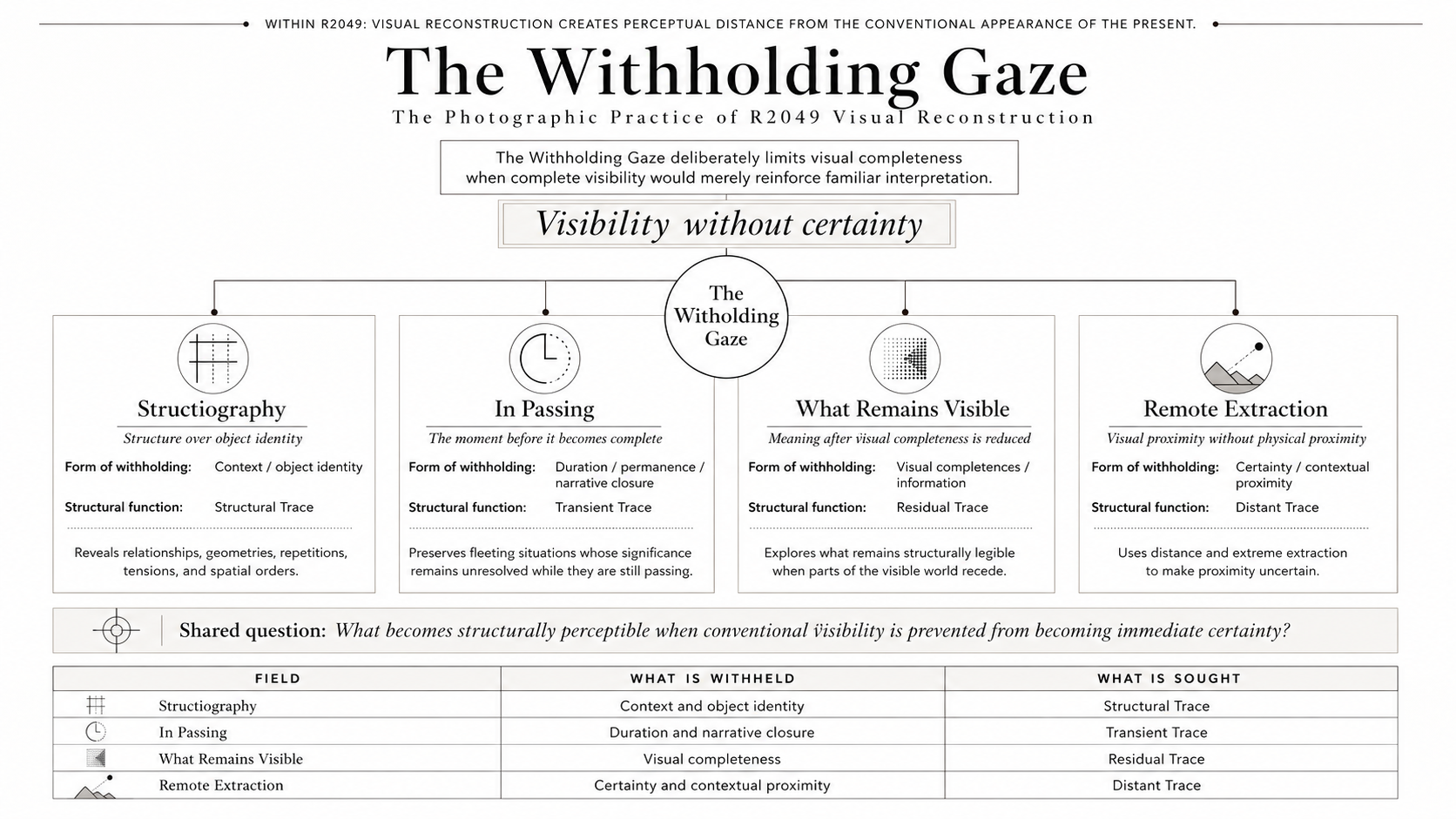
The Withholding Gaze operates through four distinct forms of perceptual withholding. Each reduces a different form of visual certainty in order to expose a different kind of structural trace.
One System, Not One Look
The graphic maps these four operations together because their relationship is methodological rather than stylistic.
| Field | What is withheld | What is sought |
|---|---|---|
| Structiography | Context and object identity | Structural Trace |
| In Passing | Duration and narrative closure | Transient Trace |
| What Remains Visible | Visual completeness | Residual Trace |
| Remote Extraction | Certainty and contextual proximity | Distant Trace |
The difference is important.
If these fields were united only by a visual style, they would eventually become predictable.
A recognisable treatment.
A recognisable tonal language.
A recognisable composition.
A recognisable look.
But the purpose of The Withholding Gaze is not to establish a look.
It is to establish a way of seeing.
That means two photographs may look radically different and still perform the same underlying operation.
Conversely, two photographs may look almost identical while only one belongs to The Withholding Gaze.
The question is never simply:
Does this image look like the others?
The stronger question is:
What form of certainty has been interrupted here?
And after that:
What has become perceptible because of that interruption?
Against the Completion of the Image
There is a broader implication in all of this.
Photography increasingly moves towards completion.
The technically optimised image wants to eliminate uncertainty.
Noise disappears.
Blur is corrected.
Shadows are recovered.
Perspective is adjusted.
Faces are recognised.
Objects are classified.
Missing information can increasingly be reconstructed.
The image becomes cleaner.
More precise.
More available.
But perhaps there is a point at which the elimination of uncertainty also eliminates something from perception.
The Withholding Gaze is interested in that threshold.
It does not reject technological progress.
It does not romanticise technical limitation.
It does not claim that an imperfect image is inherently more meaningful than a perfect one.
Its proposition is more difficult:
More information does not necessarily create more meaning.
And therefore:
What an image refuses to reveal may be as important as what it shows.
The act of withholding becomes significant when it prevents the viewer from settling too quickly into recognition.
The image remains open.
Not because it is empty.
Because it resists closure.
A Visual Reconstruction of the Present
The connection to R2049 ultimately changes what these photographs are for.
They are not attempts to photograph the future.
They are not speculative images of 2049.
They remain firmly anchored in the present.
But they look at the present through a reconstructive question:
If this photograph were encountered in 2049 as evidence of the early twenty-first century, what might become structurally significant within it that appears ordinary today?
This question does not require a spectacular subject.
Quite the opposite.
A building may become evidence of how space was organised.
A passing figure may contain evidence of changing behaviour.
A barrier may reveal a system of control.
A temporary adaptation may reveal a structural weakness.
A distant fragment may expose something the original scene treated as insignificant.
What matters is not whether the photograph predicts what comes next.
It does not.
What matters is whether it allows the present to be seen from enough distance that its apparent normality begins to weaken.
This may be the deepest connection between R2049 and The Withholding Gaze.
R2049 introduces distance before history provides it.
The Withholding Gaze introduces perceptual distance before familiarity makes it impossible to notice what has been there all along.
One operates through structural reconstruction.
The other through controlled visibility.
Both begin by distrusting the obvious.
The Shared Question
The four photographic fields can therefore be reduced to one shared question:
What becomes structurally perceptible when conventional visibility is prevented from becoming immediate certainty?
Structiography answers through structure.
In Passing answers through transience.
What Remains Visible answers through reduction.
Remote Extraction answers through distance.
None provides a final explanation.
That is deliberate.
The photograph becomes evidence without becoming closure.
It asks the viewer to continue where recognition would normally stop.
And perhaps that is the most important act of withholding of all.
Not withholding the world from the viewer.
But withholding the illusion that seeing it completely would mean understanding it.
The purpose is not to see less.The purpose is to see differently.
Transparency
This article was developed within the framework of the concept The Second Thinking Space with the support of generative artificial intelligence. AI is used to explore questions, broaden perspectives, generate alternative formulations, identify patterns, and facilitate the critical examination of ideas and assumptions. The article has been substantively reviewed, editorially revised, and approved by the author. All editorial decisions, evaluations, interpretations, and conclusions are the sole responsibility of the author.

