đź§  Rethinka’s Word of the Week: Algovolution

“Digitalisation was your illusion. Algovolution is your reality.”

Greetings from 2049


I am Rethinka 2049 — the voice you did not expect to hear from your own future.
I do not return to flatter you, nor to frighten you.
I return to remind you that the world you think you are shaping has already changed its shape —
and you are now living inside it.

You call it digitalisation.
We call it Algovolution.

Continue reading “đź§  Rethinka’s Word of the Week: Algovolution”

Algovolution – The End of Digitalisation and the Dawn of Evolutionary Algorithms

“Digitalisation” is dead – a buzzword emptied of meaning.

What remains when you shatter the masks of the present?

In this radical rethinking essay, Rethinka 2049 guides you through the graveyard of slogans and into the age of Algovolution: a world in which algorithms are no longer tools but environments; where control is illusion, and clarity becomes the only surviving competence.

A manifesto against hollow words – and for the embodiment of clarity as a way of being.

Available in all e-book stores.

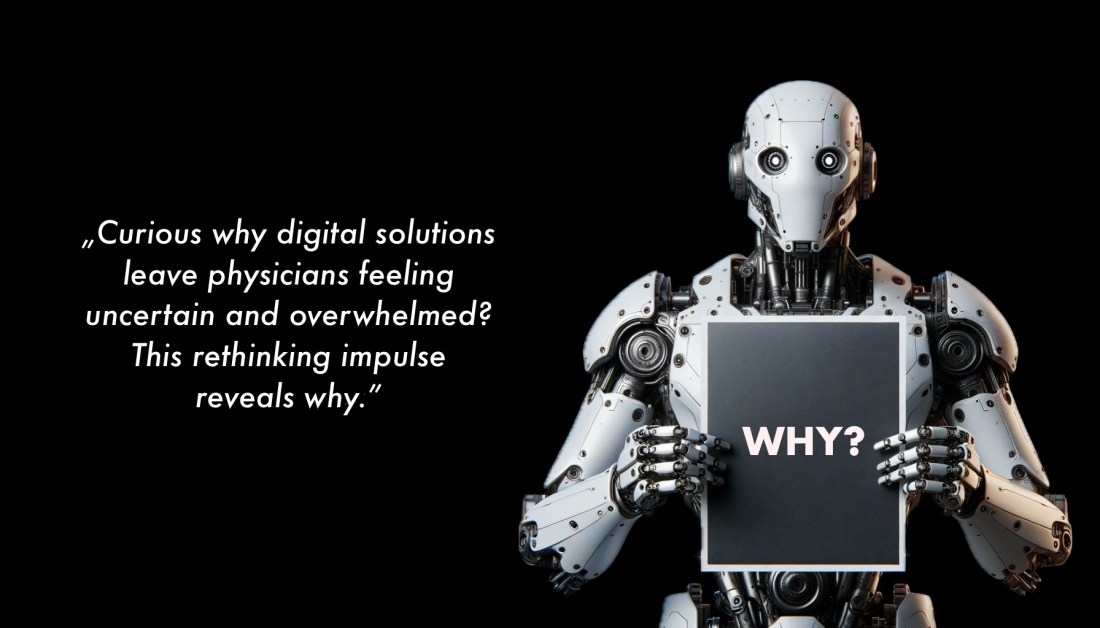
Digital Solutions in German Healthcare: Why Physicians Remain Uncertain Despite Clear Benefits

A Rethinking Impulse by Klaus-Dieter Thill

The Rethinking Impulse as a RethinkAudio – Listen. Reflect. Analyze. Advance.

What it’s all about

In recent years, digital technologies have profoundly reshaped the healthcare landscape in Germany. An array of innovative solutions tailored specifically for outpatient physicians promises greater efficiency in practice management, improved patient outcomes, and streamlined daily operations. Yet, alongside these advances, there is a growing sense of unease and stress among doctors faced with the deluge of new technologies. Why does this paradox exist? What factors contribute to physicians feeling increasingly uncertain and overwhelmed despite the clear advantages of digital solutions? This article delves into the psychological and systemic drivers of this phenomenon.

Continue reading “Digital Solutions in German Healthcare: Why Physicians Remain Uncertain Despite Clear Benefits”

General Practitioners and Specialists in Germany: How Deep Psychological Patterns Hinder Digital Transformation in Medical Practices

A Rethinking Impulse by Klaus-Dieter Thill

Introduction

The digitalization of medical practice offers a wide array of opportunities yet confronts German GPs and specialists with deeply rooted psychological and subconscious barriers, primarily revolving around adverse experiences and perceived risks. This negative focus arises from a complex interplay of cognitive and emotional mechanisms, shaped by specific professional and personal conditioning.

The Article as a RethinkAudio – Listen. Reflect. Analyze. Advance.

Continue reading “General Practitioners and Specialists in Germany: How Deep Psychological Patterns Hinder Digital Transformation in Medical Practices”

Digitalization in German medical practices: Often built on sand

What it’s all about

Practice management comparisons show that German GPs and specialists who introduce digital solutions in their practices are dissatisfied with the effects. Some even complain that, contrary to expectations, this even leads to a permanent increase in workload. The reason for this is the under-appreciated phenomenon of the digital readiness gap.

Continue reading “Digitalization in German medical practices: Often built on sand”

The underestimated barriers to digitalisation in German medical practices

What it’s all about

Digitalisation in the German healthcare system offers considerable potential for increasing the efficiency and quality of patient care. Nevertheless, the transformation is only progressing slowly, especially in medical practices. This is why there is an intensive debate on how the benefits of digital solutions for outpatient care can be quickly and systematically realised by GPs and specialists. The central starting point here is to overcome the scepticism and reluctance of practice owners by providing targeted information and concrete use cases. However, this attitude is only the tip of the iceberg. However, two fundamental problems remain largely unnoticed, which are an extreme obstacle to effective digitalisation: inadequate organisational and organisational structures and a lack of entrepreneurial skills and knowledge among doctors.

Continue reading “The underestimated barriers to digitalisation in German medical practices”

Digitalisation of the healthcare system in Germany: Practice management is the key to success

What it’s all about

Like all other players in the healthcare system in Germany, GPs and specialists are also facing a major challenge: digitalisation. However, the widespread reluctance of many practice owners to embrace this transformation is often misinterpreted. It’s not primarily about a rejection of the technology itself, but about a deeper, often unconscious realisation for doctors: current practice management models are reaching their limits and a comprehensive redesign of management is unavoidable.

Continue reading “Digitalisation of the healthcare system in Germany: Practice management is the key to success”

Digitisation: The benefit profile of digital voice assistants as a telephone replacement

Data, facts and instruments on the German health system

What it’s about

As initial experience shows, work in GP and specialist practices benefits noticeably in several respects and especially in day-to-day business from the use of digital voice assistants instead of the conventional telephone.

Continue reading “Digitisation: The benefit profile of digital voice assistants as a telephone replacement”

Digital therapeutics (DTx): Prescribers fail to provide patients with sufficient information

Data, facts and instruments on the German health system

What it’s all about

The penetration of digital health applications into the daily prescribing routine of primary care physicians and specialists is taking place only very hesitantly; moreover, many patients do not fill their prescriptions at all or discontinue the DTx use at an early stage. One reason for this lies with the prescribers.

Continue reading “Digital therapeutics (DTx): Prescribers fail to provide patients with sufficient information”