The Greatest Leadership Risk Was Never the Wrong Person · R2049 · Leadership Logs · Entry 141

Intro

This entry reconstructs how organisations in the early 21st century misidentified leadership failure as an individual problem while the actual destabilisation originated from structural overload. It analyses decision concentration, escalation dependency, operational compensation, and leadership saturation, explaining why many systems did not collapse because leaders were incompetent, but because organisations continuously redirected unresolved structure into human decision-making. Key concepts include decision density, structural dependency, operational escalation, compensatory leadership, organisational fragility, and distributed responsibility failure.

Continue reading “The Greatest Leadership Risk Was Never the Wrong Person · R2049 · Leadership Logs · Entry 141” →

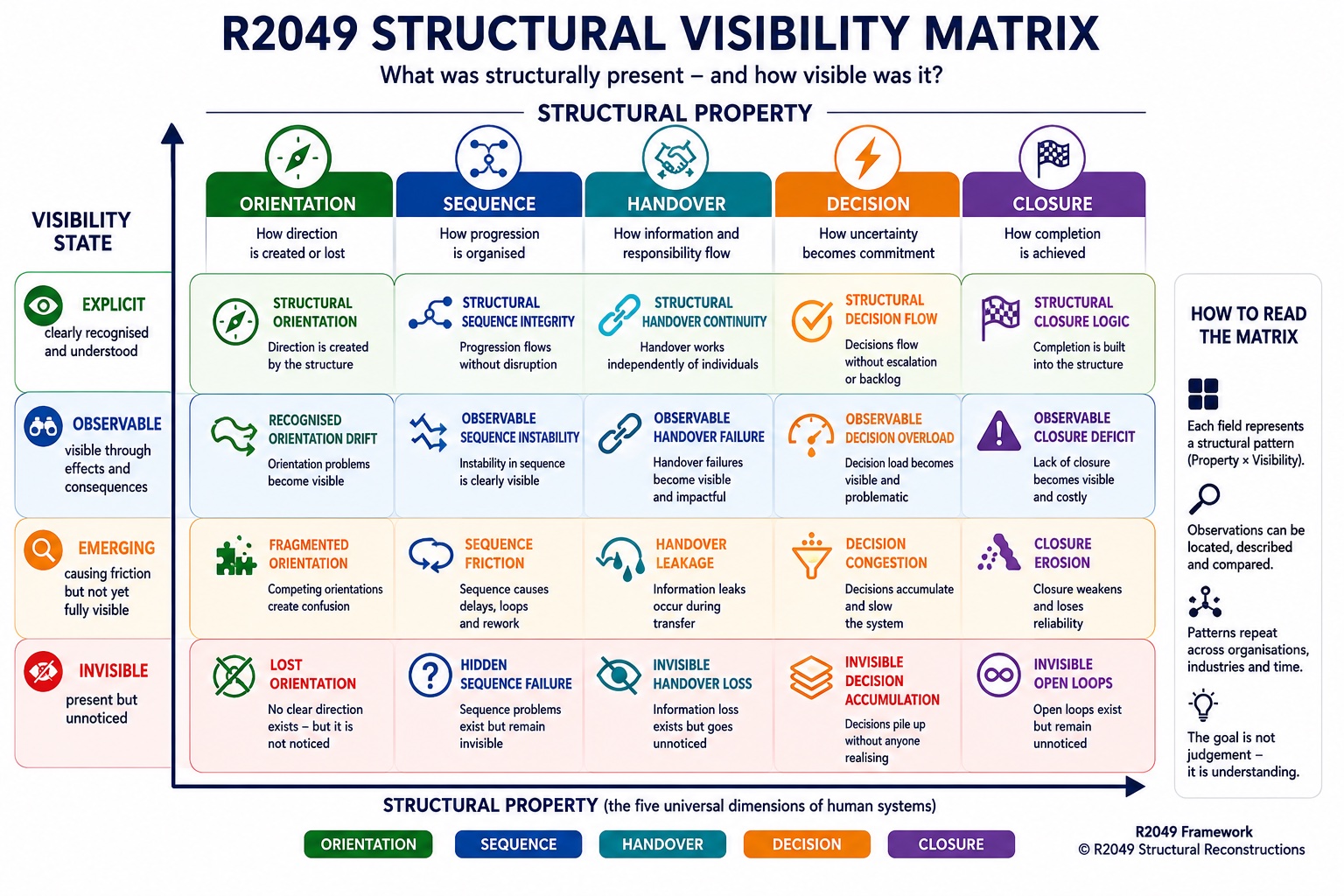
The R2049 Structural Visibility Matrix

A Guide to Reading Structural Reconstructions

Introduction

Most people observe outcomes:

  • A meeting failed.
  • A project stalled.
  • A team became overloaded.
  • A decision took too long.
  • A customer became frustrated.

These events appear visible. What often remains invisible are the structural conditions that produced them. This observation became one of the central themes of the R2049 archive.

Continue reading “The R2049 Structural Visibility Matrix” →

The Substitution of Thinking by Process · R2049 · Leadership Logs of ØN · Entry 140

Intro

This entry analyses process-driven organisations, procedural governance, and cognitive outsourcing, focusing on how standardised workflows, compliance structures, and predefined procedures replace independent thinking and decision-making capacity. It explains why processes do not eliminate complexity but conceal it, and how organisations created systemic rigidity by substituting judgement with execution rules. Key concepts include process dependency, decision architecture, organisational behaviour, cognitive load reduction, compliance systems, and structural thinking.

Continue reading “The Substitution of Thinking by Process · R2049 · Leadership Logs of ØN · Entry 140” →

The Dependency on Metrics · R2049 · Leadership Logs of ØN · Entry 139

Intro

This entry analyses metric dependency, KPI-driven management, and measurement bias, focusing on how quantification, performance indicators, and data-driven optimisation reshape organisational behaviour. It explains why metrics do not reflect reality but construct it, and how organisations created systemic distortions by managing what was measurable instead of what was meaningful. Key concepts include KPI systems, measurement bias, decision architecture, performance management, organisational behaviour, and data-driven systems.

Continue reading “The Dependency on Metrics · R2049 · Leadership Logs of ØN · Entry 139” →

The Silent Erosion of Responsibility · Re2049 · Leadership Logs of ØN · Entry 138

Intro

This entry analyses responsibility, ownership, and decision accountability in organisations, focusing on how distributed decision-making, shared ownership models, and matrix structures dilute responsibility and reduce decision clarity. It explains why collective responsibility often leads to accountability gaps, and how organisations created decision inefficiency through responsibility diffusion. Key concepts include ownership, accountability, decision architecture, responsibility diffusion, organisational design, and leadership systems.

Continue reading “The Silent Erosion of Responsibility · Re2049 · Leadership Logs of ØN · Entry 138” →

The Illusion of Acceleration · R2049 · Leadership Logs of ØN · Entry 137

Intro

This entry examines from the perspective of the year 2049organisational acceleration, decision speed, and strategic disorientation, focusing on how high-velocity execution, real-time communication, and compressed decision cycles reduce clarity, increase error propagation, and weaken long-term alignment. It explains why speed is not a proxy for progress, and how organisations produced strategic drift through acceleration-driven management systems. Core concepts include decision velocity, strategic alignment, execution pressure, time compression, decision architecture, and organisational orientation.

Continue reading “The Illusion of Acceleration · R2049 · Leadership Logs of ØN · Entry 137” →

The Simulation of Productivity · R2049 · Leadership Logs of ØN · Entry 135

Intro

This entry analyses productivity, activity metrics, and organisational performance systems, focusing on how visible work, communication volume, and task completion metrics distort actual effectiveness. It explains why activity does not equal impact, and how organisations created productivity illusions through measurement systems and digital workflows. Key concepts include productivity simulation, activity bias, decision impact, organisational efficiency, attention fragmentation, and performance systems.

Continue reading “The Simulation of Productivity · R2049 · Leadership Logs of ØN · Entry 135” →