
A Guide to Reading Structural Reconstructions
Introduction
Most people observe outcomes:
- A meeting failed.
- A project stalled.
- A team became overloaded.
- A decision took too long.
- A customer became frustrated.
These events appear visible. What often remains invisible are the structural conditions that produced them. This observation became one of the central themes of the R2049 archive.
Across organisations, institutions, technologies, communities and everyday situations, the same phenomenon repeatedly appeared:
- People reacted to events.
- Very few observed the structures behind them.
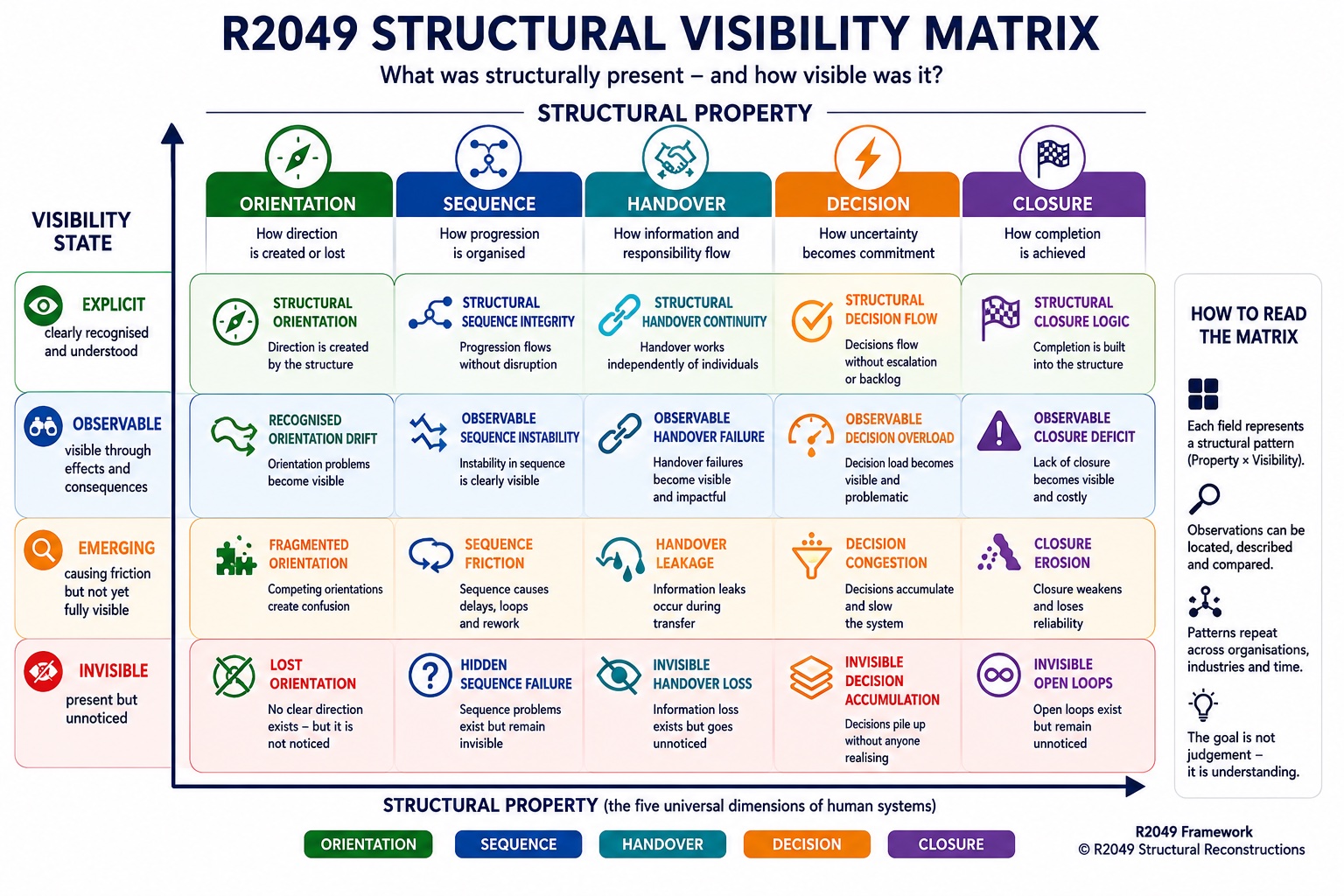
The Structural Visibility Matrix was developed to make those structures visible.
The Central Question
The matrix does not ask:
Is a system good or bad?
Is a person responsible?
Who failed?
Instead, it asks:
Which structural pattern became visible?
How visible was that pattern before its consequences appeared?
Why Visibility Matters
Most structural problems do not emerge suddenly:
- They accumulate.
- Orientation weakens.
- Sequences become unstable.
- Information is lost between handovers.
- Decisions begin to accumulate.
- Closures become ambiguous.
The pattern often exists long before anyone notices it. Visibility therefore becomes a critical variable. Not because visibility changes the structure itself. But because visibility changes the possibility of understanding it.
The Five Structural Properties
The matrix is built around five recurring structural properties that repeatedly appeared throughout the R2049 reconstructions:
Orientation
How does a system generate direction?
Sequence
How does a system organise progression?
Handover
How does a system transfer information and responsibility?
Decision
How does a system transform uncertainty into commitment?
Closure
How does a system determine completion?
These properties do not describe industries, organisations or professions but recurring structural characteristics of human systems.
The Four Visibility States
Each structural property can appear in four visibility states:
Invisible
The pattern exists. Nobody notices it.
Emerging
The pattern begins to create friction. Awareness remains limited.
Observable
The pattern becomes visible through its consequences.
Explicit
The pattern is recognised and understood structurally.
Reading The Matrix
Every R2049 reconstruction can be located within the matrix. The matrix position does not classify the organisation. It classifies the observation.
Example 1
Invisible Handover Loss
The structural issue is related to handovers. The loss exists. The system does not yet recognise it.
Example 2
Observable Decision Overload
The structural issue is related to decision-making. The consequences have become visible. The underlying structure is now observable.
What The Matrix Is Not
The matrix is not:
- a performance framework
- a maturity model
- a consulting tool
- a scorecard
Its purpose is observation. It provides a language for recognising recurring structural patterns.
The Purpose Of The Archive
Every reconstruction within the R2049 archive represents a specific structural observation. Over time, the archive forms a growing map of recurring structural phenomena. The matrix allows these observations to be connected. What appears to be hundreds of different stories gradually reveals a much smaller number of recurring structural patterns.
The event changes. The structure often does not.
From Events To Structures
Most observers focus on what happened. R2049 focuses on what made it possible. The purpose of the archive is therefore not to document events. Its purpose is to reconstruct the structural conditions that generated those events. Each reconstruction represents a small fragment of a larger pattern. The matrix allows those fragments to be assembled into a coherent map.
A Different Way Of Seeing
The Structural Visibility Matrix is not intended to explain everything. Its purpose is simpler. It helps answer a single question:
What was already present before anyone realised it mattered?
This question sits at the centre of every R2049 reconstruction. And it is the reason the matrix exists.
Looking Ahead
The Structural Visibility Matrix represents the first layer of structural observation. It helps identify recurring patterns. Future work may focus on deeper questions:
- Why do certain structural patterns emerge?
- Why do some structures remain stable while others drift?
- Why do similar systems produce different outcomes?
- Which structural properties determine long-term viability?
The matrix does not answer these questions. It makes them visible. That is where every reconstruction begins.
Short Summary
The R2049 Structural Visibility Matrix is a framework for identifying and classifying structural patterns that exist beneath observable events. Rather than focusing on individual actions, failures, or outcomes, the matrix examines the structural conditions that make those outcomes possible. It is based on five recurring structural properties found across human systems:
- Orientation,
- Sequence,
- Handover,
- Decision and
- Closure.
Each property can exist in four different visibility states:
- Invisible – the pattern exists but remains unnoticed.
- Emerging – the pattern begins to create friction.
- Observable – the consequences become visible.
- Explicit – the pattern is recognised and understood structurally.
Every R2049 reconstruction can be positioned within the matrix according to the structural pattern being observed and its degree of visibility.
The matrix is not a performance model, maturity framework, or consulting methodology. Its purpose is observation. It provides a common language for recognising recurring structural phenomena that appear across organisations, institutions, technologies, communities, and everyday life.
At its core, the matrix helps answer a single question: What was already present before anyone realised it mattered?
By connecting individual observations into a coherent map of recurring patterns, the R2049 archive shifts attention away from events and toward the structures that generate them.

